
Chess Opening Principles: The Foundation of Every Good Game
You do not win chess games in the first ten moves, but you can certainly lose them. The opening principles on this page are the timeless rules that guide strong play before the real fight begins. Learn to control the center, develop your pieces, and keep your king safe, and you will start every game on the right foot, no memorization required.
Analyze Your Games FreeWhat Are Opening Principles?
Opening principles are a small set of guidelines that tell you what to prioritize in the first phase of the game. They were distilled over centuries of chess by great players who noticed that the same handful of ideas kept producing strong positions. Instead of asking “what is the best move in this exact position?” you ask “which principle have I not yet satisfied?” and the answer usually points you to a good move.
This is why principles matter so much for beginners. Memorizing specific openings only helps when your opponent cooperates and plays the moves you studied. Principles, on the other hand, work in every position, against every opponent, on every move. They turn the chaotic opening into a simple checklist: fight for the center, get your pieces out, tuck your king away, and connect your rooks.
The goal of the opening is not to win the game outright. It is to reach a healthy, active position where all your pieces are working, your king is safe, and you are ready for the middlegame. If you can do that consistently, you will already be beating most players at your level before either side has launched a serious attack.
Control the Center
The four central squares, e4, d4, e5, and d5, are the most valuable real estate on the board. A piece placed in or near the center reaches far more squares than the same piece stuck on the edge. A knight in the center can jump to eight squares; a knight in the corner can only reach two. Controlling the center gives your pieces mobility, restricts your opponent, and lets you shift your forces quickly to wherever the action is.
The most direct way to stake a claim in the center is to push a central pawn on your first move. After 1.e4, White's pawn occupies a central square and opens diagonals for both the bishop and the queen. When Black replies 1…e5, both sides have planted a pawn in the center and freed their pieces to come out. This simple, symmetrical start is one of the oldest and most instructive ways to begin a game.
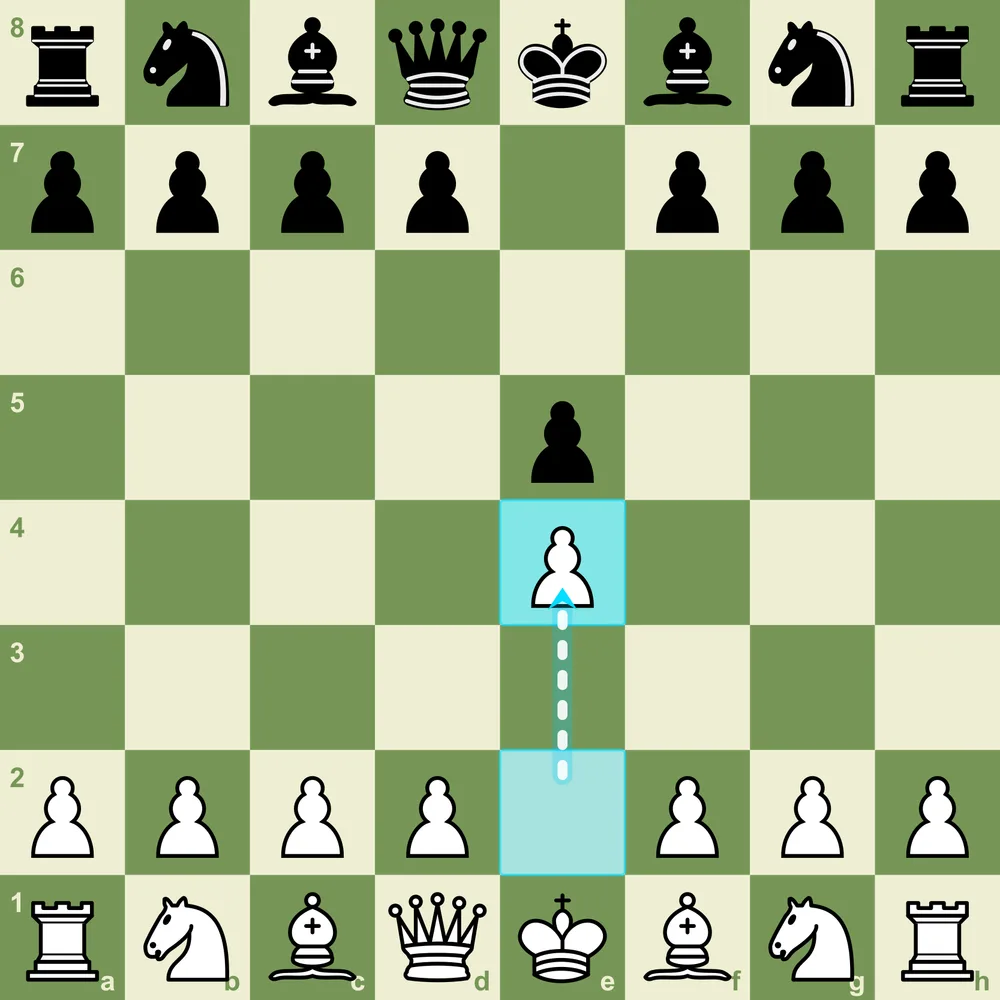
You do not always have to occupy the center with pawns. Some openings control it from a distance with pieces, for example a bishop on the long diagonal. But for beginners, the simplest and most reliable approach is to put a pawn on e4 or d4, and to challenge your opponent's central pawns rather than letting them build an unopposed wall of pawns in the middle of the board.
Develop Your Pieces
Development means getting your knights and bishops off their starting squares and into the game. At the start, every piece except your pawns is trapped behind the back rank, doing nothing. A developed piece attacks squares, supports your plans, and prepares castling. The player who develops faster usually gets the initiative, meaning they dictate what happens while the opponent scrambles to catch up.
A good rule of thumb is knights before bishops, because it is usually clear where a knight belongs, while a bishop has more squares to choose from. Develop toward the center: a knight on f3 or c3 controls central squares, while a knight on the rim, on a3 or h3, is passive. The old saying “a knight on the rim is dim” captures this perfectly.
The position below shows classical development in action. After 1.e4 e5 2.Nf3 Nc6 3.Bc4, White has developed a knight to its best square and placed a bishop on the active c4 diagonal, where it eyes the sensitive f7 square. In just three moves, White has two pieces in play and is ready to castle. Every move did a job.
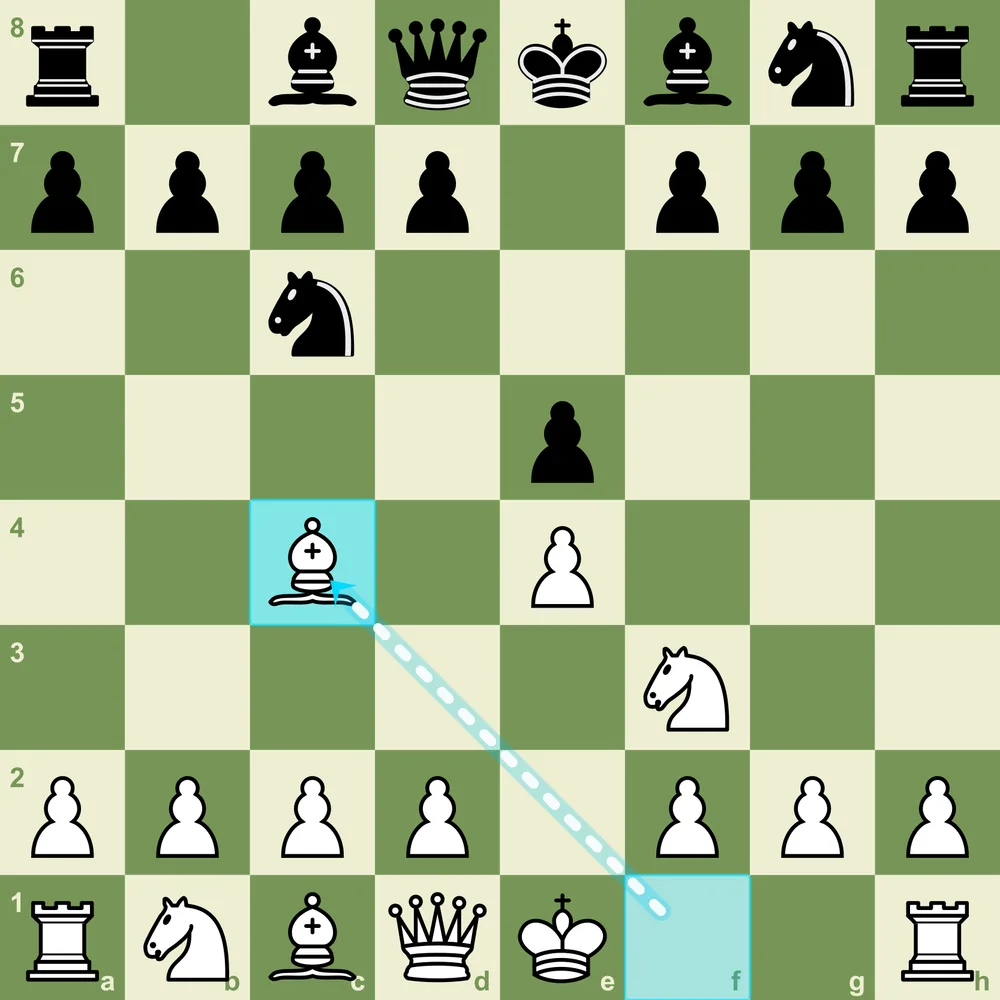
Aim to bring out all four of your minor pieces, both knights and both bishops, before you start pushing extra pawns or launching an attack. If you find yourself making a third or fourth pawn move while pieces are still sitting on their starting squares, pause and ask whether you should be developing instead.
Castle Early
Castling is one of the most valuable moves in chess because it accomplishes two goals at once. It whisks your king away from the dangerous center and tucks it safely behind a wall of pawns, and it brings a rook toward the middle of the board where it can support your other pieces. A king left stranded in the center is a target; once the position opens up, it can come under a devastating attack.
In the position below, White has castled kingside after 1.e4 e5 2.Nf3 Nc6 3.Bc4 Bc5 4.O-O. Notice how naturally it flowed from the previous principles: White controlled the center, developed the knight and bishop, and then castled the moment the path was clear. The king now sits on g1 behind three pawns, and the rook has moved to f1.
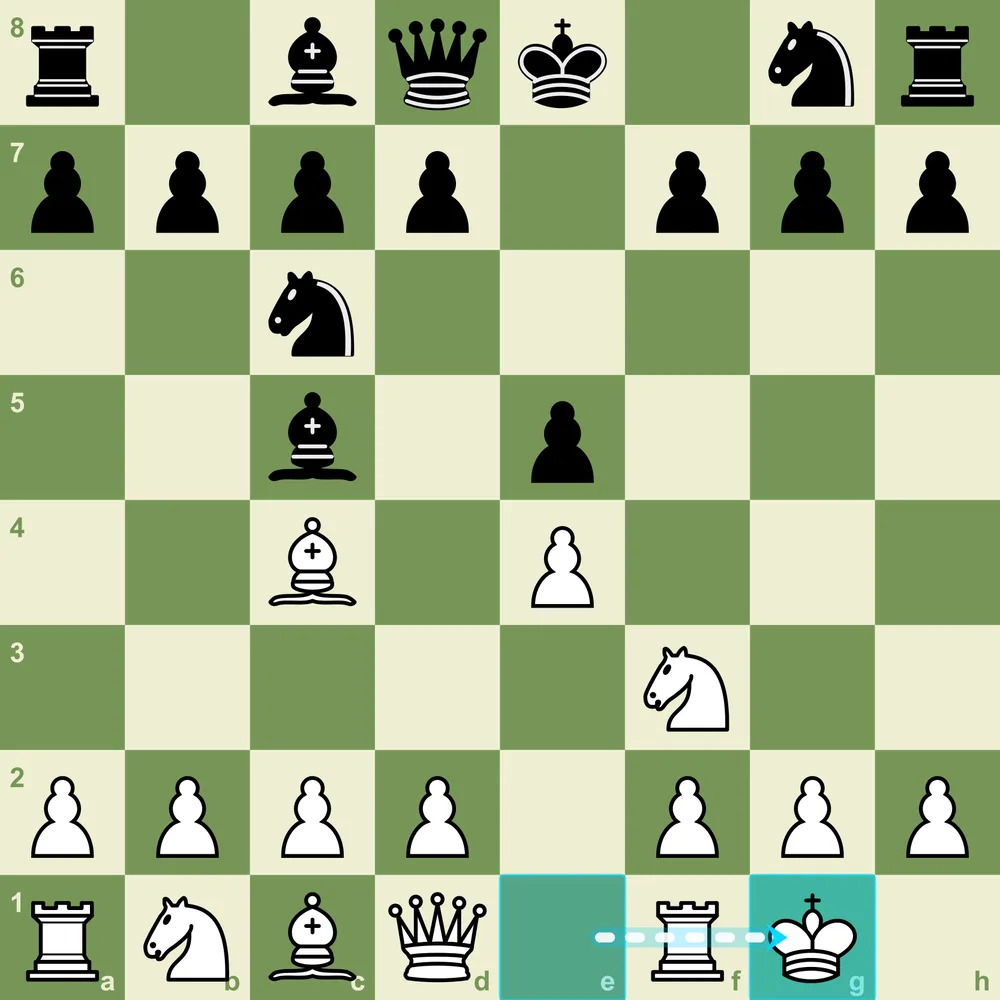
As a beginner, aim to castle within your first eight to ten moves in most games. Kingside castling is usually quicker and safer because it requires clearing only two pieces, the knight and bishop, from between the king and rook. Delaying castling to grab a pawn or chase a threat is one of the most common ways beginners walk into a losing attack.
The Rest of the Classic Principles
Controlling the center, developing pieces, and castling are the big three, but a few more principles round out the picture. Together they form the complete checklist that guides strong opening play.
Do Not Move the Same Piece Twice
In the opening, every move counts. If you move a piece twice before your other pieces are developed, you are effectively giving your opponent a free move to get ahead. Bring each piece out to a good square once, get everything into the game, and only then start repositioning. The exception is when moving a piece again captures material or meets a concrete threat.
Do Not Bring Your Queen Out Too Early
The queen is your most powerful piece, which makes it a liability when it wanders out early. Because it is so valuable, your opponent can attack it with lesser pieces and develop with tempo while you scramble to move it to safety. Keep the queen at home until your minor pieces are out and it has a safe, useful square to go to.
Connect Your Rooks
Connecting the rooks means clearing every piece off your back rank between them, usually by developing both bishops and both knights, moving the queen, and castling. When the rooks “see” each other along the back rank, they defend one another and can be lifted onto open files. Reaching this point is a reliable sign that you have finished the opening successfully and are ready for the middlegame.
Common Opening Mistakes
Understanding the principles is only half the battle. Just as important is recognizing the traps that beginners fall into again and again. Here are the mistakes that cost the most rating points, and how to avoid them.
Bringing the Queen Out Too Soon
This is the single most common beginner mistake, so it deserves a closer look. The temptation is real: an early queen sortie can threaten a quick checkmate, and if the opponent does not defend correctly, you win on the spot. But against sensible play, the early queen simply becomes a target.
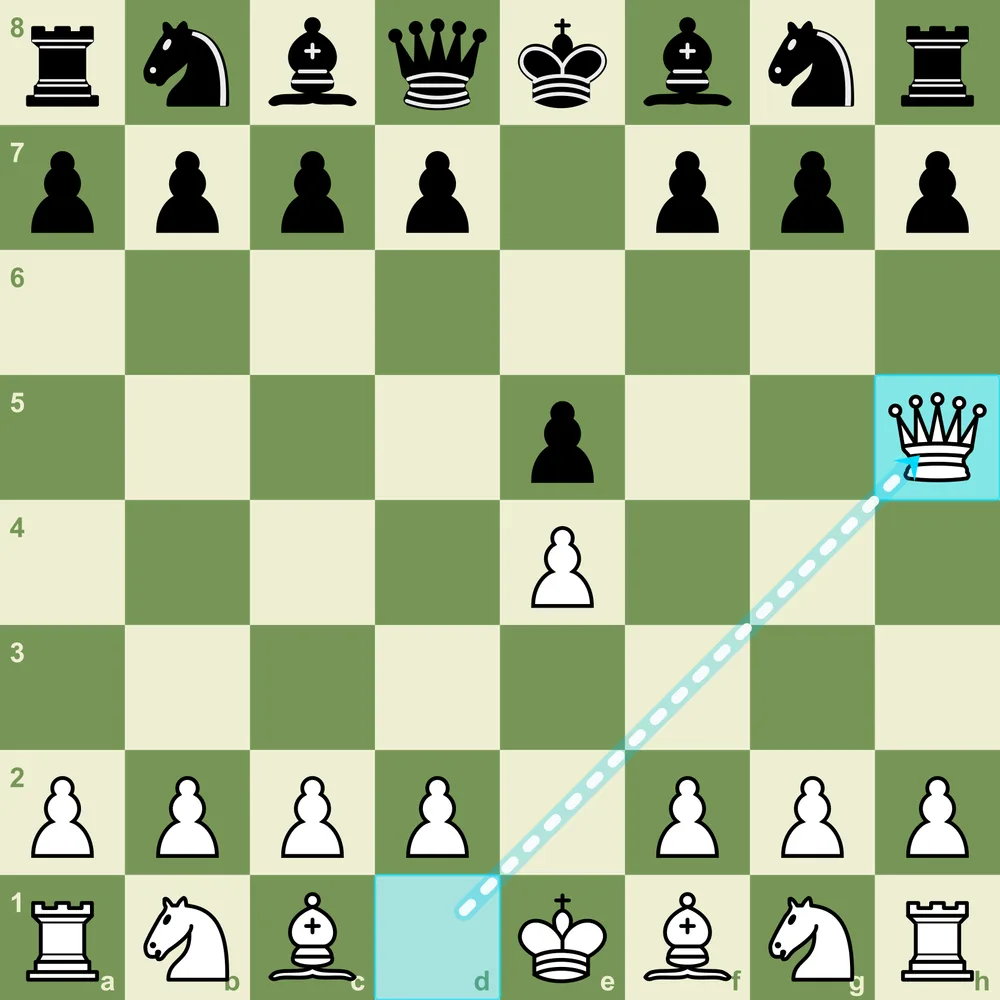
After 1.e4 e5 2.Qh5, White threatens the e5 pawn and dreams of Qxf7 checkmate. But Black simply plays 2…Nc6, defending e5 and developing a piece. When White continues 3.Bc4 hoping for mate, 3…g6 hits the queen and 4.Qf3 Nf6 leaves Black a full tempo ahead with easy development, while the White queen has already moved twice and accomplished nothing. This is the early queen mistake in a nutshell.
Making Too Many Pawn Moves
Beginners often push pawn after pawn in the opening, grabbing space or trying to trap pieces, while their knights and bishops sit at home. Every extra pawn move is a move you are not developing, and pawns cannot move backward to fix mistakes. Limit yourself to the one or two pawn moves needed to free your pieces, then develop.
Ignoring Your Opponent's Threats
Following your own plan is good, but not when it lets your opponent do something even better. Before every move, take a moment to ask what your opponent is threatening. Many beginner games are decided by a hanging piece or an overlooked check, not by opening theory. Developing with a purpose while staying alert to threats keeps you out of trouble.
Delaying Castling for a Pawn
Grabbing a free-looking pawn while your king is still in the center is a classic trap. By the time you have captured, your opponent may have opened lines toward your exposed king and generated a dangerous attack. When in doubt, castle first and count material later. King safety is almost always worth more than a single pawn in the opening.
Putting the Principles Together
You do not need to weigh all six principles on every move. Instead, run through them as a quick mental checklist. Whichever one you have not yet satisfied usually tells you what to do next.
Grab the center. Push a central pawn to e4 or d4 and stay ready to challenge your opponent's central pawns.
Develop with purpose. Bring your knights and bishops toward the center, knights before bishops, one good square each.
Castle your king. Get the king to safety within the first eight to ten moves, usually on the kingside.
Connect the rooks. Finish developing, move the queen to a sensible square, and let your rooks defend each other on the back rank.
Follow this checklist and avoid the common mistakes, and you will emerge from the opening with a solid, active position in game after game. The moves will start to feel natural, and you will spend your energy on the middlegame, where most games are actually decided. That is the real reward of learning principles instead of memorizing lines.
Put These Principles Into Practice
ChessHelper analyzes your games in real time and shows you when you drift from sound opening principles. Build good habits from your very first move.
Get Started FreeJoin 10,000+ beginners improving their opening play
Opening Principles FAQ
No. That is the whole point of opening principles. Instead of memorizing long move sequences, you learn a handful of goals: fight for the center, develop your knights and bishops, castle your king to safety, and connect your rooks. If you apply these ideas on every move, you will reach a healthy position against almost any opponent at the beginner level, even in openings you have never studied.
There is no exact cutoff, but for most beginner games the opening lasts roughly the first 8 to 12 moves. It ends once both sides have developed their minor pieces, castled, and connected their rooks. At that point you transition into the middlegame, where plans revolve around attacking, defending, and improving your position rather than simply getting your pieces out.
Yes. Principles are guidelines, not laws. You can move the same piece twice to capture a free piece, bring your queen out early to win material or deliver a strong tactic, or delay castling when your king is already safe. The key is that a concrete, calculated reason should override a general rule. Beginners get into trouble when they break principles for no reason, not when they break them for a good one.