
Best Chess Openings for Intermediate Players
You have outgrown the beginner openings. You understand basic principles, you can play 10 moves of theory, and you want positions that reward deeper knowledge. This guide covers the best openings for players rated 1000 to 1600 who are ready to build a serious, long-term repertoire.
Analyze Your OpeningsWhen to Upgrade Your Opening Repertoire
Not every player rated 1000 needs to immediately switch from beginner openings to intermediate ones. The right time to upgrade depends on how you feel in your games, not just your rating number. If you consistently reach comfortable middlegame positions with your current openings and find that your losses come from tactical errors rather than opening problems, your repertoire is still serving you well.
The signs that you are ready for more complex openings include: your opponents are consistently getting good positions against your current openings because they know the theory better, you find the resulting middlegame positions boring or too simple, you want sharper or more strategically complex positions, or you feel like your opening knowledge has become a ceiling rather than a foundation.
The openings recommended in this guide offer richer strategic possibilities and deeper theoretical content than typical beginner openings. They reward study and punish your opponents for playing without a plan. But they also demand more from you: you need to understand the ideas behind the moves, not just memorize the first 10 moves of the main line. That is what makes the transition from beginner to intermediate openings such a powerful growth opportunity.
Best Openings for White (1000-1600)
Ruy Lopez (1.e4 e5 2.Nf3 Nc6 3.Bb5)
The Ruy Lopez is the natural upgrade from the Italian Game and one of the most important openings in all of chess. Instead of placing the bishop on c4, White plays 3.Bb5, pinning the knight that defends Black's e5 pawn. This creates subtle, long-lasting pressure on Black's center that persists well into the middlegame. The Ruy Lopez has been the weapon of choice for world champions from Lasker to Caruana for over a century.
What makes the Ruy Lopez perfect for intermediate players is its strategic depth. The positions you reach teach critical concepts like pawn tension, piece maneuvering, and the importance of the bishop pair. The typical middlegame involves a slow buildup on the kingside while maintaining central tension. Unlike simpler openings where the plan is obvious from move five, the Ruy Lopez requires you to think and adapt, which is exactly the kind of challenge that drives improvement.
Start with the Morphy Defense (3...a6) as your main line to study. This is by far the most common response, and understanding it will cover 80 percent or more of your games. From there, you can branch into the Closed Ruy Lopez and the Marshall Attack as your knowledge deepens.
Read our full Ruy Lopez guideEnglish Opening (1.c4)
The English Opening is a flexible, positional system that avoids the well-trodden paths of 1.e4 and 1.d4. By playing 1.c4, White controls the d5 square from the flank and keeps options open for how to develop. The English can transpose into Queen's Gambit structures, Sicilian reversed positions, or entirely unique setups depending on Black's response. This versatility is its greatest strength.
For intermediate players, the English is valuable because it forces you to think about positional concepts like piece placement and pawn structure rather than relying on memorized tactical sequences. Many of your opponents at the intermediate level will be unfamiliar with the English, which means you will frequently get them out of their preparation and into positions where understanding matters more than memorization.
Read our full English Opening guideBest Openings for Black vs 1.e4
Sicilian Defense (1.e4 c5)
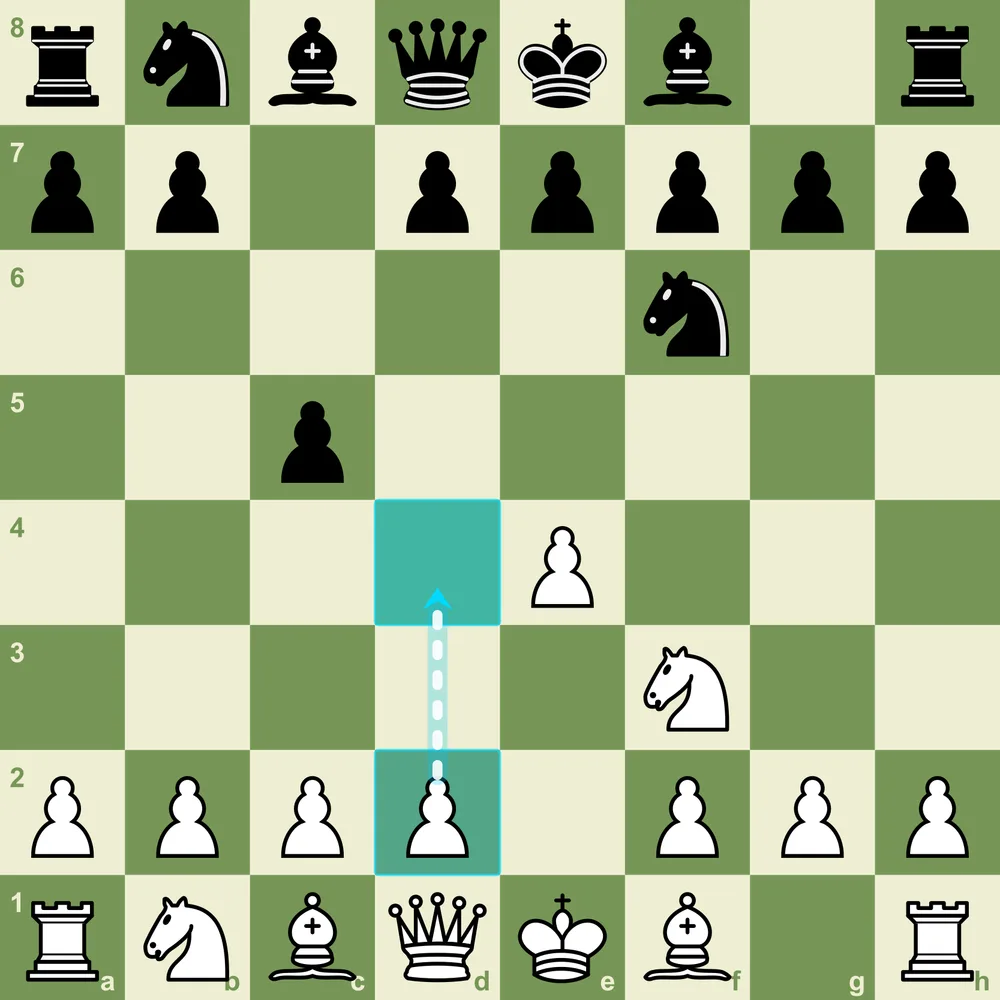
The Sicilian Defense is the most popular and statistically successful response to 1.e4 at every level of chess. By playing 1...c5, Black immediately creates an asymmetrical pawn structure that leads to unbalanced, fighting positions. Unlike 1...e5 which often leads to symmetrical play, the Sicilian ensures both sides have different plans and targets, which means there is always something to play for.
For intermediate players, we recommend starting with the Sicilian Najdorf (5...a6) or the Classical Sicilian (5...Nc6) in the Open Sicilian, or the Accelerated Dragon if you prefer a more streamlined approach. The key is to choose one variation and study it deeply rather than trying to learn multiple Sicilian systems at once. The Sicilian rewards deep knowledge of specific positions, and that focus is what makes it such a powerful weapon.
Be warned: the Sicilian does require more study than simpler defenses. You need to know how to handle the Open Sicilian (where White plays 2.Nf3 and 3.d4), various Anti-Sicilians (like the Alapin with 2.c3 or the Grand Prix Attack with 2.f4), and the Closed Sicilian (2.Nc3). The investment is worth it because the Sicilian gives Black the best winning chances of any response to 1.e4.
Caro-Kann Defense (1.e4 c6)
If the Sicilian feels too sharp or theory-heavy, the Caro-Kann Defense is an excellent alternative that grows with you from intermediate to advanced levels. After 1.e4 c6 2.d4 d5, Black challenges White's center immediately while maintaining a solid, flexible pawn structure. The Caro-Kann avoids the “bad bishop” problem that plagues the French Defense, as Black's light-squared bishop can develop freely outside the pawn chain.
At the intermediate level, the Caro-Kann is particularly effective because your opponents often do not know the best plans against it. The positions are less tactical than the Sicilian but offer rich strategic play with clear plans. Study the Advance Variation (3.e5), the Exchange Variation (3.exd5), and the Classical Variation (3.Nc3 dxe4 4.Nxe4) as your three main branches.
Read our full Caro-Kann guideBest Openings for Black vs 1.d4
King's Indian Defense (1.d4 Nf6 2.c4 g6)
The King's Indian Defense is one of the most dynamic and combative responses to 1.d4. Black allows White to build a broad pawn center with pawns on c4, d4, and often e4, and then counterattacks with powerful pawn breaks like e7-e5 or c7-c5. The resulting positions are sharp, strategically complex, and offer Black genuine winning chances even against stronger opponents.
What makes the King's Indian special for intermediate players is its fighting spirit. Unlike more solid defenses that aim to equalize and hold a draw, the KID actively seeks imbalance and counterplay. The typical middlegame involves a kingside attack by Black against White's queenside expansion, creating exciting, double-edged positions where both sides have real chances.
The King's Indian has been a favorite weapon of legendary attackers like Garry Kasparov and Bobby Fischer. Study the main line with the Classical Variation (where White plays Nf3, Be2, and O-O) and the Samisch Variation (where White plays f3) as your first priority. Understanding the typical pawn breaks and piece maneuvers in these structures will give you a powerful weapon against 1.d4 that you can use for your entire chess career.
Read our full King's Indian guideBuilding a Complete Repertoire
A complete opening repertoire means having a prepared response for every situation you will encounter. At the intermediate level, this means:
As White
One main system after 1.e4 e5 (Ruy Lopez recommended), plus a plan against the Sicilian, French, Caro-Kann, and Scandinavian. Alternatively, a 1.d4 or 1.c4 repertoire that sidesteps these entirely.
As Black vs 1.e4
One main defense (Sicilian or Caro-Kann recommended), studied deeply enough that you can handle the main line and the 2 to 3 most common sidelines.
As Black vs 1.d4
One main defense (King's Indian recommended), plus a plan against the London System and other non-standard first moves like 1.Nf3 or 1.c4.
The goal is not to know everything about every opening. It is to have a plan for every game so you are never caught completely off guard. As you face new positions, add them to your study list and gradually expand your knowledge. A repertoire is a living document that grows with you, not a finished product you build once and never touch again.
Transitioning from Beginner Openings
Here is how the most common beginner-to-intermediate transitions work, and why each one makes sense for your development:
Italian Game → Ruy Lopez
The most natural transition in chess. Both openings start with 1.e4 e5 2.Nf3 Nc6, so you already know the first two moves. The difference is that instead of Bc4, you play Bb5. The Ruy Lopez keeps similar themes (central control, kingside play) but adds layers of strategic complexity. You will feel at home in the pawn structures because many Italian Game middlegames share structural similarities with Ruy Lopez positions.
London System → English Opening
If you enjoyed the London System's solid, positional nature but want more flexibility, the English Opening is a natural next step. Both openings avoid sharp tactical battles in favor of strategic maneuvering, but the English offers far more variety in the resulting positions. You will also learn to play different pawn structures, which broadens your overall chess understanding.
French Defense → Sicilian Defense
This is the biggest leap on the list. The French is solid and defensive, while the Sicilian is dynamic and counterattacking. But the transition makes sense because both openings teach you to play as Black with an asymmetric pawn structure. If you felt cramped in the French and wished for more active play, the Sicilian gives you exactly that. Be prepared for a steeper learning curve but also for more exciting games and better winning chances.
King's Indian Setup → Full King's Indian Defense
If you were already playing the King's Indian setup as a beginner, the transition to the full theoretical King's Indian is seamless. You already know the basic structure (fianchettoed bishop, kingside castling, e5 break). Now you add deeper knowledge of specific variations, learn to handle White's different setups, and develop a more nuanced understanding of when to break in the center versus when to launch a kingside attack.
Level Up Your Opening Play
ChessHelper analyzes your games in real time and identifies where your opening preparation needs work. Build a stronger repertoire with every game you play.
Start Analyzing FreeJoin 10,000+ intermediate players strengthening their opening repertoire
Intermediate Openings FAQ
No. Switching your entire repertoire overnight is a recipe for a temporary rating drop and frustration. Transition one opening at a time. For example, if you are currently playing the Italian Game as White, try switching to the Ruy Lopez while keeping your Black openings the same. Give yourself at least 30 to 50 games with the new opening before evaluating whether it is working for you. Once you are comfortable, you can update another part of your repertoire.
Aim to know 10 to 15 moves of main line theory in your primary openings, plus the key ideas and plans for 2 to 3 important side variations. You do not need to know every line to 20 moves deep. What matters more is understanding the strategic ideas: what pawn structure are you aiming for, where do your pieces belong, what is the typical middlegame plan. If you understand the ideas, you can find good moves even when your opponent plays something you have not studied.
Expect to lose some rating points when you adopt a new opening. This is normal and temporary. The key is to analyze your losses and figure out whether you are losing because of opening-specific mistakes or because of middlegame or tactical errors. If you are consistently getting bad positions out of the opening itself, you may need to study the key lines more carefully. If you are reaching decent positions but losing in the middlegame, the problem is not the opening. Give any new opening at least 50 games before deciding whether to keep it or try something else.