Chess Tactics for Beginners: The Four Essential Motifs
Most beginner games are not lost to deep strategy. They are lost to a single tactic that one player saw and the other did not. Learn the four motifs behind the majority of those swings — the fork, the pin, the skewer, and the discovered attack — and you will start winning material instead of giving it away.
Analyze Your Tactics FreeWhat Is a Chess Tactic?
A tactic is a short, forcing sequence of moves that wins material or delivers checkmate. Where strategy is about long-term plans, a tactic is about the immediate, concrete consequences of the pieces as they stand right now. If you can attack two things at once, or trap a piece that cannot move, or force your opponent into a position where every reply loses, you have found a tactic.
The reason tactics matter so much at the beginner level is simple: they decide almost every game. Studies of amateur play consistently show that most decisive games are settled by one side hanging a piece or missing a two-move combination, not by superior positional understanding. If you can reliably see one move further than your opponent when the pieces start bumping into each other, you will win far more than you lose.
Nearly every tactic you will ever play is built from a small number of recurring patterns called motifs. Learn to recognize the motifs and you stop calculating every position from scratch. Instead, your eye is drawn to the exact features that make a tactic possible: an undefended piece, two pieces on the same line, a king with no escape squares. This guide covers the four motifs that account for the overwhelming majority of beginner tactics.
How to Spot a Tactic Before It Happens
Tactics do not appear out of nowhere. They almost always announce themselves through a few recognizable warning signs. Before every move, run through this quick checklist for both your position and your opponent's. These are the exact features that make the four motifs below possible:
- 1
Undefended Pieces
Any piece not protected by a pawn or another piece is a target. Scan the whole board for loose pieces on both sides every move. A single undefended piece is the most common ingredient in a beginner tactic, because it gives an attacker a free second target for a fork or a discovered attack.
- 2
Pieces on the Same Line
Whenever two valuable pieces share a rank, file, or diagonal, a pin or a skewer may be lurking. This is especially dangerous when the king is one of the two pieces, because the king cannot be left in check and must react. Get into the habit of noticing when your own king lines up with your queen or rook.
- 3
Exposed or Crowded Kings
A king with few escape squares, or one still stuck in the center, invites checks that come with a second threat. Many forks and discovered attacks work precisely because the king is forced to move out of check, leaving another piece to be captured for free.
- 4
Forcing Moves: Checks, Captures, Threats
Before settling on a move, always look at every check, every capture, and every direct threat available to you — in that order. Forcing moves limit your opponent's replies, which is exactly what makes a tactic work. Most missed tactics are simply forcing moves the player never considered.
The Fork
One Piece, Two Targets
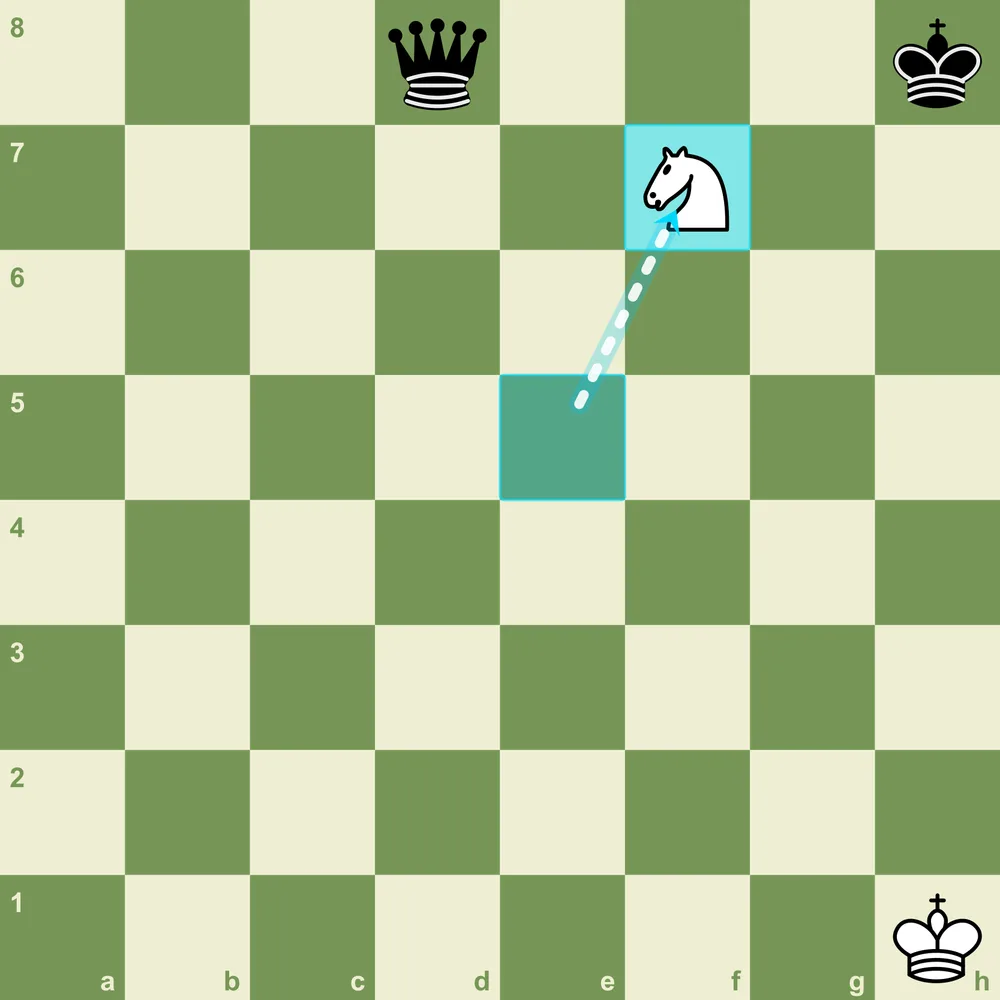
A fork is a single piece attacking two or more enemy pieces at the same time. Because your opponent can only answer one threat per move, they must give up the other. Every piece can fork, but the knight is the undisputed king of forks: it jumps over other pieces, and its targets sit on squares that are hard to picture, so knight forks routinely catch beginners by surprise. When a fork hits the king and the queen at once, as in the diagram below, it is often called a royal fork or family fork.
In the position shown, the white knight lands on f7 with check. The black king on h8 must respond to the check immediately, and once it moves the knight simply captures the queen on d8. White gives up nothing and walks away with the strongest piece on the board — a game-winning material advantage from a single leap.
How to spot it: Look for two enemy pieces that could both be reached by one of your pieces from a single square, and pay special attention to forks that include a check — a check forces your opponent to respond, guaranteeing you time to grab the second target. Knight forks in particular hinge on squares a knight can reach in one move, so train your eye to see those squares even when the knight is not there yet.
How to use it: The most valuable forks combine a check with an attack on an undefended piece, because a defended piece can sometimes be traded back. Maneuver a knight toward central outposts on the fifth and sixth ranks where it hits the most squares, and watch for the moment your opponent's king and queen, or two rooks, drift onto squares a single knight leap could catch.
How to avoid it: Keep your valuable pieces off squares a single enemy knight could reach in one jump, and be wary of leaving your king and queen a knight's move apart. Whenever your opponent has an active knight, briefly picture every square it can hop to next turn before you commit to your own move.
The Pin
The Piece That Cannot Move
A pin happens when a piece is attacked but cannot move without exposing a more valuable piece behind it. Only pieces that move in straight lines — bishops, rooks, and queens — can create pins, and the pinned piece is frozen in place, unable to do its job. When the piece behind is the king, moving the pinned piece would be illegal, so the pin is called absolute. When the piece behind is merely valuable, such as the queen, the pin is relative: the defender can legally break it but usually pays a heavy price.
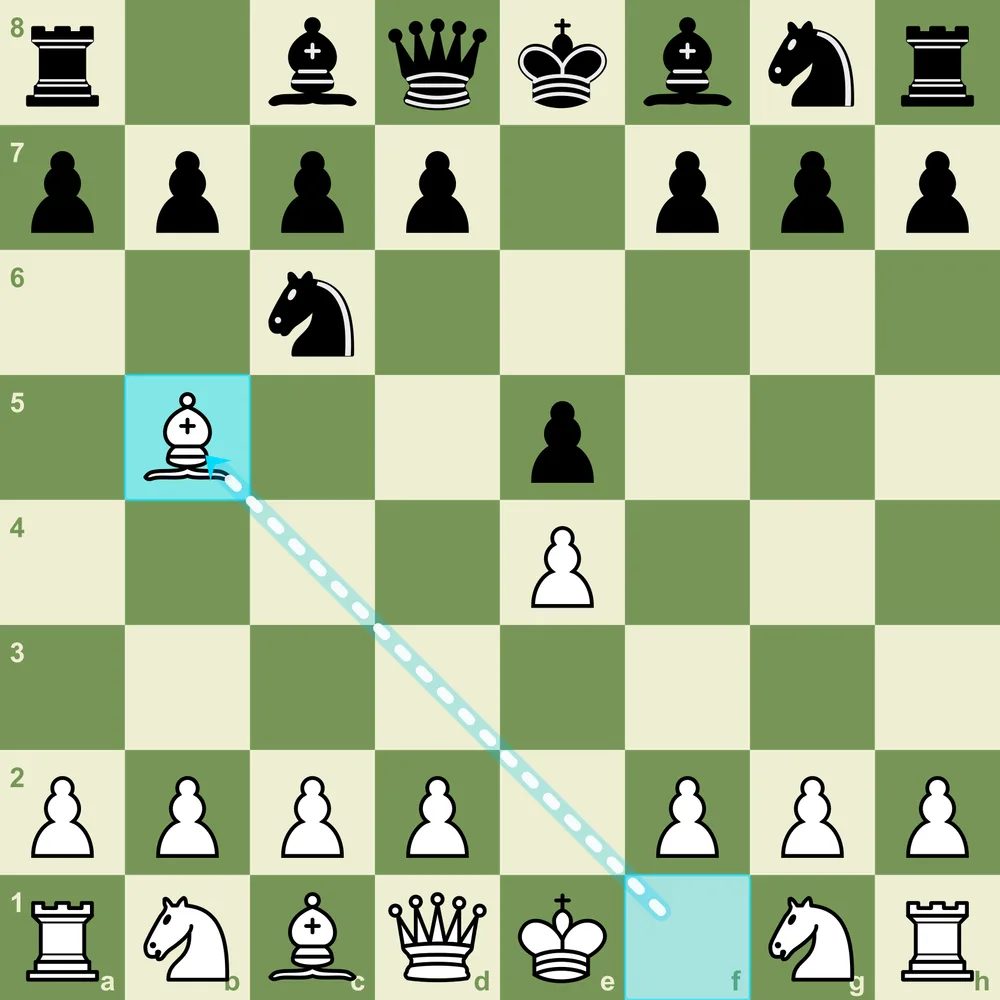
The diagram shows the most famous pin in all of chess, straight out of the Ruy Lopez. White plays the bishop to b5, pinning the black knight on c6 against the king on e8. The knight is absolutely pinned — it cannot legally move because doing so would place the black king in check from the bishop. That knight is now a defender in name only, and White can build up pressure against it and the center while it sits helplessly.
How to spot it: Scan the long-range lines — files, ranks, and diagonals — for an enemy piece with a more valuable piece directly behind it on the same line. If one of your bishops, rooks, or the queen already aims down that line, or could be brought to it, you likely have a pin. Pins against the king are the strongest because the pinned piece is completely immobilized.
How to use it: A pinned piece is a fixed target, so pile more attackers onto it. A classic plan is to attack a pinned knight or bishop with a pawn as well; since it cannot run, it will eventually fall or force a damaging concession. Pins are also a setup move for other tactics — a frozen defender can no longer guard the squares it was protecting, which often opens the door to a fork or a mating attack.
How to avoid it: Try not to line up a valuable piece directly behind a minor piece on an open line, and be cautious about lining pieces up with your own king before you have castled. If you are pinned, look to break it by challenging or trading the pinning piece, by interposing another piece on the line, or by carefully moving the piece behind so the pinned piece is free again.
The Skewer
A Pin in Reverse
A skewer is a pin turned back to front. Instead of a small piece shielding a big one, the valuable piece stands in front and is forced to move, exposing the less valuable piece that was hiding behind it. Like the pin, the skewer is the work of the long-range pieces: bishops, rooks, and queens. The most brutal skewers hit the king, because a king in check has no choice but to step aside and abandon whatever stood behind it.
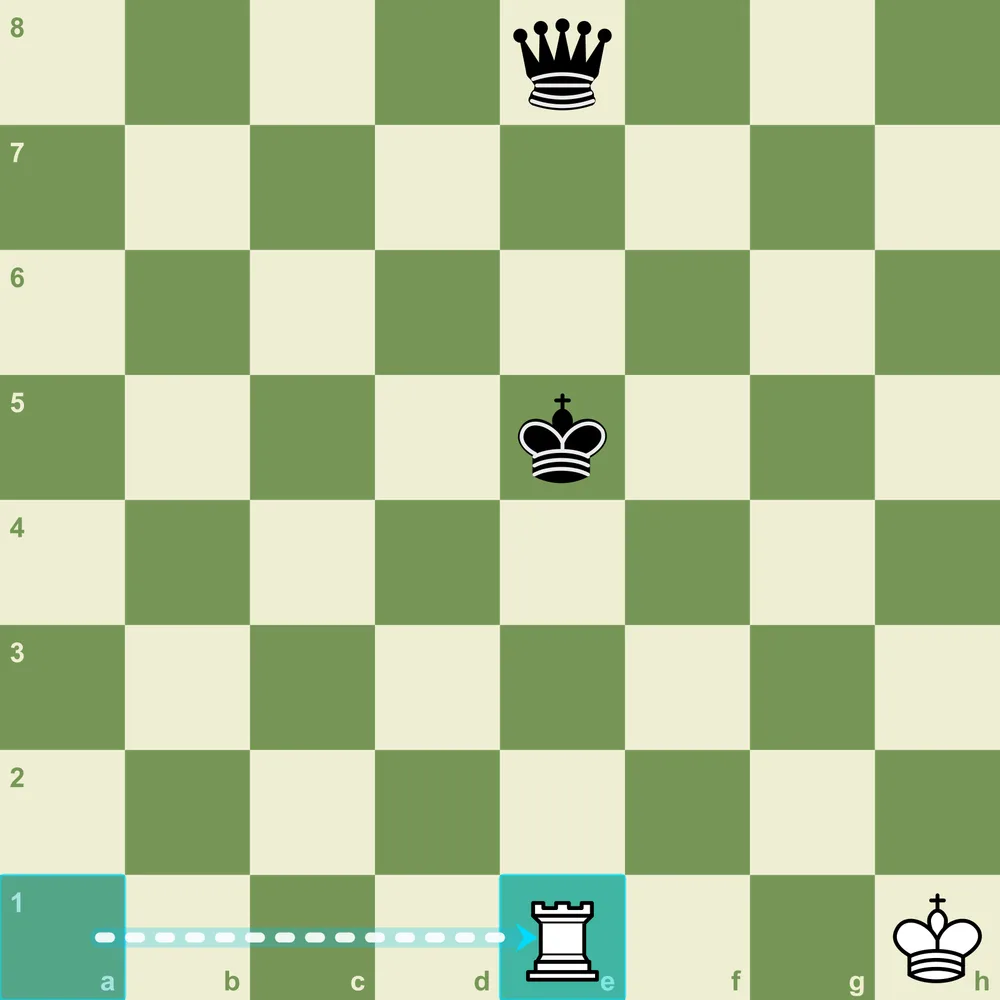
In the position shown, the white rook swings to e1 and checks the black king on e5 down the open e-file. The black queen is sitting behind the king on e8. Because the king must get out of check, it steps off the e-file — and the rook promptly captures the undefended queen. White has skewered the two most important black pieces and comes out a whole queen ahead.
How to spot it: Look for a valuable enemy piece — the king or queen most of all — sitting on the same open line as another enemy piece, with the more valuable one in front. Then ask whether one of your bishops, rooks, or the queen can attack the front piece along that line. A skewer that begins with check is the deadliest, since the front piece is forced to move.
How to use it: Skewers shine in the endgame, where the board is open and long-range pieces roam freely. A common technique is to give a check that drives the enemy king onto a line where its rook or queen already sits behind it. Look for chances to force the front piece to move with a check or an unavoidable threat, then collect the piece that was hiding.
How to avoid it: Keep your king and queen off the same open rank, file, or diagonal, especially when enemy rooks, bishops, or the queen are active. If you are about to be skewered by a check, see whether you can block the check with another piece or move the front piece to a square that still shields the one behind it.
The Discovered Attack
Two Threats From One Move
A discovered attack is one of the most powerful motifs in chess because it creates two threats with a single move. One of your pieces stands in front of another, blocking its line of fire. When the front piece moves away, it unmasks the attack of the piece behind — and the front piece can make a threat of its own on the way out. Your opponent is suddenly facing two attacks and can only answer one.
The most devastating version is the discovered check, and its ultimate form is the double check, where both the moving piece and the unmasked piece give check at the same time. Against a double check there is no blocking and no capturing — the king absolutely must move. In the diagram, a white knight sits on e4 directly in front of a white rook on e1, both aimed up the e-file at the black king on e8. When the knight jumps to d6, it gives check itself while the rook's check is revealed behind it: a double check that leaves the black king no reply but to run.
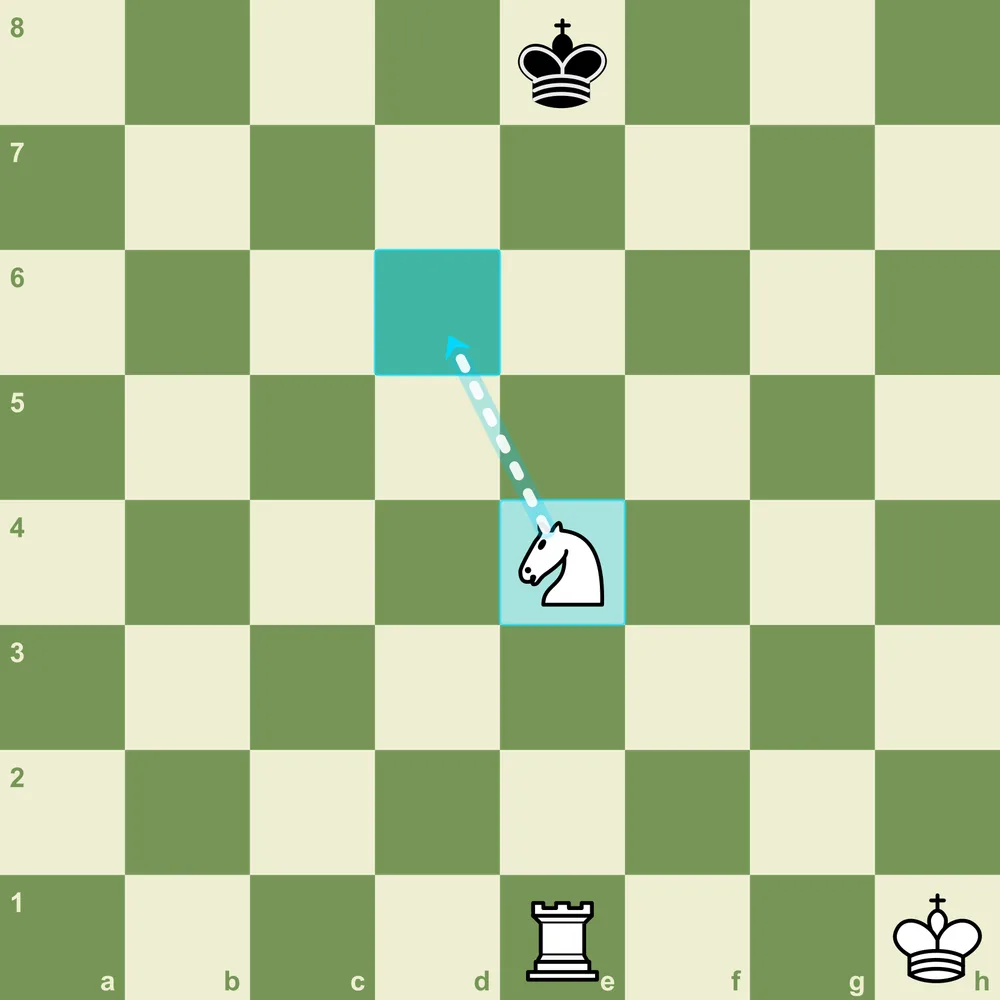
How to spot it: Look for your own pieces stacked on a line — one of your bishops, rooks, or the queen aiming at a valuable enemy target, with another of your pieces sitting in the way. The piece in front is your key: if it can move and create a threat as it leaves, you have a discovered attack. When the unmasked piece hits the enemy king, you have a discovered check, the most forcing form of all.
How to use it: Send the front piece somewhere it does real damage — grabbing an undefended piece, forking two targets, or delivering its own check. Because the discovered threat happens for free while your opponent scrambles to deal with the front piece, discovered attacks let you win material that looked perfectly safe. Double checks are so forcing they are often the engine behind spectacular mating combinations.
How to avoid it: Be suspicious whenever an enemy piece sits in front of a rook, bishop, or queen that lines up with your king or queen. Ask what happens if that blocking piece suddenly moves. Do not assume a piece is harmless just because it is not attacking anything right now — the danger is in what it is hiding.
How to Train Your Tactical Vision
Knowing the four motifs is only the first step. The players who win consistently are the ones who see these patterns instantly, without having to calculate from scratch. That instinct is built through deliberate, repeated practice. Here is how to develop it.
Solve Puzzles Every Day
A small daily dose beats an occasional marathon. Fifteen minutes of tactics puzzles a day trains your brain to recognize the motifs automatically. Free puzzle trainers on Chess.com and Lichess will feed you an endless supply sorted by difficulty, so you are always working at the right level.
Name the Motif
When you solve a puzzle, do not just play the move — say which motif made it work. Was it a fork, a pin, a skewer, a discovered attack, or a combination of several? Labeling the pattern locks it into memory far more effectively than simply finding the right answer and moving on.
Run the Checklist in Real Games
Before every move, scan for loose pieces, pieces lined up on the same file, rank, or diagonal, and every check and capture available to both sides. This deliberate routine feels slow at first, but with practice it becomes a fast, automatic sweep that catches tactics you would otherwise walk right past.
Review Your Own Games
After each game, look for the tactics you found and, more importantly, the ones you and your opponent missed. Every missed fork or overlooked pin is a pattern you can add to your vocabulary. Reviewing your real games is the fastest way to turn abstract knowledge into practical skill.
The Golden Rule: Check Before You Move
The single biggest source of lost material at the beginner level is not a missed brilliant combination — it is failing to notice that a piece was hanging or that a move walked into an opponent's tactic. Before you touch a piece, always ask: is my move safe, and did I miss a tactic of my own? That one habit will save you more points than any opening you could memorize.
Catch Every Tactic in Your Games
ChessHelper analyzes your moves in real time and flags the forks, pins, skewers, and discovered attacks you might have missed. Turn tactical knowledge into rating points.
Get Started FreeJoin 10,000+ players sharpening their tactics
Chess Tactics FAQ
Start with the fork, and specifically the knight fork. Forks are the most common way beginners win material, they appear in almost every game, and the knight's unusual movement makes its forks the hardest to see coming. Once you are comfortable spotting forks, learn the pin next, since pins set up many of the forks and captures you will look for later. Master these two before worrying about skewers and discovered attacks.
Tactical vision comes from pattern recognition, and pattern recognition comes from repetition. Solve a handful of tactics puzzles every day rather than a large batch once a week. In your own games, get into the habit of asking three questions before every move: are any of my pieces undefended, are any of my opponent's pieces undefended, and are any two valuable pieces lined up on the same rank, file, or diagonal. Those checks catch the vast majority of beginner-level tactics.
Both attack two pieces standing on the same line, but the order is reversed. In a pin, the less valuable or immobile piece is in front and a more valuable piece is behind it, so the front piece cannot move without exposing the one behind. In a skewer, the more valuable piece is in front and is forced to move, allowing you to capture the piece that was hiding behind it. A simple way to remember it: a pin freezes the front piece, while a skewer chases it away.