
Common Opening Traps: And How to Avoid Them
Nearly every beginner loses a game or two to a famous opening trap before they learn what happened. The good news is that the classics — Scholar's Mate, the Fried Liver Attack, and Legal's Mate — all rely on the same handful of ideas. Learn how each one works and the simple defensive move that neutralizes it, and you will never be caught off guard again.
Analyze Your Games FreeWhat Is an Opening Trap?
An opening trap is a sequence of moves that sets a hidden threat early in the game, hoping your opponent will make a natural-looking reply that walks straight into disaster. Traps are not the same as good openings. A trap usually breaks a principle or two, and if the opponent finds the right defense, the trapper is often left worse off. But at the beginner level, where players rarely check every threat, these traps succeed again and again.
Here is the reassuring pattern: almost every famous beginner trap targets one square, f7 (or f2 when you are playing Black). At the start of the game, that pawn is guarded only by the king, which makes it the softest spot in the whole position. Scholar's Mate, the Fried Liver Attack, and Legal's Mate are all, at heart, assaults on f7. Once you understand that, the traps stop looking like magic and start looking like the same idea wearing three different costumes.
In the sections below we walk through each trap move by move, explain exactly why it works, and show you the concrete defense. None of these require memorization. They all come down to a single rule of thumb: before you reply, ask what your opponent's move actually threatens.
Scholar's Mate (Mate in Four)
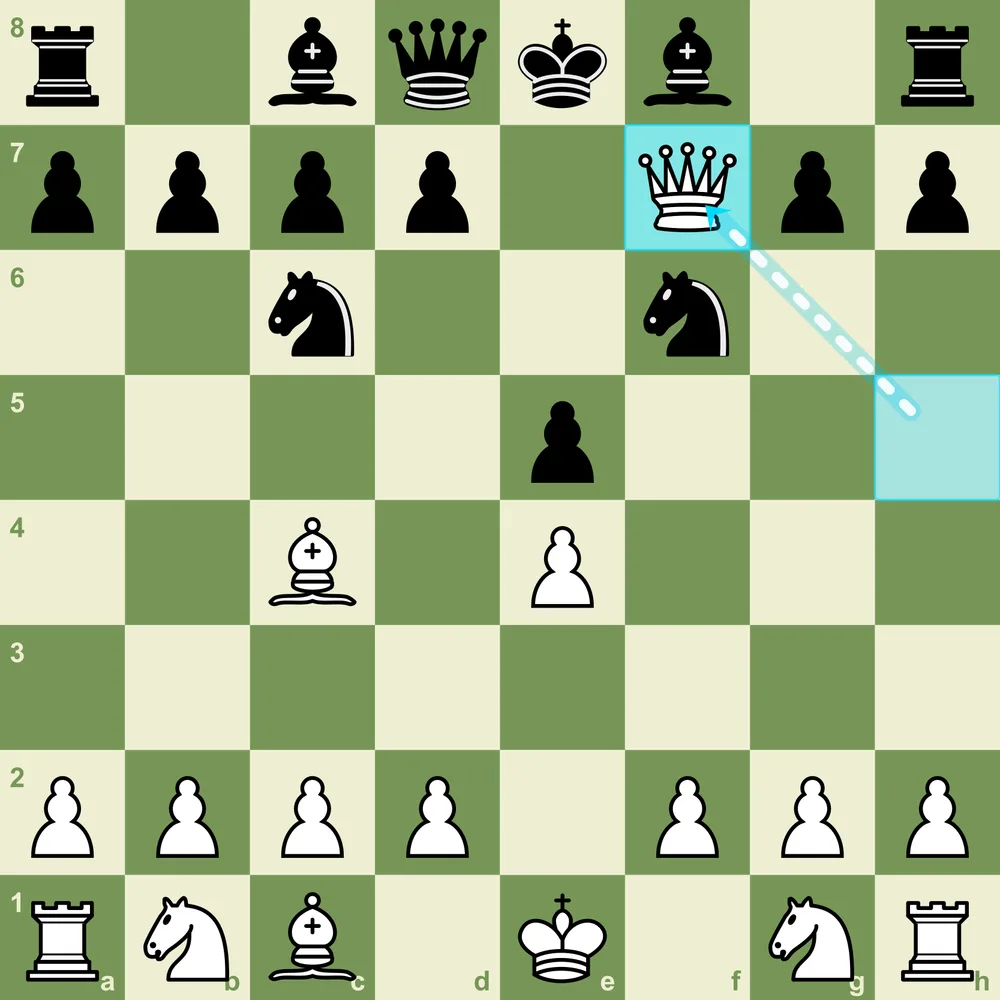
Scholar's Mate is the trap every beginner meets first. White plays 1.e4 e5 2.Bc4 Nc6 3.Qh5, quietly aiming both the bishop and the queen at the f7 pawn. If Black does not notice the threat and continues developing with a move like 3…Nf6, White crashes through with 4.Qxf7#. The queen captures on f7, the bishop on c4 defends her, and Black's king has no escape. Game over in four moves.
Why does it work? Two attackers converge on a square defended by just one piece, the king. The queen delivers the check from point-blank range, and because the c4 bishop guards f7, the king cannot capture the queen. Meanwhile Black's knight on f6, played to develop, did nothing to address the threat. The trap punishes the natural instinct to keep developing while ignoring what the opponent is setting up.
How to Defend Against It
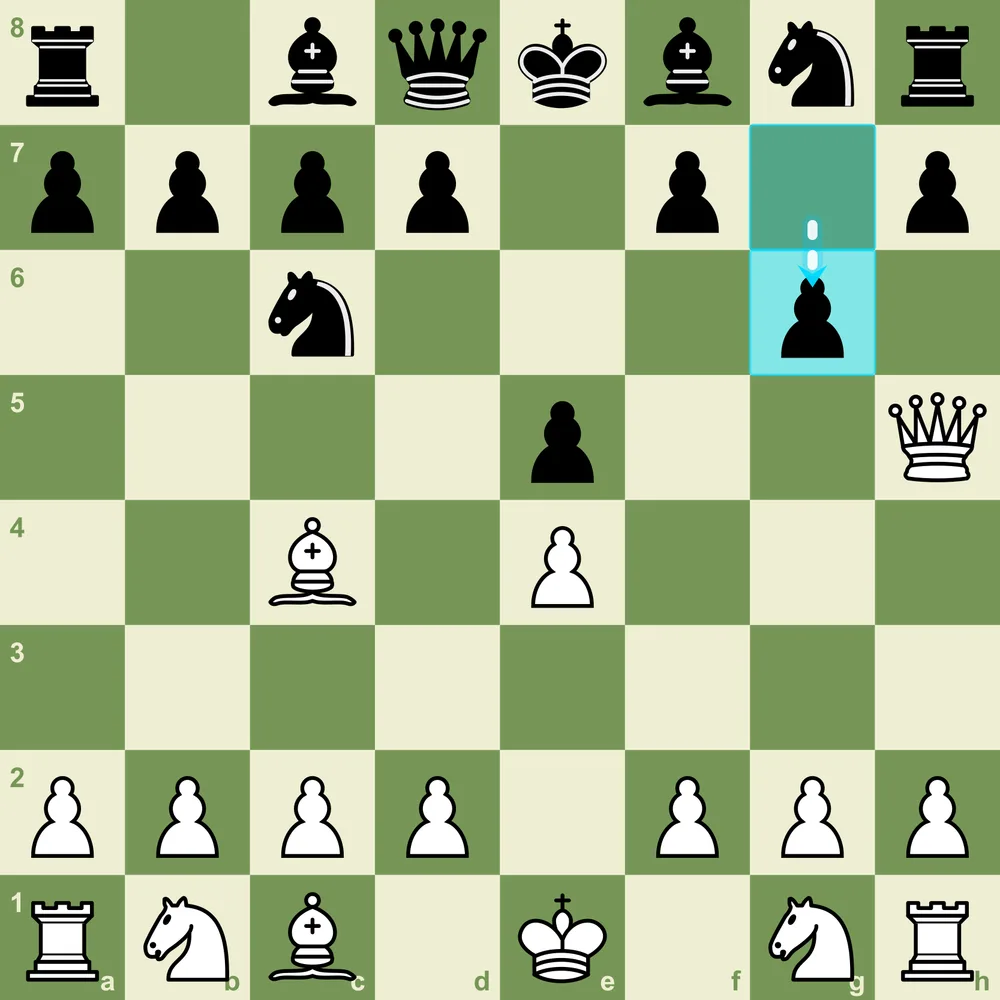
The defense is refreshingly simple. As soon as White commits the queen to h5, defend f7 and hit the queen at the same time. The cleanest move is 3…g6. The pawn attacks the queen on h5, forcing it to retreat, and it does not weaken anything important because the f7 pawn is still guarded by the king and the newly opened bishop diagonal. After the queen retreats, Black is simply better developed and White has wasted time shuffling the queen around.
Another good option is 3…Qe7, which defends f7 directly, though g6 is more active. Whatever you choose, the lesson is the same: when the enemy queen comes out early to threaten mate, do not panic and do not ignore it. Chase the queen with a developing move or a pawn, keep f7 covered, and let your opponent pay for bringing the queen out too soon.
The Fried Liver Attack
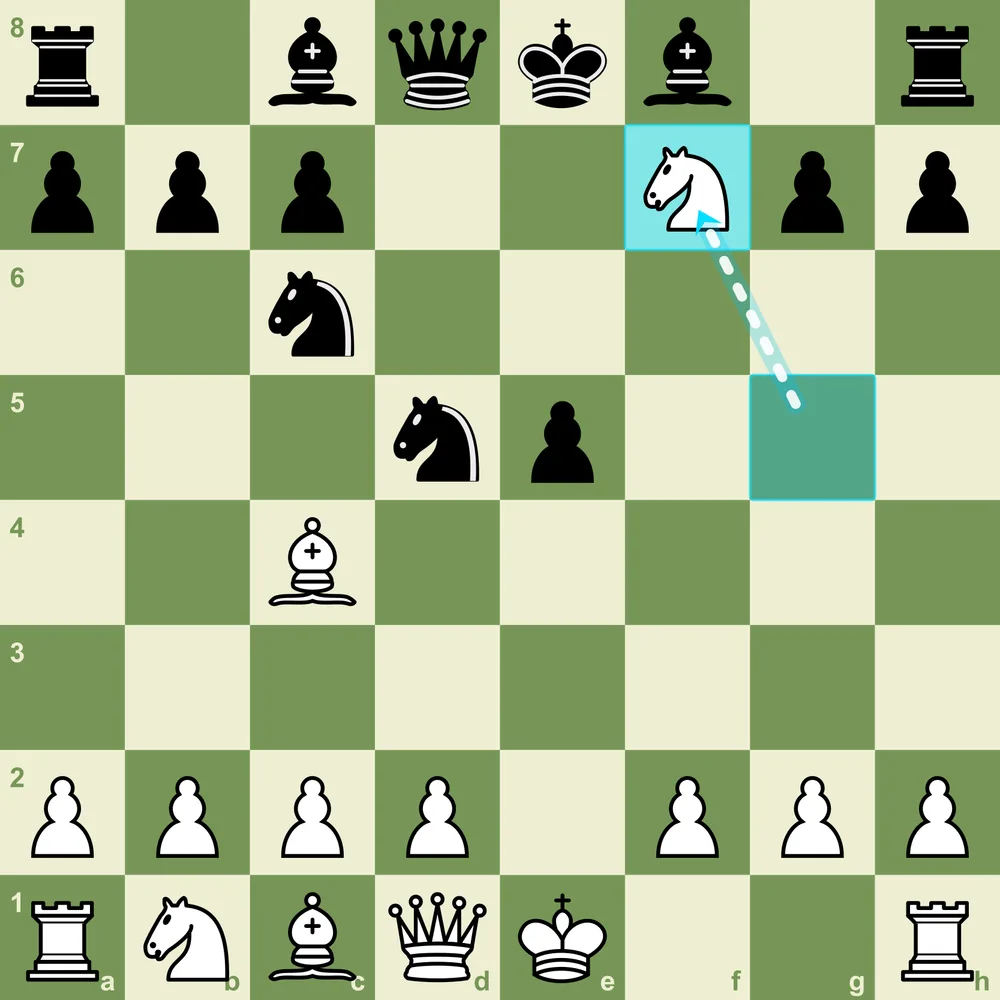
The Fried Liver is a sharper, more sophisticated assault on f7 that grows out of the Italian Game. It begins 1.e4 e5 2.Nf3 Nc6 3.Bc4 Nf6 4.Ng5. That knight jump immediately threatens f7. Black usually defends with 4…d5, striking the center, and after 5.exd5 comes the critical fork in the road. If Black recaptures greedily with the knight, 5…Nxd5??, White unleashes the famous sacrifice 6.Nxf7!.
The knight grabs the f7 pawn and forks Black's queen and rook. After the king is dragged into the open with 6…Kxf7, White continues 7.Qf3+, tying the king to the defense of the pinned knight on d5 and building a ferocious attack. The exposed king, stuck in the center with no way to castle, usually does not survive. White has given up a knight but gets a raging initiative and often wins back far more than the material.
How to Avoid It
The trap only springs if Black recaptures on d5 with the knight. The clean way to sidestep it entirely is the Traxler / Two Knights approach of not walking into it in the first place. The most reliable practical fix at the beginner level is the 5…Na5 line: instead of recapturing the pawn immediately, Black attacks the c4 bishop, chasing away one of the attackers before White can build up on f7. After the bishop retreats, Black regains the pawn under far safer circumstances.
If you want to avoid the whole discussion, remember that 4.Ng5 already tells you f7 is the target. You can prevent the entire line as Black by meeting the Italian with a solid move order that supports f7 early, or simply by knowing that recapturing with the knight on d5 is the move that hands White the sacrifice. When a knight leaps to g5 aiming at f7, treat it as a loud warning, not a free tempo to ignore.
Legal's Mate
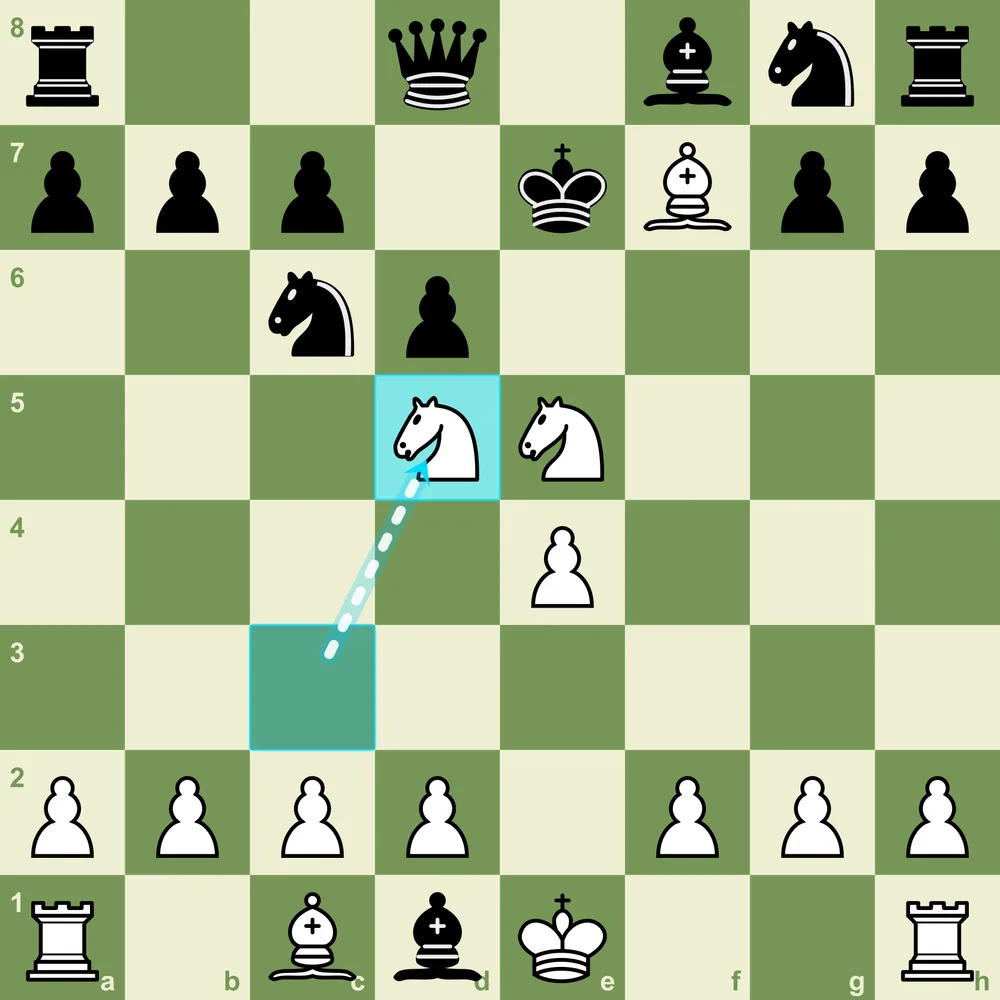
Legal's Mate is the most elegant trap of the three because it involves a genuine queen sacrifice. The line runs 1.e4 e5 2.Nf3 Nc6 3.Bc4 d6 4.Nc3 Bg4. Black pins the f3 knight to White's queen, thinking the knight is frozen in place. But the pin is only an illusion of safety. White plays 5.Nxe5!, apparently blundering the queen.
If Black takes the bait with 5…Bxd1??, capturing the queen, White plays 6.Bxf7+ Ke7 and then delivers the stunning finish 7.Nd5#. The knight leaps in from c3, and the Black king, boxed in by its own pieces on e7, is checkmated. White gave up the queen and won with three minor pieces working in perfect harmony. It is one of the oldest and prettiest combinations in chess.
How to Avoid It
The trap depends entirely on Black grabbing the queen. When White plays 5.Nxe5, the correct response is simply to recapture the knight with 5…Nxe5. Black wins back the piece and stands perfectly fine, since the queen was never really hanging in a way you could safely collect. The queen sacrifice only works because taking it allows the mating net to close; refuse the gift and there is no trap at all.
The broader lesson is about pins. A pin against the queen feels powerful, but a pinned piece is not truly paralyzed if giving up the queen leads to something even better, like mate. Before you snap off a queen that has been offered, always ask why your opponent allowed it. If the answer is a forced sequence you cannot see to the end, be suspicious. A healthy dose of caution around free material is the single best defense against every trap on this page.
How to Stay Out of Trouble
You do not need to memorize a database of traps. These four habits will keep you safe against every trick on this page and the hundreds you have never seen:
Ask What the Last Move Threatens
Before you reply, pause and ask what your opponent's move actually does. Nearly every trap works because the victim answers on autopilot. A single moment of attention to check for threats defuses most of them instantly.
Guard the f7 Square
Because f7 is defended only by the king at the start, it is the target of almost every early attack. Keep an eye on it, be wary when an enemy queen, bishop, or knight starts aiming that way, and castle to bring your rook into its defense.
Do Not Be Greedy With Material
A hanging queen or a free pawn is often bait. If your opponent has left something valuable en prise, assume there is a reason and calculate what happens after you take it. The Fried Liver and Legal's Mate both punish players who grab material without looking ahead.
Develop and Castle Quickly
Traps thrive against undeveloped positions with the king stuck in the center. If you bring out your pieces, contest the center, and castle within the first ten moves, you remove the very conditions that let traps succeed in the first place.
Spot Traps Before They Spring
ChessHelper analyzes your games in real time, flags the tactics you missed, and shows you the best move in every position. Stop losing to the same tricks.
Get Started FreeJoin 10,000+ players sharpening their opening play
Opening Traps FAQ
Scholar's Mate is by far the most common trap beginners fall for. White brings out the queen and bishop to gang up on the f7 pawn and delivers checkmate in just four moves. It works so often at the beginner level because new players do not yet spot the threat, but it is easy to stop once you know the single defensive idea behind it. After you learn to defend f7 and refuse to panic, the same early queen sortie usually just loses White time.
At the start of the game, the f7 pawn (and f2 for White) is defended only by the king. That makes it the weakest point in the whole position, and almost every famous opening trap targets it. Scholar's Mate, the Fried Liver Attack, and the Legal's Mate combination all revolve around an attack on f7. Once you castle and finish developing, f7 is protected by your rook and king together, so the danger largely disappears. Knowing this one fact explains most beginner traps at a glance.
The best defense is not memorizing every trap but following sound opening principles. Develop your pieces toward the center, castle early, keep an eye on your f7 pawn, and ask what your opponent's last move threatens before you reply. Most traps only work because the victim grabs material or develops carelessly. If you slow down, check for threats, and avoid greedy captures, you will sidestep the vast majority of them even if you have never seen the specific line before.