Endgame Basics for Beginners: Convert Your Winning Positions
Most beginner games are won or lost in the endgame, yet it is the phase players study least. The good news is that a handful of ideas cover the vast majority of endings you will ever reach. Learn the opposition, the two basic checkmates, and how to promote a pawn with your king, and you will start turning slight advantages into full points.
Analyze Your Endgames FreeWhy the Endgame Decides Your Games
When most of the pieces have been traded off and only a few remain, the game enters the endgame. It is tempting to think this is the easy part, but the opposite is true for beginners. Countless games that were completely winning end in a draw or even a loss simply because the player did not know the correct technique to finish the job. A single extra pawn or a lone queen against a bare king is worthless if you cannot convert it into checkmate or a new queen.
What makes the endgame worth studying is that it is almost entirely knowledge, not guesswork. The positions repeat with astonishing regularity, and the winning methods are precise and repeatable. Once you know how to hold the opposition or drive a king into the corner, you will never lose the thread again. This is very different from the opening, where your opponent's choices constantly change the position in front of you.
In this guide we cover the four ideas that form the backbone of endgame play: the opposition in king-and-pawn endings, the king-and-rook checkmate, the king-and-queen checkmate, and how to promote a passed pawn with the support of your king. Master these and you will already be ahead of most players at your level.
The Opposition: The Key to King and Pawn Endings
The opposition is the most important concept in king-and-pawn endgames, and it is beautifully simple once you see it. Two kings can never stand next to each other, so when they face off with a single square between them, one player is effectively frozen. The side that does not have to move is said to “have the opposition,” and it controls where the other king is allowed to go. Because a king must move on its turn, the side in opposition can force the enemy king to step aside and surrender key squares.
In the diagram below, the white king stands on e6, the pawn is on e5, and the black king is on e8 with Black to move. The kings are directly opposed with one square between them, and crucially it is Black's turn. That means White holds the opposition. Black must move to d8 or f8, and wherever the king goes, the white king simply advances to the opposite side—to f7 or d7—clearing the way for the pawn to march forward and queen. This is the model position that every winning pawn endgame is trying to reach.
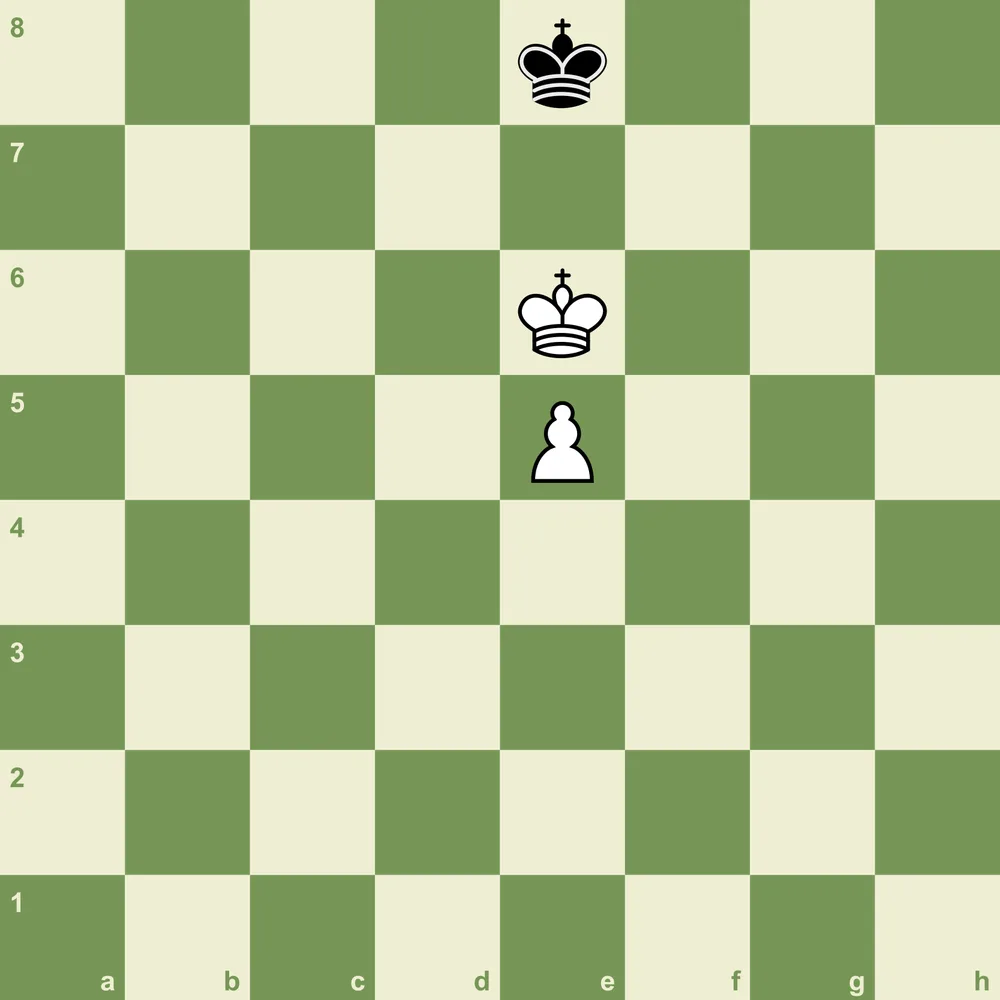
The practical rule to remember is that your king should lead the pawn, not the other way around. If you can get your king two ranks ahead of the pawn while keeping the opposition, the win is guaranteed. If instead you push the pawn too early and let the enemy king sit directly in front of it, the defender can often hold a draw. Whenever you reach a king-and-pawn ending, ask yourself a single question: who has the opposition? The answer usually tells you who is winning.
King and Rook Checkmate
A king and rook against a lone king is a routine win, but only if you know the method. The rook cannot do the job alone; it needs the king as a partner. The plan has two parts. First, the rook cuts off the enemy king by controlling a rank or file that the king is not allowed to cross, shrinking the box the king lives in. Second, your own king marches up to face the enemy king with one square between them, taking the opposition just as in a pawn ending.
You repeat this squeezing process, pushing the defending king toward any edge of the board. When the enemy king is finally pinned against the last rank and your king stands directly opposite it, the rook delivers the finishing blow by sliding along that edge. In the position below, the black king is trapped on a8, the white king supports from a6, and the rook swings all the way across to h8—check along the eighth rank with no escape. That is checkmate.
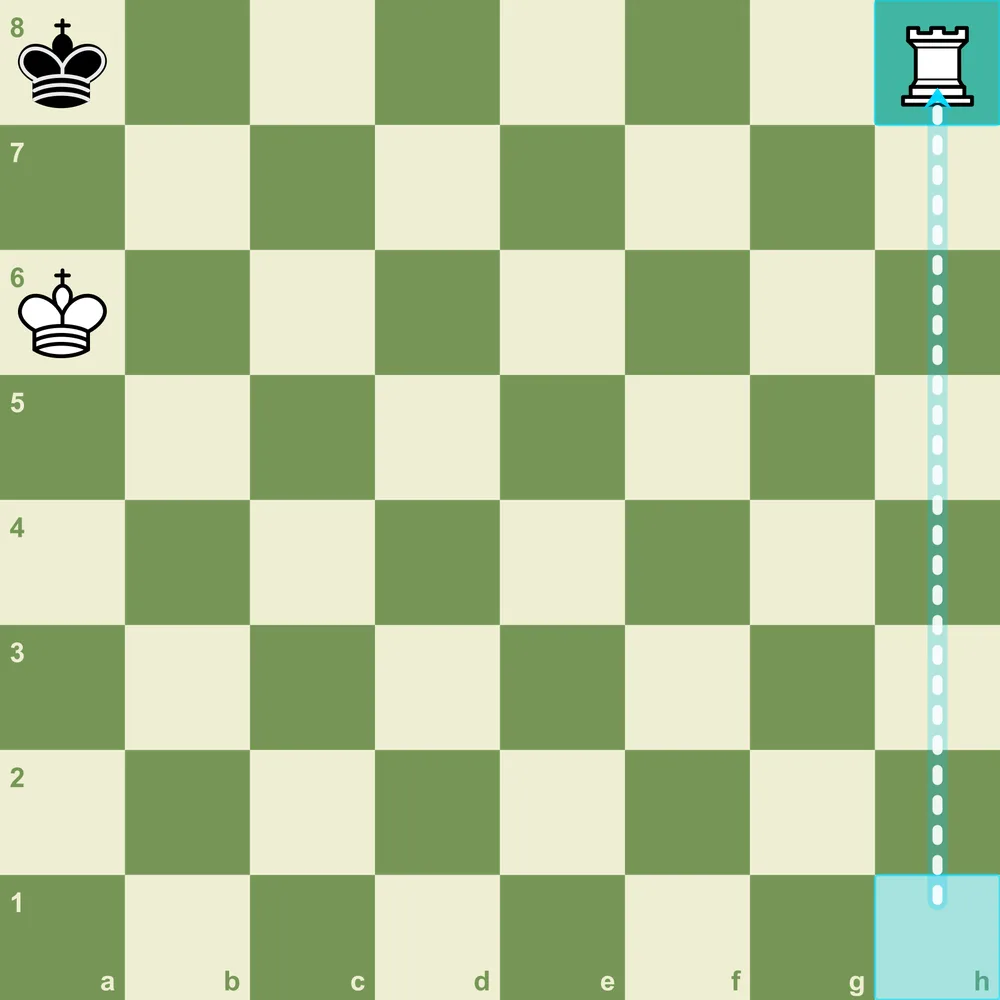
Two habits will keep you on track. Keep your kings facing each other before you give the final check, because the mate only works when the enemy king has no safe square to run to. And if the defending king ever moves toward your rook to attack it, simply slide the rook to the far side of the board—it does its job from a distance just as well. With a little practice you will be able to force this checkmate in well under the fifty-move limit every time.
King and Queen Checkmate
The king-and-queen checkmate is the most common one you will ever deliver, because it is what you reach after promoting a pawn. The queen is so powerful that the method is even faster than the rook mate, but it comes with one famous trap: stalemate. If you corner the enemy king so thoroughly that it has no legal move and it is not in check, the game is drawn and your advantage vanishes. Learning to avoid this is the whole skill.
The technique is to use the queen to herd the enemy king toward an edge while always leaving it at least one breathing square. A reliable way to picture it is the “knight's-move” box: keep your queen a knight's distance from the enemy king, and it will be driven backward step by step without ever being stalemated. Once the king reaches the edge, you bring your own king up to support the queen, and then the queen moves in for the mate—never delivering it until your king is guarding the queen's checkmating square.
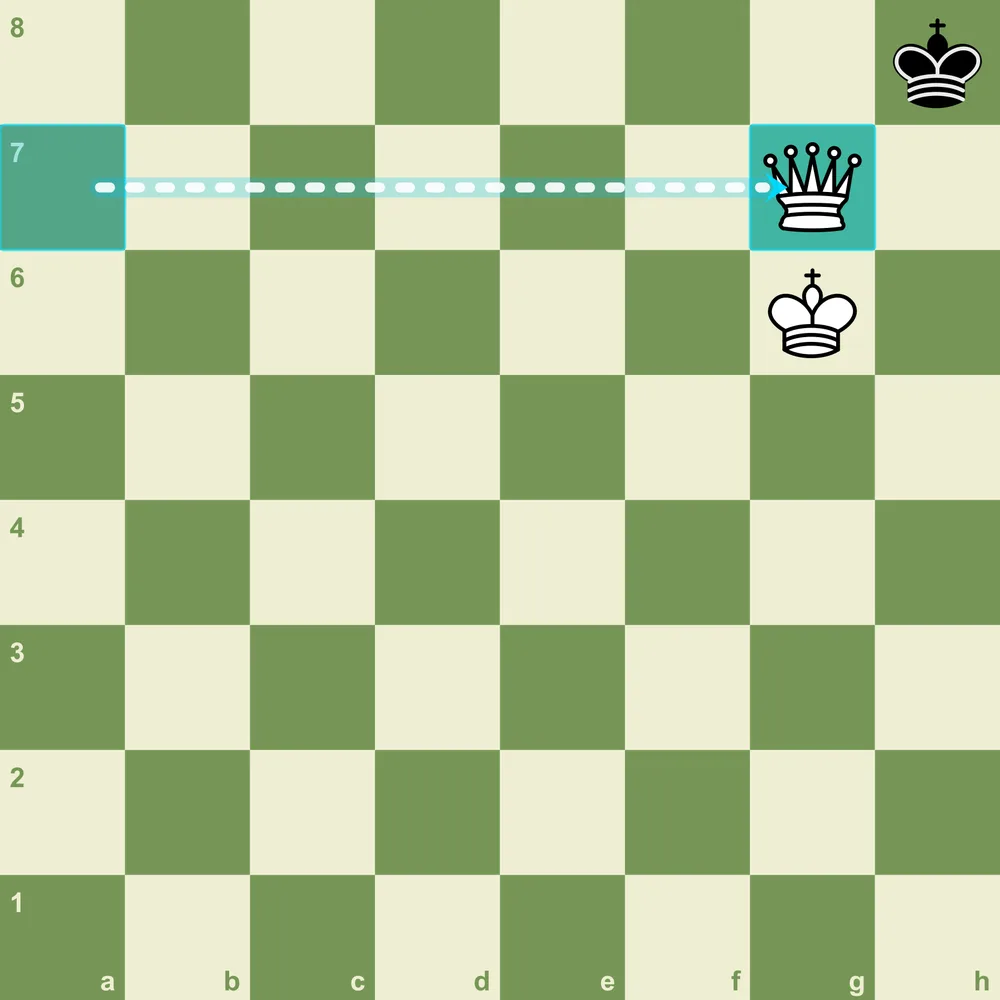
In the position above, the black king sits in the corner on h8. The white king has already come up to g6, so when the queen arrives on g7 it gives check, covers every escape square, and is itself defended by the king—a clean checkmate. Notice how the king does the essential work: without it on g6, the queen on g7 could simply be captured. The lesson is that the queen delivers the blow, but the king makes it possible. Always bring the king into the attack before you go for the finish.
Promoting a Pawn with King Support
An extra pawn only matters if you can turn it into a queen, and the key to doing that is your king. A pawn cannot advance safely on its own against an enemy king—it will simply be blockaded and captured. But a pawn escorted by its king becomes unstoppable. The king clears the path ahead of the pawn, shields it from the enemy king, and controls the promotion square so nothing can stop it from reaching the eighth rank.
The diagram below shows the ideal situation. The white pawn stands on e7, one step from promotion, with the white king right beside it on e6. The black king is stranded far away on g1, hopelessly out of range. With White to move, the pawn simply advances to e8 and becomes a queen—the king has done all the work of shepherding it home. This is exactly the kind of position the opposition technique from earlier is designed to create.
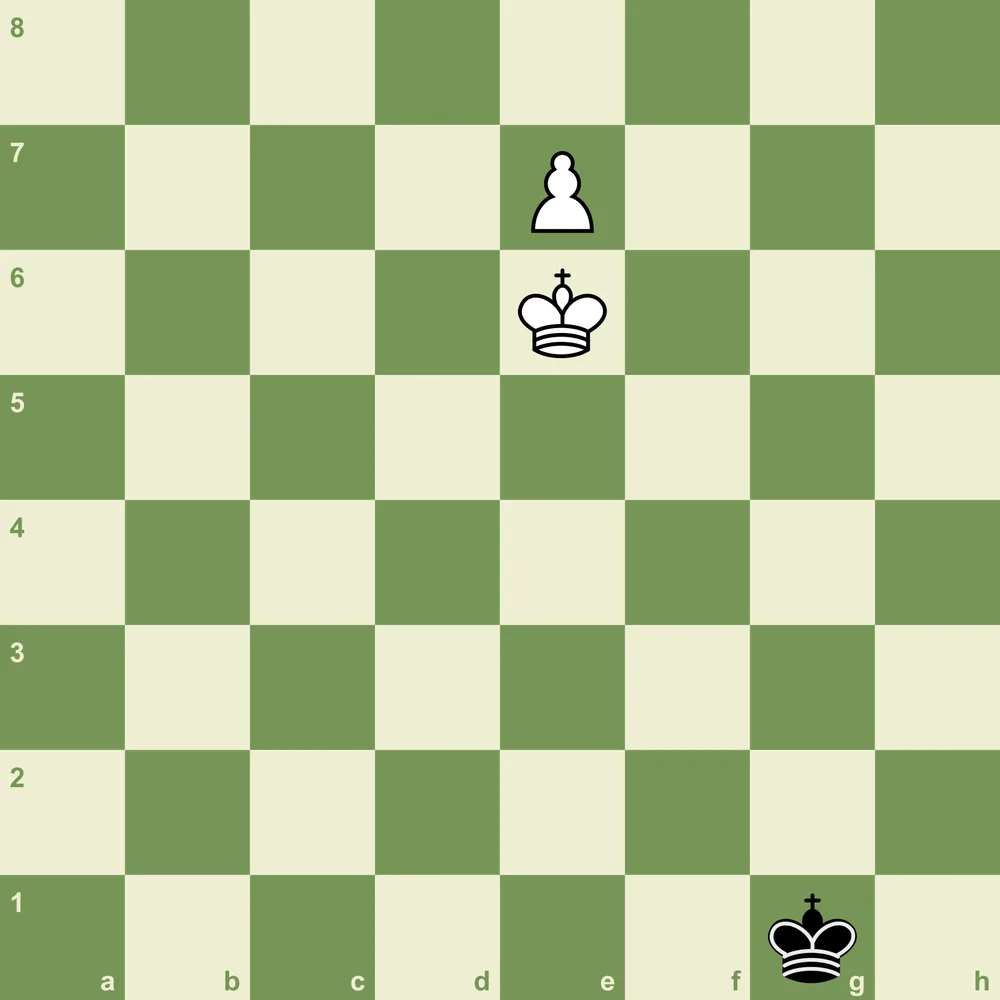
The single most important guideline for winning these endings is to advance your king in front of your pawn, not behind it. A pawn that races ahead of its king is easy to stop; a pawn that follows a well-placed king is nearly always winning. When the enemy king is far away, as it is here, you can even push the pawn on its own—but whenever the kings are close, use the opposition to muscle the defender aside and clear the promotion square. Combine these ideas and you will convert extra pawns into wins with confidence.
Endgame Principles to Carry Into Every Game
The specific positions above teach concrete technique, but they also point to a set of general rules that apply to nearly every ending you will play. Keep these five in mind and you will make good decisions even in endgames you have never studied before.
Activate Your King
The king is a fighting piece in the endgame, not a target to be hidden. With few pieces left, march it toward the center and the action. In every position we covered, the king was the decisive factor—escorting a pawn, supporting a checkmate, or seizing the opposition.
Push Passed Pawns
A passed pawn—one with no enemy pawns able to stop it—is a potential queen. Support it with your king and advance it. The threat of promotion often ties down the enemy pieces and hands you the game even before the pawn reaches the end.
Fight for the Opposition
In king-and-pawn endings, the side holding the opposition usually dictates play. Before you move, work out who will be forced to give ground. Gaining the opposition at the right moment is often the difference between a win and a draw.
Drive the King to the Edge
Both basic checkmates work the same way: use your rook or queen together with your king to shrink the enemy king's space until it is trapped against an edge or in a corner. Squeeze methodically rather than chasing random checks.
Watch for Stalemate
When you have overwhelming material, the only way to spoil the win is stalemate. Before every move that limits the enemy king, check that it still has a legal reply unless you are actually giving checkmate. A moment of care here saves half points.
Turn Your Endgames Into Wins
ChessHelper reviews your games in real time and shows you exactly where an endgame slipped away. Learn the correct technique from your own positions.
Get Started FreeJoin 10,000+ players sharpening their endgame technique
Endgame Basics FAQ
Endgames appear in a huge share of your games, and the technique never changes. Unlike opening theory, which shifts with your opponent's choices, a king-and-pawn or king-and-rook endgame follows the same rules every single time. Once you learn how to hold the opposition or drive a lone king to the edge, you can convert winning positions and save lost ones for the rest of your chess life. Just a few hours spent on the fundamentals below will win you more games than memorizing another twelve moves of an opening.
The opposition is a situation where the two kings stand on the same file (or rank) with exactly one square between them, and it is the other side's turn to move. Because a king cannot stay still while its opponent advances, the player forced to move must step aside and give ground. Holding the opposition lets your king escort a pawn forward or block the enemy king out of key squares. It is the single most important idea in pawn endgames.
You use the two pieces as a team to squeeze the enemy king toward any edge of the board. The rook cuts off a rank or file so the king cannot cross it, and your own king marches up to stand two squares away, taking the opposition. When the enemy king is trapped on the last rank with your king directly opposite, the rook slides along that edge to deliver mate. The whole method takes only a handful of moves once you understand the roles each piece plays.