
What is the French Defense?
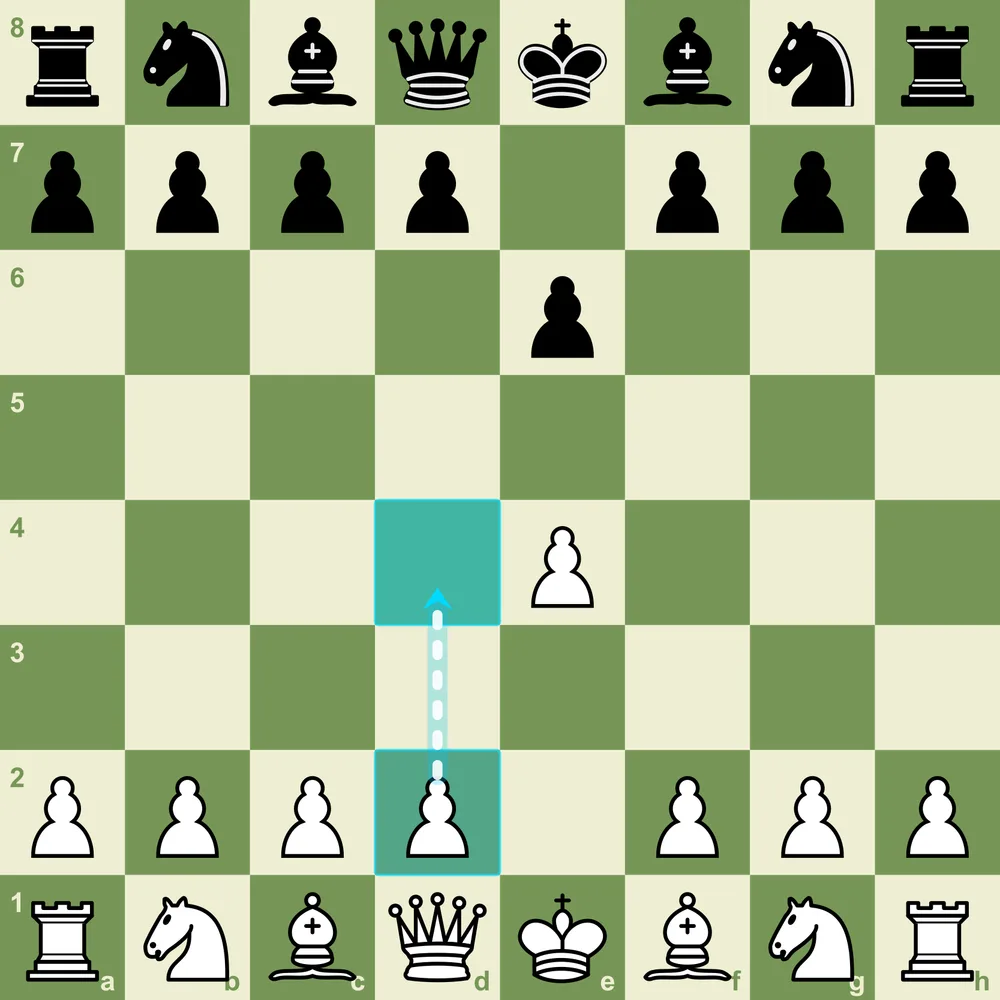
The French Defense arises after the moves 1.e4 e6. With this quiet but purposeful reply, Black signals the intention to build a solid pawn center by following up with ...d5 on the next move. Unlike the Sicilian Defense, which seeks immediate asymmetry, the French Defense leads to structured positions where both sides have clear strategic plans and pawn break targets.
The opening gets its name from a famous correspondence match between the cities of London and Paris in 1834, where the Parisian team employed 1...e6 to great effect. Since then, the French has been a weapon of choice for world champions and club players alike. Mikhail Botvinnik, Tigran Petrosian, Viktor Korchnoi, and Alexander Morozevich have all relied on it as a core part of their repertoire.
The defining feature of the French is the French pawn chain: after the typical sequence 1.e4 e6 2.d4 d5, White often advances with 3.e5, creating a pawn chain on d4 and e5 against Black's pawns on d5 and e6. Black's strategic goal then becomes clear: attack the base of White's chain with ...c5 to undermine the entire structure. This battle around the pawn chain gives the French its unique strategic character.
How to Play
After 1.e4, Black plays 1...e6, which prepares the key move ...d5 on the next turn. The pawn on e6 supports a future d5 advance, immediately challenging White's control of the center. On move two, after 2.d4, Black follows through with 2...d5, striking at the e4-pawn and creating central tension.
At this point, White must make an important decision about how to handle the tension. The five main choices (Advance, Winawer, Classical, Tarrasch, and Exchange) each lead to fundamentally different types of positions. Regardless of which variation White chooses, Black's plan revolves around a few core ideas: challenge the center with ...c5, develop pieces to active squares, and look for counterplay on the queenside or against White's pawn chain.
The French is an excellent choice for players who prefer positions with clear plans rather than memorizing long theoretical lines. Once you understand the strategic themes of the pawn chain, the same ideas recur across all variations, making the opening easier to learn and play consistently.
Main Variations
Advance Variation (3.e5)
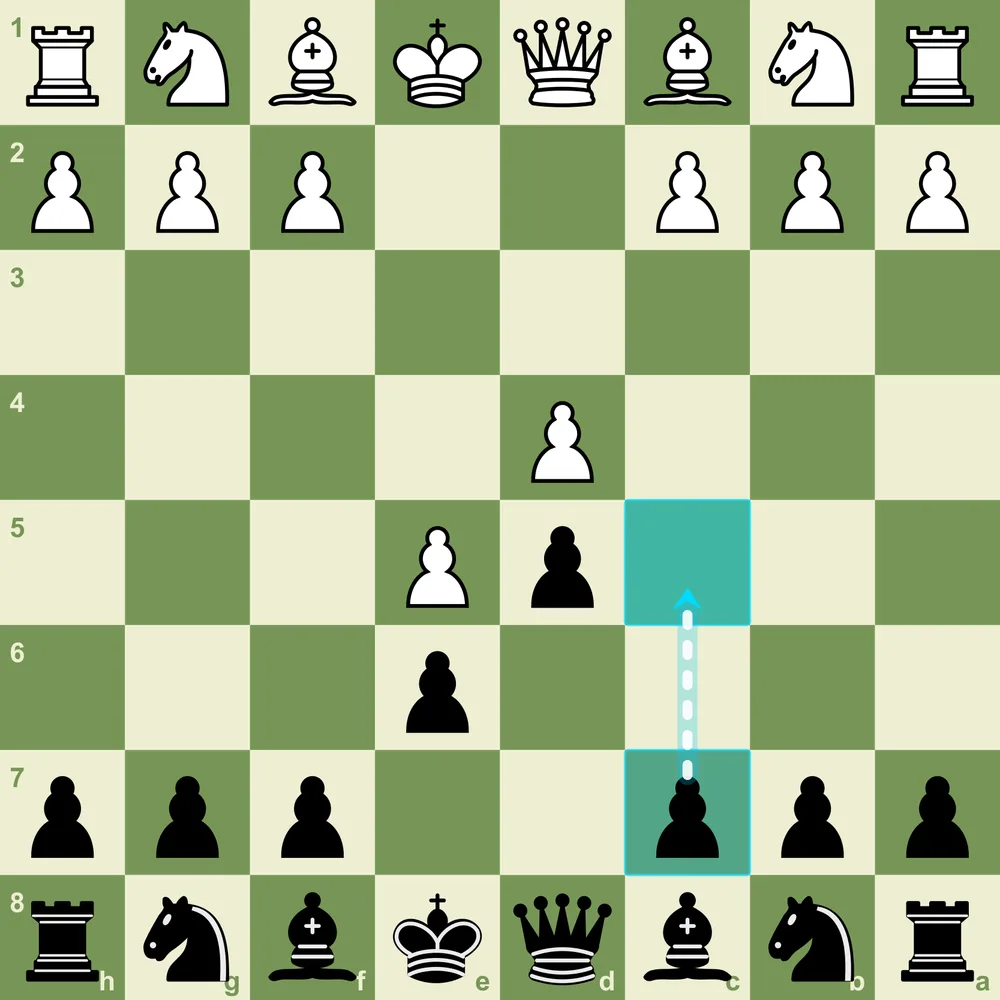
The Advance Variation is the most common choice at club level and one of the most instructive pawn structures in chess. After 1.e4 e6 2.d4 d5 3.e5, White grabs space and locks the center. Black immediately targets the base of White's pawn chain with 3...c5, often followed by ...Nc6 and ...Qb6 to pile pressure on d4. White must decide whether to defend the chain with c3 or seek active play. This variation leads to strategic battles that teach the fundamentals of pawn chain play.
Winawer Variation (3.Nc3 Bb4)
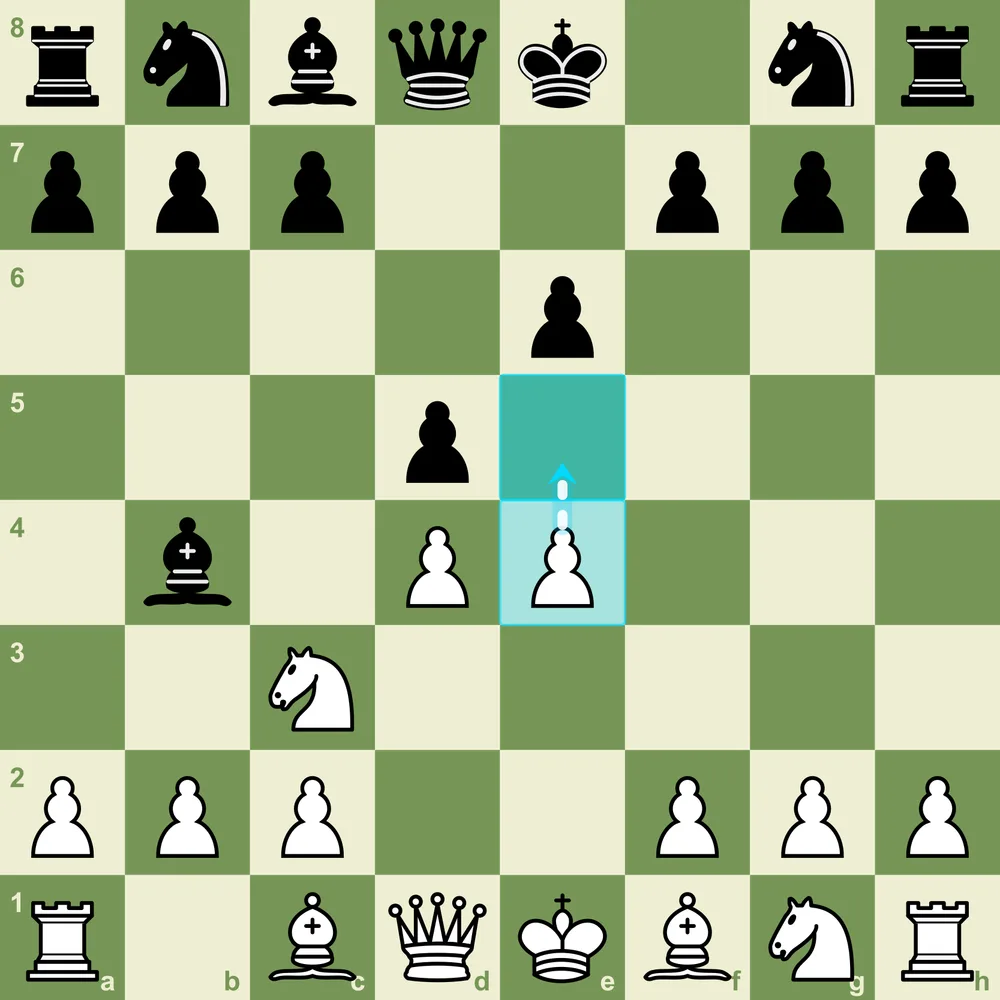
The Winawer is the sharpest and most theoretically demanding line in the French Defense. After 1.e4 e6 2.d4 d5 3.Nc3 Bb4, Black pins the knight that defends e4, creating immediate tactical tension. White typically responds with 4.e5 and after 4...c5 5.a3 Bxc3+ 6.bxc3, the position becomes wildly unbalanced. White gets the bishop pair and a strong center but has a shattered pawn structure. Black gets piece activity, a solid structure, and targets to attack. Both sides must play precisely, making the Winawer a favorite of ambitious players who enjoy deep calculation.
Classical Variation (3.Nc3 Nf6)
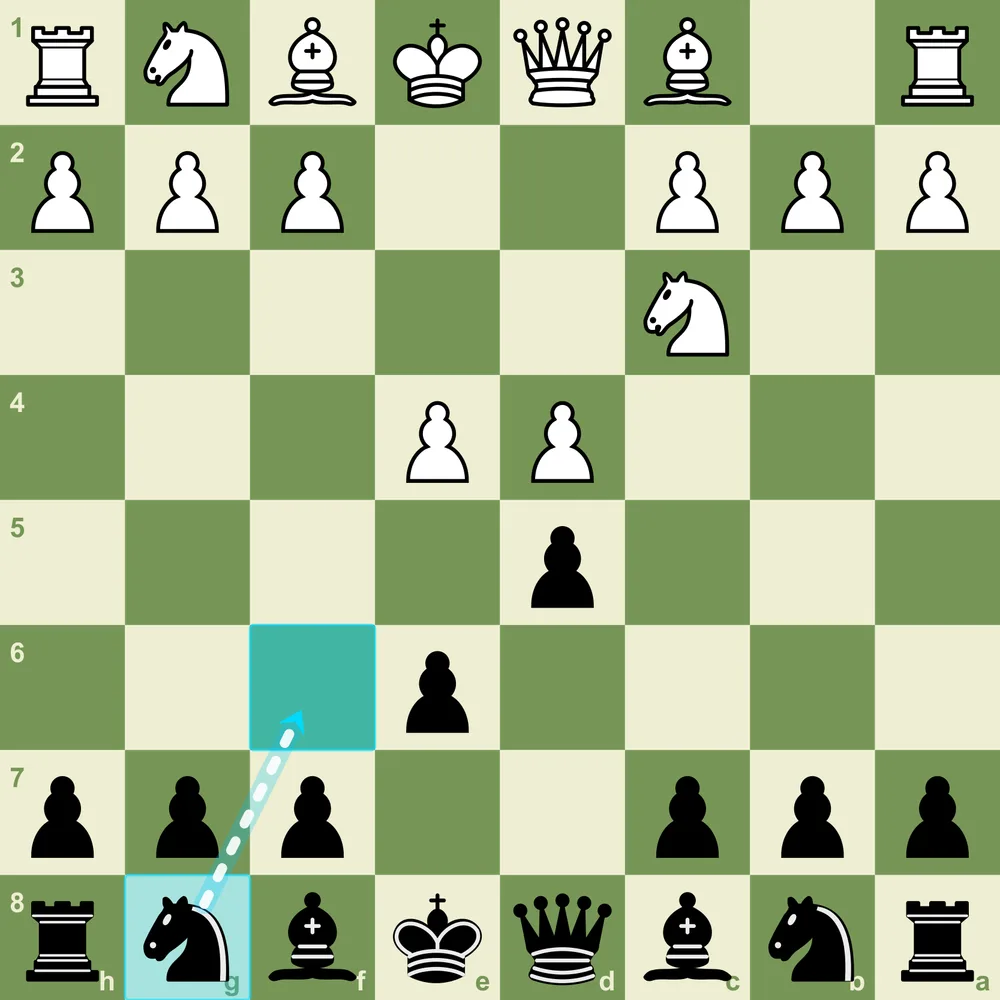
The Classical Variation is a solid and principled approach. After 1.e4 e6 2.d4 d5 3.Nc3 Nf6, Black develops naturally while maintaining pressure on e4. White's main response is 4.e5, kicking the knight back. Black retreats with 4...Nfd7 and prepares the standard French counterplay with ...c5. The resulting positions are less chaotic than the Winawer but still offer rich middlegame play. Black typically follows up with ...Nc6, ...Be7, ...0-0, and ...f6 to challenge the e5-pawn and open lines for the pieces. This variation suits players who prefer positional clarity with occasional tactical flare-ups.
Tarrasch Variation (3.Nd2)
The Tarrasch Variation is White's way of avoiding the Winawer pin entirely. After 1.e4 e6 2.d4 d5 3.Nd2, the knight goes to d2 instead of c3, keeping the c-pawn free and preventing ...Bb4 from having its usual sting. The trade-off is that the knight is slightly less active on d2. Black can respond with 3...c5 (the open Tarrasch), 3...Nf6 (the classical approach), or 3...Nc6 (the Guimard). The resulting positions tend to be slightly quieter than the Winawer or Advance but still contain genuine strategic complexity. Many top grandmasters, including Anatoly Karpov, have favored this variation with White.
Exchange Variation (3.exd5)
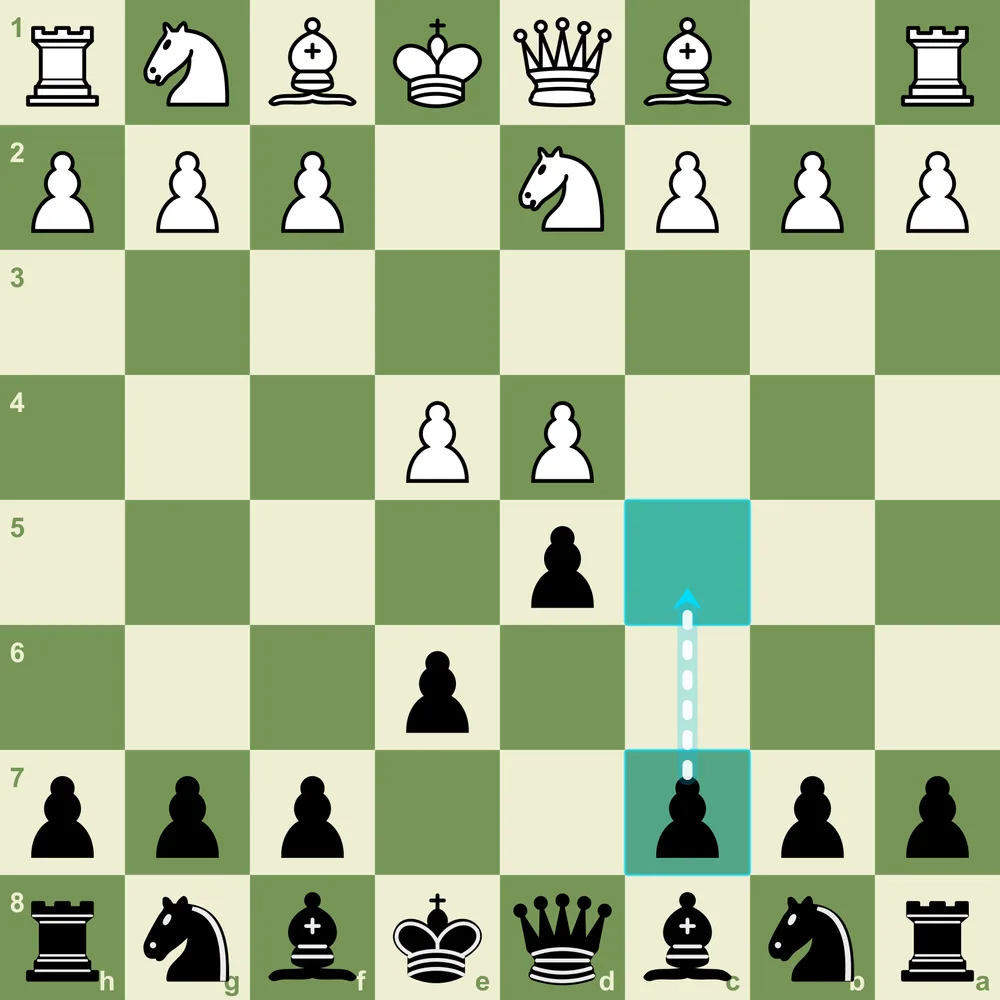
The Exchange Variation arises after 1.e4 e6 2.d4 d5 3.exd5 exd5. By releasing the central tension immediately, White creates a symmetrical pawn structure. This variation is generally considered the least challenging option for White, and many French Defense players are relieved to see it on the board. However, underestimating the Exchange would be a mistake. White can still play for a small initiative with plans involving Bd3, 0-0, Re1, and Bf4 to control key squares. Black should aim for active piece development with ...Bd6, ...0-0, ...Bg4, and seek to control the c-file.
The French Pawn Chain
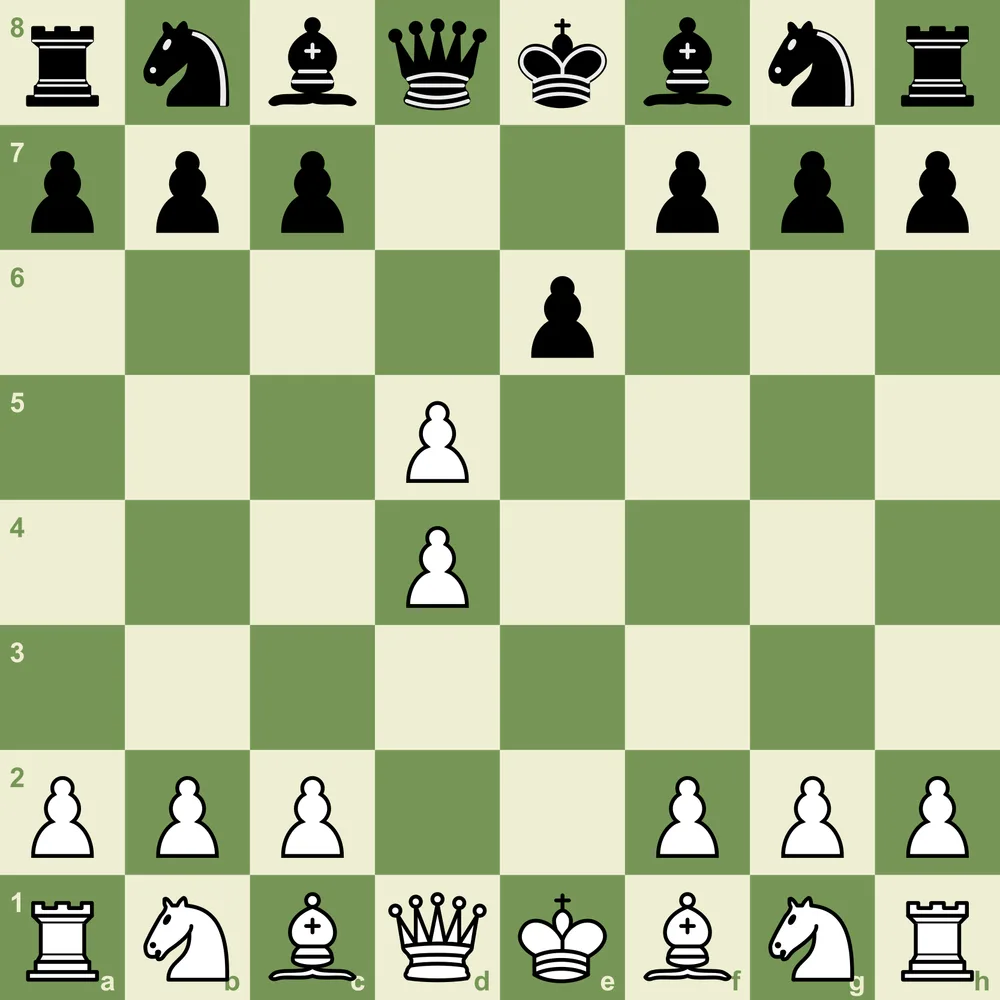
The pawn chain is the central strategic concept of the French Defense. After the typical sequence 1.e4 e6 2.d4 d5 3.e5, White's pawns on d4 and e5 form a chain pointing toward Black's kingside, while Black's pawns on d5 and e6 form a chain pointing toward White's queenside. This interlocking structure defines the character of the middlegame.
The key principle, first articulated by Aron Nimzowitsch, is that you should attack the base of the opponent's pawn chain. For Black, the base of White's chain is the d4-pawn. This is why ...c5 is almost always Black's first strategic priority: it strikes directly at d4, threatening to undermine the entire chain. If White's d4-pawn falls, the e5-pawn becomes weak and unsupported.
White, in turn, often attacks the base of Black's chain (the e6-pawn) with f4-f5 or tries to maintain the chain with c3 while launching a kingside attack. This creates a natural asymmetry: Black plays on the queenside and in the center, while White plays on the kingside. Understanding this dynamic will serve you well not just in the French but in any position featuring locked pawn chains.
Key Takeaway
Always play ...c5 early in the French Defense. This is Black's most important strategic move: it targets the base of White's pawn chain and generates queenside counterplay. Without ...c5, Black risks being squeezed on the kingside.
Pros and Cons
Advantages
- •Extremely solid pawn structure that is hard for White to break through
- •Clear strategic plans based on the pawn chain: play ...c5 and attack the queenside
- •Offers real winning chances as Black, unlike many other 1.e4 defenses
- •Less theory-dependent than the Sicilian; understanding trumps memorization
- •Teaches deep positional concepts applicable to many other openings
Disadvantages
- •The light-squared bishop on c8 can be passive, hemmed in by the e6-pawn
- •Black is often cramped in the early middlegame and needs patience
- •White can gain significant space with the Advance Variation, which some players find uncomfortable
- •The Winawer requires precise theoretical knowledge to navigate the sharp lines
- •Less dynamic than the Sicilian for players who prefer open, tactical battles
Common Mistakes
1. Forgetting to play ...c5
The single most common mistake in the French Defense is neglecting the ...c5 break. Without this move, Black has no counterplay against White's pawn chain and risks being slowly squeezed on the kingside. Always prioritize ...c5, ideally within the first five to seven moves. It is the backbone of Black's entire strategy.
2. Playing ...f6 too early
While ...f6 is an important break in many French positions (challenging the e5-pawn), playing it too early can be dangerous. Before pushing ...f6, make sure your king is castled, your pieces are developed, and you have already played ...c5. An early ...f6 can weaken the e6-pawn and open lines toward your king before you are ready to handle the consequences.
3. Failing to develop the light-squared bishop
Many beginners leave the c8-bishop sitting passively for the entire game. You need a plan for this piece. Consider ...b6 followed by ...Ba6 to exchange it, reroute it via ...Bd7-e8-g6, or play a line where the pawn structure opens naturally. Having a clear plan for the light-squared bishop separates strong French players from those who struggle with the opening.
4. Getting passive and waiting
The French is a counterattacking opening, not a passive one. If you simply develop your pieces and wait for White to do something, you will get crushed by a kingside attack. Black must actively generate counterplay with ...c5, ...Qb6, ...a6 and ...b5, or ...f6. Every move should contribute to your plan of undermining White's center or creating queenside pressure.
Master the French Defense with ChessHelper
Practice French Defense positions at your rating level. Get real-time move suggestions, understand the strategic plans, and build confidence in every variation.
Start Practicing FreeJoin 10,000+ chess players improving their openings
Related Openings
Caro-Kann Defense
Like the French, the Caro-Kann (1.e4 c6) offers Black a solid pawn structure and clear plans against 1.e4. The key difference is that the light-squared bishop remains outside the pawn chain, avoiding the French's main drawback. A great alternative if you enjoy the French's strategic style but want a freer bishop.
Learn moreSicilian Defense
The Sicilian (1.e4 c5) is the more aggressive alternative to the French. Where the French leads to closed, strategic battles, the Sicilian creates open, tactical warfare from the start. If you want more dynamic play and are willing to study more theory, the Sicilian is the natural counterpart to the French in your repertoire.
Learn moreFrequently Asked Questions About the French Defense
Not at all. While the French Defense gives Black a solid pawn structure, it is anything but passive. Black actively counterattacks White's center with ...c5 and often launches a queenside pawn storm with ...a6, ...b5, and ...c4. In the Winawer Variation, positions become extremely sharp with both sides attacking on opposite flanks. World champions like Botvinnik and Petrosian chose the French precisely because it offers real winning chances as Black.
The light-squared bishop hemmed in by the e6-pawn is the most well-known drawback of the French Defense. There are several practical solutions. First, you can exchange it early with ...b6 and ...Ba6 (common in the Tarrasch and some Advance lines). Second, you can reroute it to a more active diagonal with ...Bd7-e8-g6 or ...Bd7-c6. Third, in some lines after ...cxd4 and ...exd5, the pawn chain dissolves and the bishop gains freedom. Finally, some modern approaches simply accept the bishop is slightly passive and compensate with active piece play elsewhere.
The Exchange Variation has a reputation for being drawish at the top level, and many French Defense players are happy to see it because it means White has given up the fight for an advantage in the opening. However, the resulting symmetrical pawn structure does not mean the game is drawn. White can still create imbalances with plans like Bd3, 0-0, Re1, and c3 followed by a kingside attack. Black can aim for active play with ...Bd6, ...0-0, ...Bg4, and seizing the c-file. At the amateur level, these positions are far from drawn and offer plenty of room for both sides to outplay each other.