
What is the Petrov Defense?
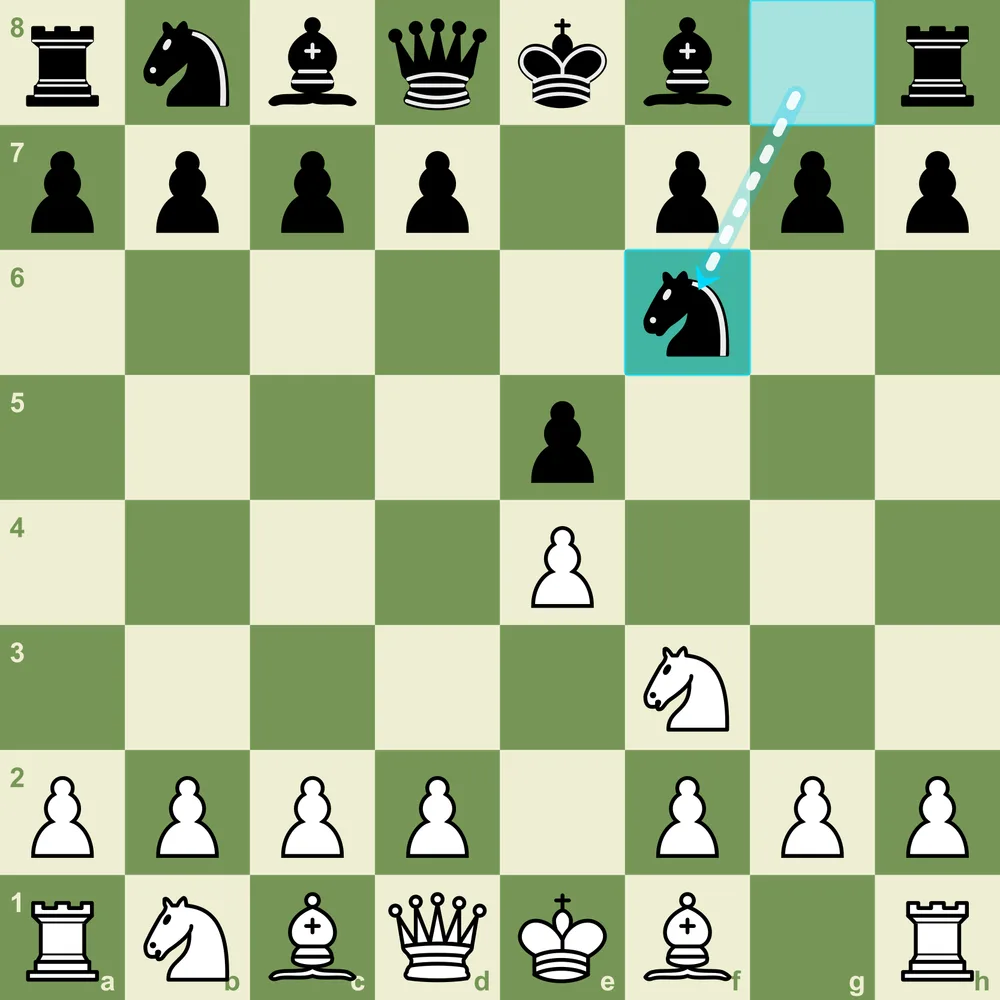
The Petrov Defense arises after 1.e4 e5 2.Nf3 Nf6 and is one of the most principled and durable replies to the King's Pawn opening. The idea is beautifully simple: when White attacks Black's e5 pawn with 2.Nf3, most players rush to defend it with 2...Nc6. The Petrov instead ignores the threat and answers symmetry with symmetry, attacking White's e4 pawn with 2...Nf6. If White grabs the pawn with 3.Nxe5, Black is not obliged to recapture immediately - and understanding exactly how to respond is the heart of the opening.
The defense is named after the 19th-century Russian master Alexander Petrov, one of the strongest players of his era, which is why it is equally well known as the Russian Defense or Russian Game (and sometimes spelled Petroff). Petrov and his contemporaries recognized that the mirror-image counterattack was fully sound, and more than a century of practice has confirmed it. Far from being a passive move, 2...Nf6 wrestles the initiative in the center away from White and refuses to let the first player dictate a one-sided attacking game.
The Petrov's greatest strength is its structural soundness. Because the position remains symmetrical for the first several moves, White struggles to generate the kind of pressure available in the Ruy Lopez or the sharper Sicilian lines. This is why the Petrov developed a reputation as a "drawing weapon" - a bulletproof way to blunt an aggressive opponent with the black pieces. Vladimir Kramnik famously leaned on it during his world championship years, and modern elite players such as Fabiano Caruana and Sergey Karjakin have kept it firmly in the top-level repertoire.
Yet the drawing-weapon label undersells the opening. Black's early knight sortie to e4 creates an active, well-placed piece, and the resulting middlegames are rich with tactical and positional resources. The Petrov even features aggressive tries for White, such as the piece-sacrificing Cochrane Gambit and the space-grabbing Modern Attack, so both sides must play accurately. Solid does not mean toothless - the Petrov offers a low-risk foundation from which a well-prepared player can absolutely play for a win.
How to Play the Petrov Defense
The Petrov begins with 1.e4 e5 2.Nf3 Nf6. The critical branch comes after 3.Nxe5, when White captures the e5 pawn. Here is the single most important rule in the entire opening: do not copy White by recapturing immediately with 3...Nxe4. First play 3...d6, attacking the intruding knight and forcing it to retreat. Only after 4.Nf3 should Black grab the pawn with 4...Nxe4, reaching the main line with full equality.
The reason for this move order is a well-known trap. If Black plays 3...Nxe4 straight away, White responds with the strong 4.Qe2, pinning the knight along the open e-file. The point is that the natural 4...Nf6 loses on the spot to 5.Nc6+, a discovered check that wins Black's queen. Black is forced into the awkward 4...Qe7, and after 5.Qxe4 d6 6.d4 the second player emerges with a passive, slightly worse position. Inserting 3...d6 first sidesteps this entirely.
Once Black reaches the main line with 4...Nxe4, the next essential move is ...d5, supporting the advanced knight and staking a claim in the center. After 5.d4 d5, Black's knight sits proudly on e4 with a solid pawn behind it, and development flows naturally: the light-squared bishop comes to d6 or e7, the king castles, and Black finishes with ...Nc6 or ...c6 and ...Nd7. The strategic philosophy is clear - keep the structure sound, activate the pieces to their best squares, and rely on the healthy symmetrical foundation to weather anything White throws forward.
Main Petrov Defense Variations
The Petrov branches into several distinct systems depending on how White treats the center. Here are the four variations every Petrov player must know.
The Classical Variation
3.Nxe5Intermediate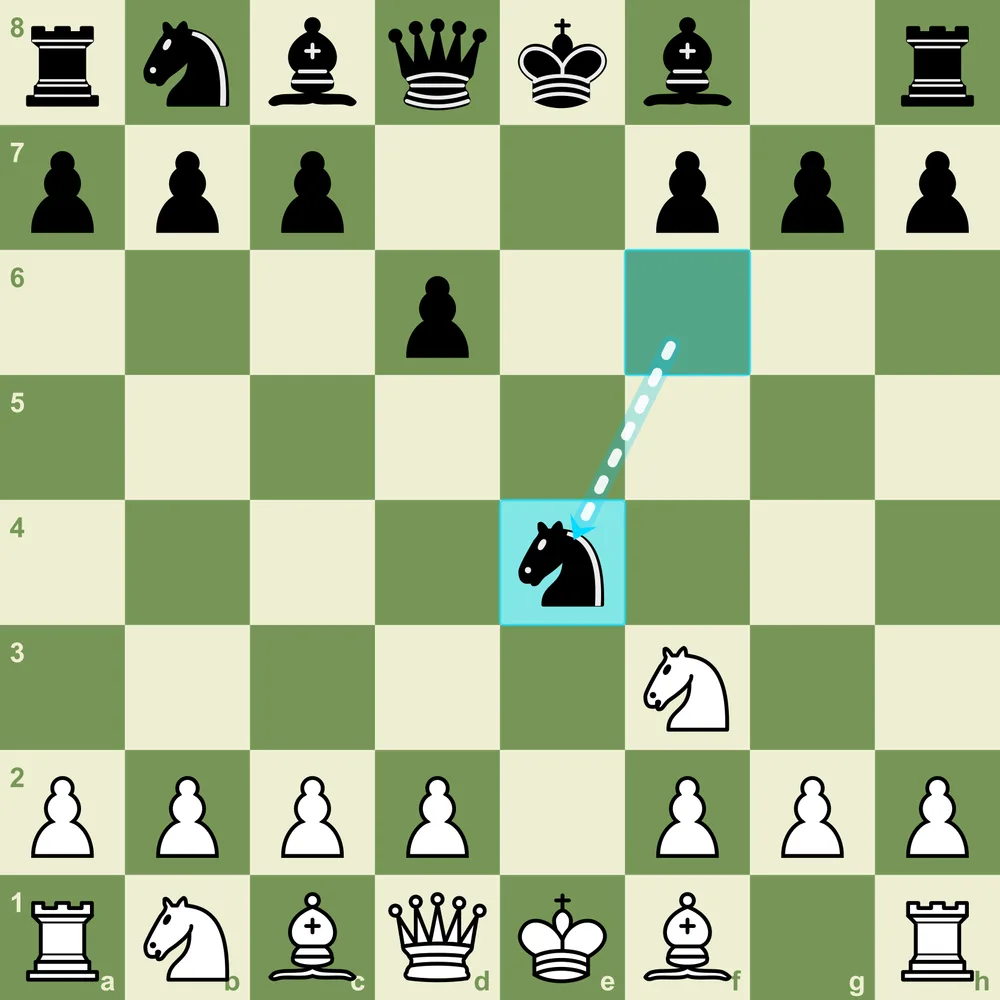
The Classical Variation is the main line of the Petrov and the position every player is aiming for. After 3.Nxe5 d6 4.Nf3 Nxe4, Black has restored material equality with the knight safely posted on e4. The insertion of 3...d6 to kick the white knight before recapturing is the defining technique of the whole opening, and it leaves Black with an active, comfortable game.
Play typically continues 5.d4 d5, when the black knight is firmly supported and the position is symmetrical and balanced. From here Black develops harmoniously with ...Bd6 (or ...Be7), ...O-O, ...Nc6 or ...c6, and often ...Bg4 to pressure the f3 knight. This is the setup that made the Petrov a trusted equalizer at the world championship level - solid, principled, and very hard for White to crack, yet packed with piece activity for the second player.
Famous practitioners: Kramnik, Caruana, Karjakin, Marshall
The Modern Attack (Steinitz)
3.d4Intermediate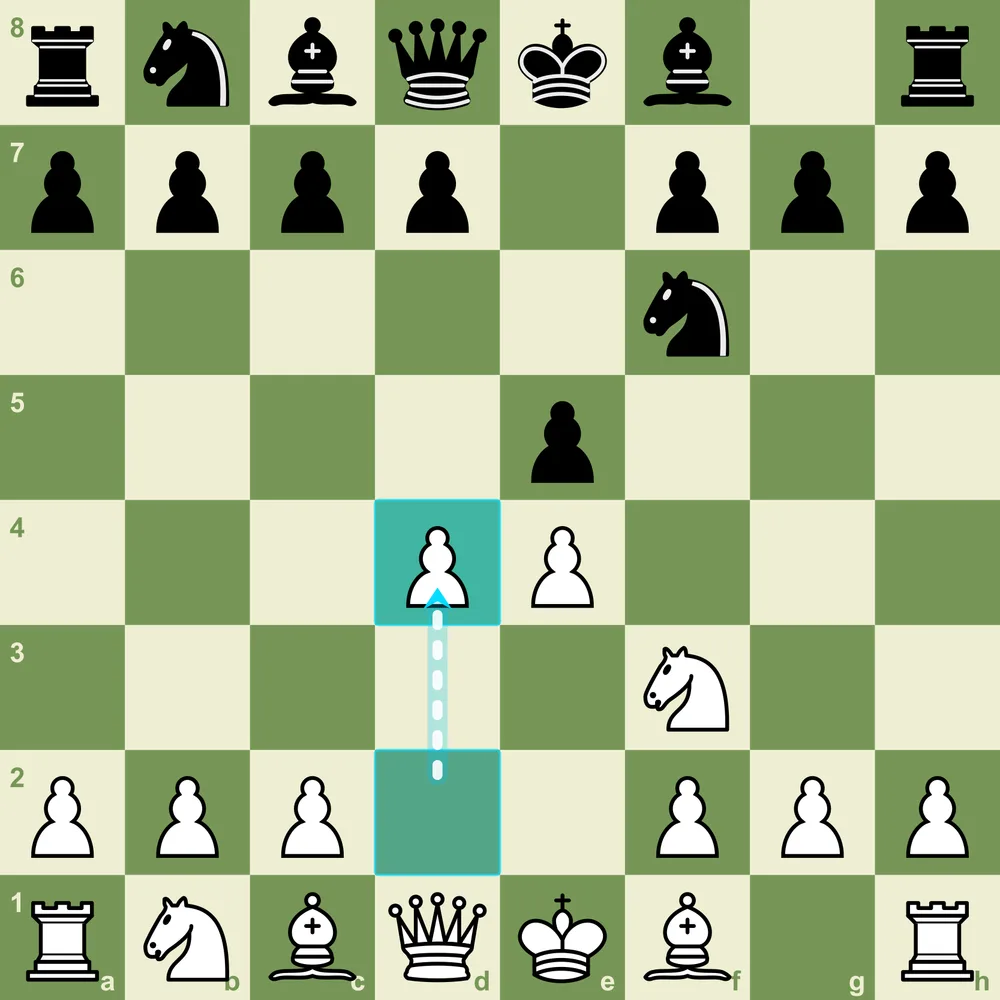
In the Modern Attack, also called the Steinitz Variation, White declines the e5 pawn and instead builds a big center with 3.d4. This is one of the most challenging ways to meet the Petrov and a favorite of ambitious 1.e4 players who want to avoid the drawish reputation of the Classical lines. White accepts a more open, dynamic struggle in return for central space and free development.
Black's most reliable response is 3...Nxe4 - now that White has not played Nxe5, capturing the e4 pawn is safe and correct. After 4.Bd3 d5 5.Nxe5 Nd7, Black challenges the strong knight on e5 and prepares to complete development. The positions are livelier than in the Classical Variation, with open lines and active pieces for both sides, so Black must be prepared to defend accurately while looking for counterplay against White's center.
Famous practitioners: Steinitz, Anand, Nepomniachtchi, Nakamura
The Three Knights Variation
3.Nc3Beginner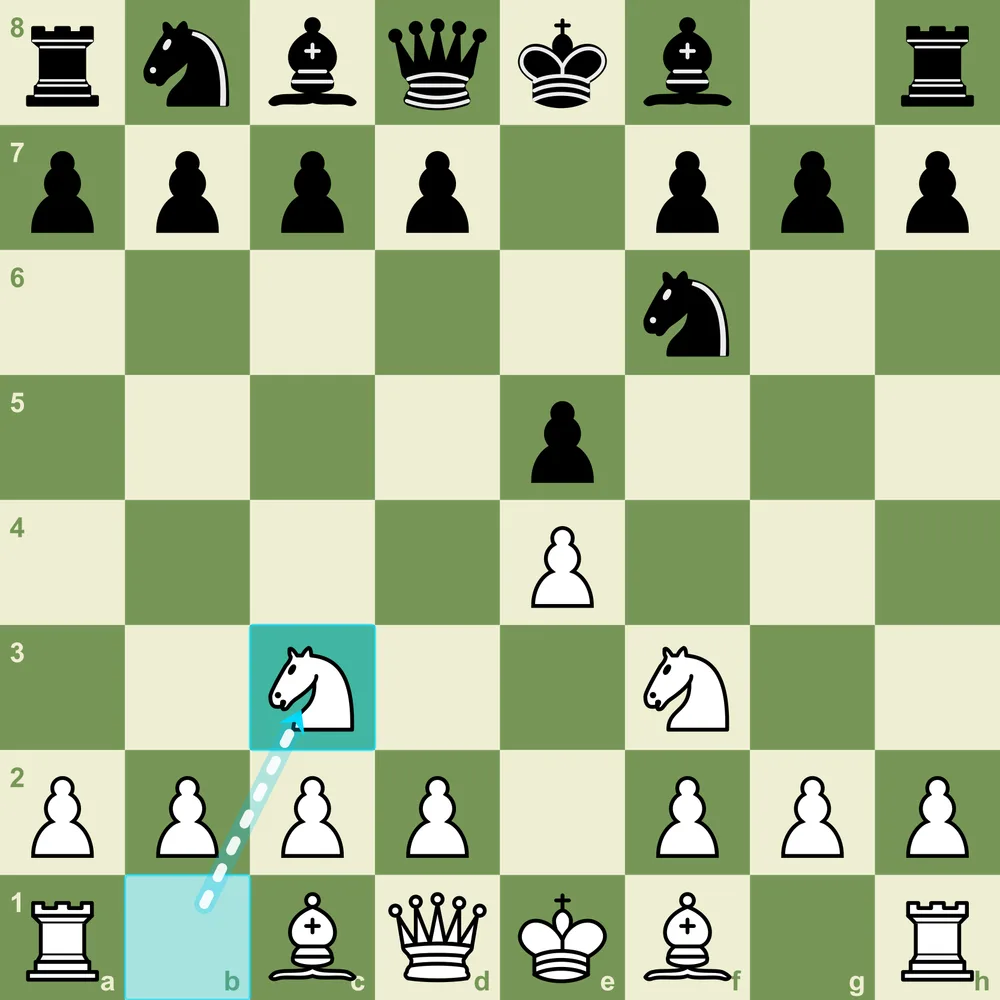
With 3.Nc3, White declines to enter the symmetrical pawn captures and instead develops a piece, defending e4 and inviting a calmer game. This is the Three Knights approach. It is a natural, low-theory choice that many players reach without any special preparation, and it is a friendly, principled way for both sides to develop.
The most common reply is 3...Nc6, which transposes directly into the Four Knights Game, one of the oldest and most respected open openings. Black can also try to keep an independent Petrov flavor with 3...Bb4, pinning the c3 knight and pressuring e4. Either way, the position remains solid and roughly balanced, making the Three Knights a comfortable line for Petrov players who are equally happy in classical open-game structures.
Famous practitioners: Tarrasch, Spassky, Short, Giri
The Cochrane Gambit
4.Nxf7Intermediate-Advanced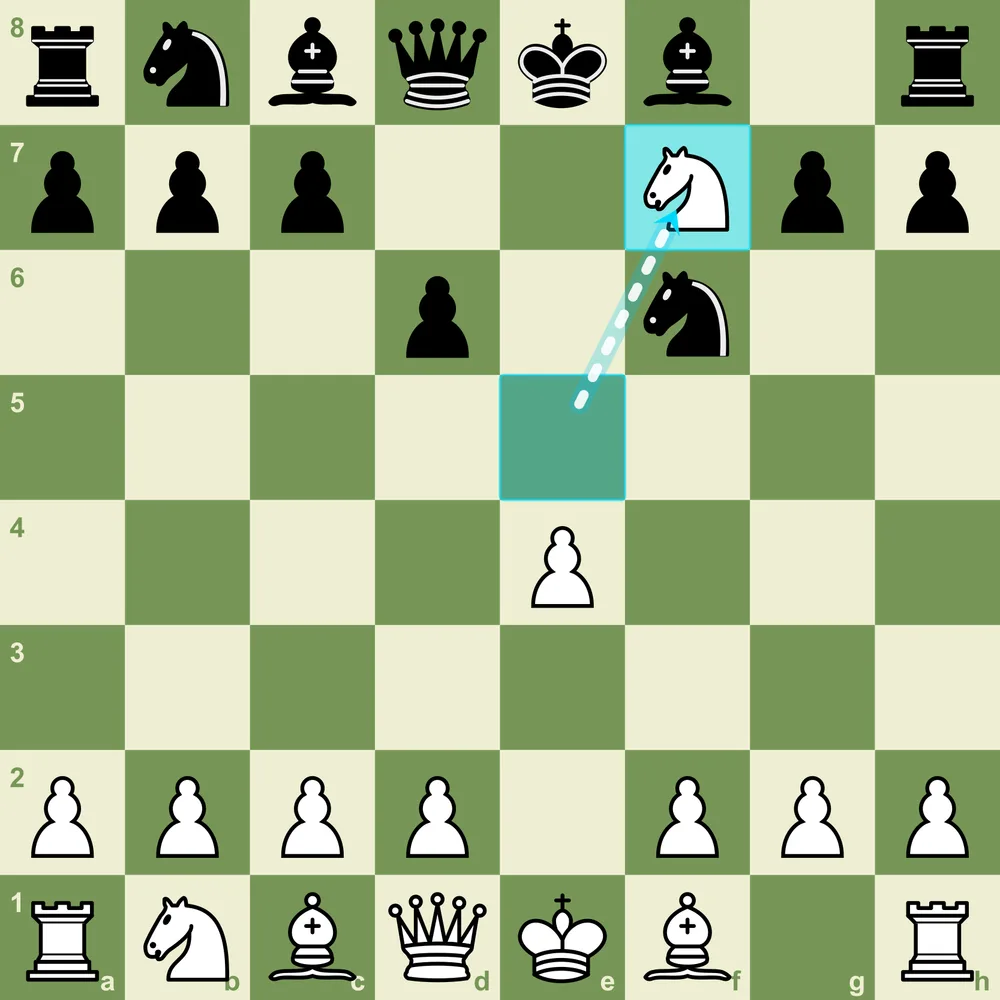
The Cochrane Gambit is the most audacious try against the Petrov. After 3.Nxe5 d6 4.Nxf7, White sacrifices a whole knight for a single pawn, and after 4...Kxf7 Black's king is dragged out to f7 with no way to castle. Named after the 19th-century player John Cochrane, this gambit trades material for a lasting attack against the exposed monarch.
White usually follows with 5.d4 and 6.Nc3 or 5.Nc3, building a pawn center and rapid development while the black king searches for shelter. Objectively the gambit is considered dubious with best play - Black is simply up a piece - but in practice it is extremely dangerous. Black must defend precisely: return the king to safety with ...Kg8 after ...g6 and ...Kg7, develop calmly, and avoid greed. A player who knows the theory can consolidate the extra material, but one careless move can be fatal.
Famous practitioners: Cochrane, Topalov, Shirov, Rapport
Pros and Cons of the Petrov Defense
Advantages
- •Rock-solid and low-risk - the symmetrical structure neutralizes White's aggression and makes the Petrov one of the safest replies to 1.e4
- •Active piece play - the early ...Nxe4 gives Black a strong central knight and easy, natural development for every piece
- •Focused theory - once you know the key 3...d6 move order and the main line, you sidestep a huge amount of the Ruy Lopez and Italian theory that 2...Nc6 requires
- •Trusted at every level - from club play to world championship matches, the Petrov has proven itself a dependable and respected defense
Disadvantages
- •Limited winning chances - the symmetry that keeps Black safe also makes it harder to play for a win, especially against a well-prepared opponent content with a draw
- •One critical move order to memorize - forgetting to insert 3...d6 before ...Nxe4 can lose material outright to the 4.Qe2 trap
- •White can force sharp play - the Modern Attack (3.d4) and the Cochrane Gambit (4.Nxf7) drag Black into concrete lines where accurate defense is essential
- •Can feel passive - players who enjoy attacking chess may find the Petrov's quiet, balanced positions less exciting than the Sicilian or open games
Common Mistakes to Avoid in the Petrov
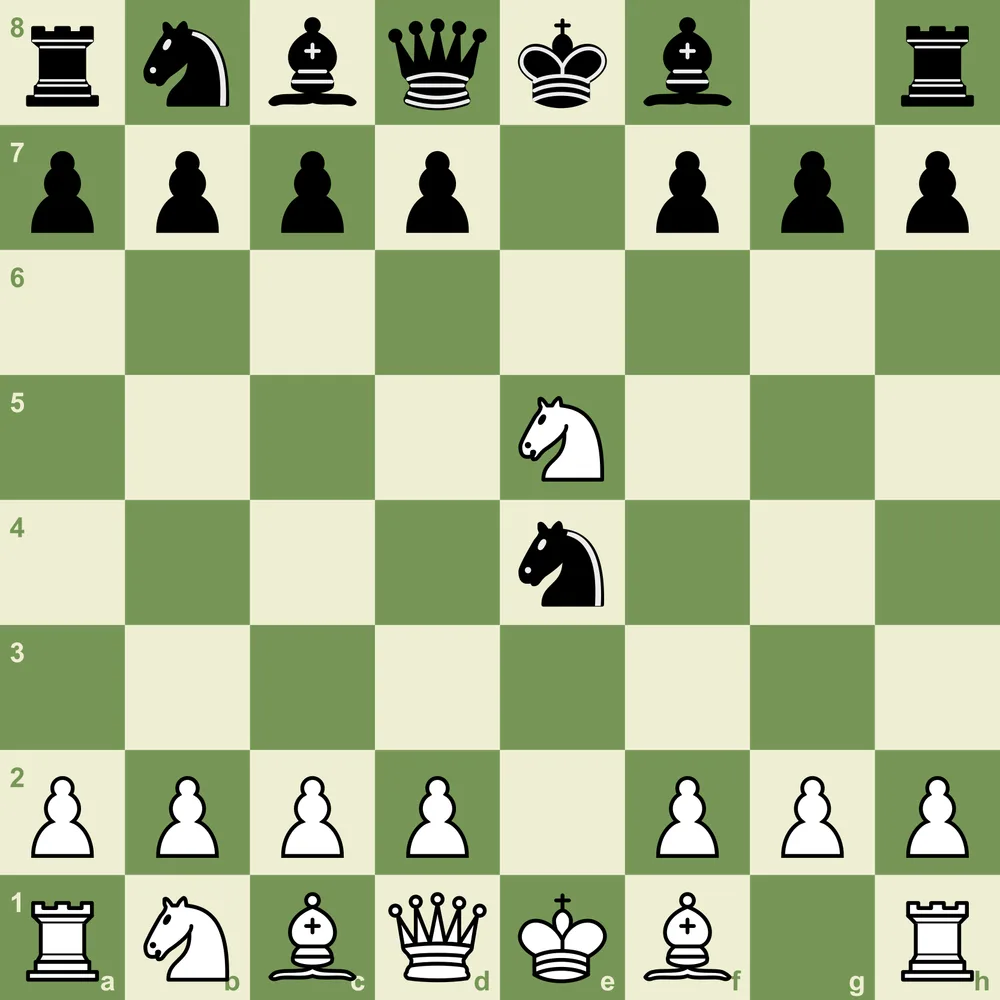
Copying White with 3...Nxe4 before playing ...d6
This is the single most important trap in the entire opening, shown in the diagram above. After 3.Nxe5, recapturing immediately with 3...Nxe4 allows 4.Qe2, pinning the knight on the open e-file. The natural 4...Nf6 then loses the queen to 5.Nc6+, a discovered check. Black is forced to play 4...Qe7, and after 5.Qxe4 d6 6.d4 White regains the piece with a clearly better position. Always insert 3...d6 first to chase the knight away, and only then recapture on e4.
Forgetting to play ...d5 to support the e4 knight
In the main line after 3.Nxe5 d6 4.Nf3 Nxe4 5.d4, Black's knight on e4 needs a solid anchor. The correct move is 5...d5, planting a pawn behind the knight so it cannot be easily challenged. Players who neglect this and continue with random development often find the e4 knight harassed by moves like Bd3, Nbd2, or Re1, losing tempo and drifting into a passive position. Remember: recapture on e4, then immediately secure the knight with ...d5.
Treating the Petrov as an automatic draw
The symmetrical structure tempts many players into passive, planless moves, assuming the position will hold itself. This is a mistake. The Petrov rewards active piece placement - develop the light-squared bishop to an aggressive square, contest the open e-file with a rook, and look for the ...Bg4 pin or a well-timed ...c5 break. Solidity is a foundation, not a substitute for a plan. Play with purpose and the Petrov can generate genuine winning chances.
Panicking against the Cochrane Gambit
When White sacrifices a knight with 4.Nxf7, Black is objectively winning a piece - but only with calm, accurate defense. The common error is greed or fear: grabbing more material while the king sits exposed, or making frantic moves that hand White the initiative. Instead, tuck the king to safety with ...g6 and ...Kg7-g8, complete development, and neutralize White's attack. Once the position is consolidated, the extra piece decides the game.
How to Practice the Petrov Defense
The Petrov rewards clear understanding over rote memorization. Follow these steps to make it a dependable part of your repertoire.
Lock in the safe move order
Before anything else, drill the correct response to 3.Nxe5: play 3...d6 to kick the knight, then 4...Nxe4 to recapture, and follow up with ...d5 to anchor the knight. Never copy White with an immediate 3...Nxe4. Repeating this simple sequence until it is automatic protects you from the opening's one truly dangerous trap.
Learn the Modern Attack responses
Ambitious opponents will often avoid the Classical lines with 3.d4. Study the reliable path 3...Nxe4 4.Bd3 d5 5.Nxe5 Nd7 and understand why capturing on e4 is safe here. Getting comfortable with these more open positions ensures you are never caught off guard when White tries to sidestep the symmetrical main lines.
Use ChessHelper to analyze your Petrov games
After each game, review the opening phase with ChessHelper's AI analysis. Did you play the move order correctly? Was your e4 knight properly supported? Did you find active squares for your pieces? ChessHelper's AI-powered engine highlights the critical moments and helps you build a deeper feel for the balanced positions the Petrov produces.
Study classic Petrov games
Few players have shown the resilience of the Petrov better than Vladimir Kramnik, who used it as a cornerstone defense at the elite level. Replay his games alongside those of Fabiano Caruana and the older masterpieces of Frank Marshall to see how Black converts a solid structure into a comfortable equality - and sometimes a full point. Pay attention to how the active pieces coordinate around the sound pawn skeleton.
Play slow time controls to internalize the plans
The Petrov is a positional opening, and its subtleties come to life in longer games. Play at least some of your practice games at 15+10 or slower, and use the extra time to ask the key questions: is my knight secure, where does my bishop belong, and how do I create activity without weakening my rock-solid structure? These slow-game habits will make the Petrov second nature.
Master the Petrov with ChessHelper
Get real-time AI analysis as you practice the Petrov Defense in your online games. Understand every position, avoid the key traps, and build an unbreakable repertoire.
Start Practicing for FreeJoin 10,000+ chess players building solid opening repertoires with ChessHelper
Related Openings
If you play the Petrov, these related 1.e4 e5 openings share the same open-game roots and will round out your understanding.
Italian Game
The classic developing choice for White after 2...Nc6. The bishop targets f7 and leads to rich, instructive open positions.
1.e4 e5 2.Nf3 Nc6 3.Bc4
Ruy Lopez
The most respected 1.e4 e5 opening. White pins the c6 knight with Bb5 and builds long-term pressure across the whole board.
1.e4 e5 2.Nf3 Nc6 3.Bb5
Scotch Game
White strikes the center at once with 3.d4, opening the position early for active piece play instead of slow maneuvering.
1.e4 e5 2.Nf3 Nc6 3.d4
Petrov Defense: Frequently Asked Questions
The Petrov Defense is an excellent choice for players who value safety and clear strategic ideas over sharp tactical battles. Instead of memorizing long forcing lines, Black follows a simple recipe: counterattack the e4 pawn, keep the position symmetrical, and complete development smoothly. The one thing every Petrov player must learn early is the correct move order after 3.Nxe5 - you must insert 3...d6 to chase the knight before recapturing on e4. Copying White immediately with 3...Nxe4 walks into the trap 4.Qe2 and can lose material. Once you know that single rule, the Petrov becomes one of the easiest 1.e4 defenses to play soundly.
The Petrov earned its solid reputation because Black's symmetrical setup neutralizes many of White's most aggressive attacking tries, and top players have used it repeatedly to hold difficult games and secure important draws with the black pieces. However, calling it purely a drawing weapon is misleading. The Petrov contains genuine bite: Black's early ...Nxe4 gives the knight an active outpost, the resulting positions are full of piece play, and many sharp lines - including the Cochrane Gambit and the Modern Attack - lead to double-edged middlegames. Elite players such as Vladimir Kramnik and Fabiano Caruana have won plenty of games with it, proving that solidity and winning chances can coexist.
After 1.e4 e5 2.Nf3, the traditional move is 2...Nc6, defending the attacked e5 pawn and leading to openings like the Ruy Lopez, Italian Game, and Scotch. The Petrov takes the opposite approach with 2...Nf6: rather than defending e5, Black ignores the threat and counterattacks White's e4 pawn symmetrically. This immediately changes the character of the game. Play often becomes balanced and structurally clean, White cannot pin Black down with a Ruy Lopez bishop, and Black frequently reaches positions with an active knight and easy development. The trade-off is that the Petrov concedes some winning ambition compared to the sharper Nc6 systems.