
What is the Scotch Game?
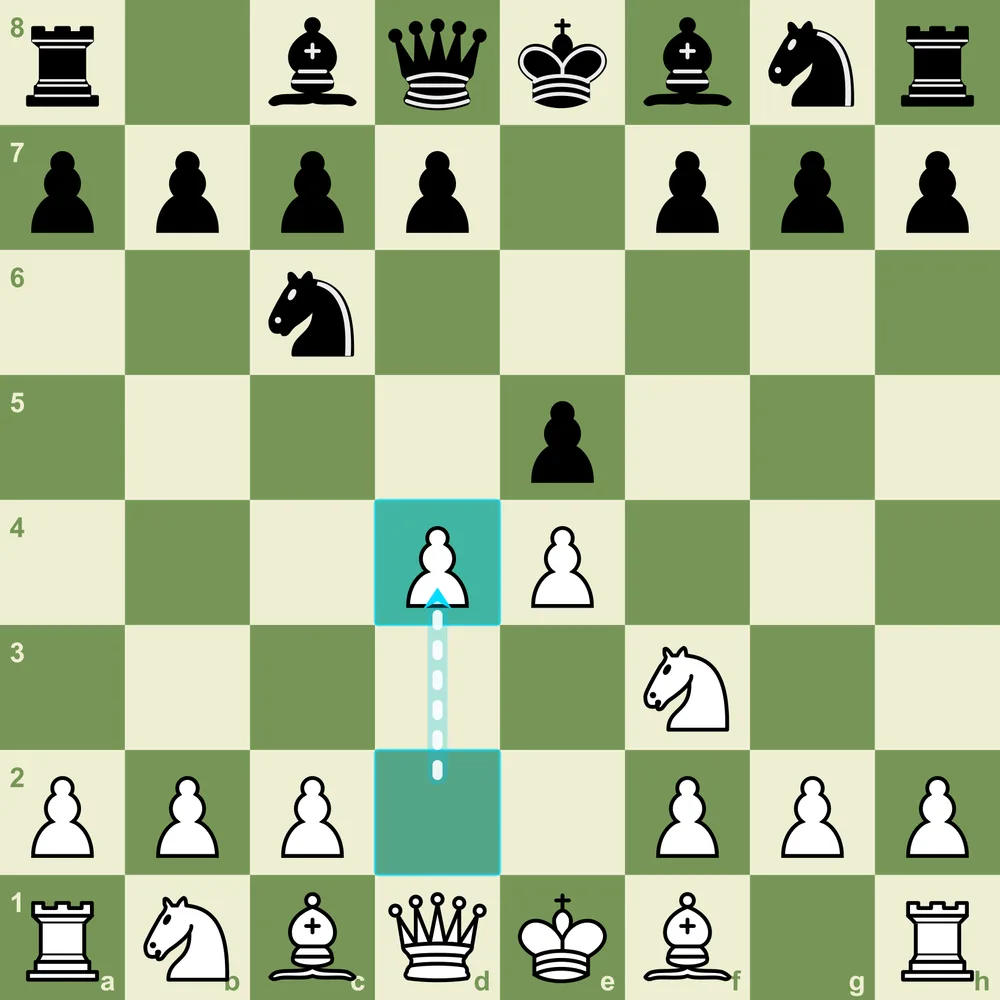
The Scotch Game begins with the moves 1.e4 e5 2.Nf3 Nc6 3.d4 and is one of the oldest and most principled ways for White to open the game. The idea behind 3.d4 is direct and thematic: White challenges Black's e5 pawn at once, opens the center, and clears lines for rapid piece development. Rather than building up slowly as in the Ruy Lopez, White commits to an open struggle where activity and initiative matter more than long-term maneuvering.
The opening takes its name from a famous correspondence match played between 1824 and 1828 by the chess clubs of Edinburgh and London, in which the Scottish side successfully employed 3.d4. Throughout the 19th century the Scotch was a mainstream choice, but as the Ruy Lopez rose to dominance the Scotch was gradually relegated to a sideline, considered too accommodating to Black because it releases the central tension so early.
Its fortunes changed dramatically in the early 1990s when Garry Kasparov adopted the Scotch as a surprise weapon in his World Championship matches against Anatoly Karpov and Viswanathan Anand. Kasparov showed that the resulting positions were far richer than their reputation suggested, and that White could generate genuine attacking chances and fresh middlegames well outside his opponents' deep Ruy Lopez preparation. This revival restored the Scotch to elite respectability, and it has been played regularly by top grandmasters ever since.
Today the Scotch is prized as a practical, low-maintenance alternative to the Ruy Lopez. It offers White clear plans, open lines, and a healthy share of the initiative, while requiring far less rote memorization. For club players it is one of the best ways to reach a comfortable, active middlegame after 1.e4 e5 without wading into the endless theory of the Spanish.
How to Play the Scotch Game
The Scotch arises after 1.e4 e5 2.Nf3 Nc6 3.d4. White's third move immediately attacks the e5 pawn, which is defended only by the c6 knight. Black almost always accepts the challenge with 3...exd4, capturing the central pawn. White then has a fundamental choice: recapture the pawn or offer it as a gambit.
The classical main line is 4.Nxd4, recentralizing the knight and reaching an open, roughly symmetrical structure where White enjoys slightly freer development. Black's two principal replies are 4...Bc5, developing with tempo against the d4 knight (the Classical Variation), and 4...Nf6, hitting the e4 pawn (the Schmidt Variation). White can also decline the recapture and play the aggressive 4.Bc4, the Scotch Gambit, aiming pressure at the f7 square.
The strategic philosophy of the Scotch is clear and appealing: open the position, develop every piece to an active square, castle quickly, and use the initiative that comes from having a small development lead. White typically follows up with moves like Nc3, Be3 or Bc4, Qd2, and long or short castling depending on the line. Because the center is resolved early, both sides know what they are fighting for, making the Scotch an excellent opening for players who prefer concrete plans over slow maneuvering.
Main Scotch Game Variations
The Scotch branches into a handful of distinct systems after 3...exd4, each with its own character. Here are the four variations every Scotch player must know.
The Main Line
4.Nxd4Intermediate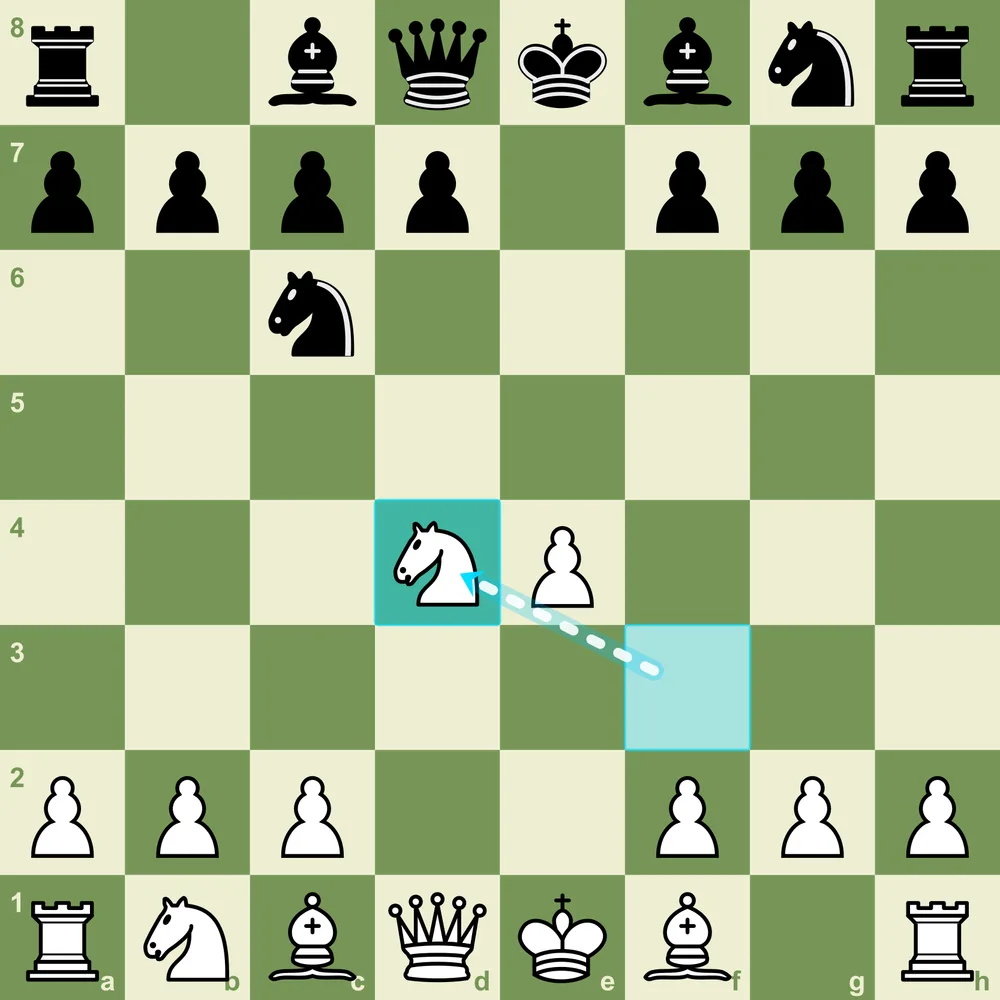
After 3...exd4 4.Nxd4, White recaptures the pawn and places the knight on the powerful central d4 square. The position is open and harmonious: White has a small lead in development and easy piece play, while Black must choose an active method of equalizing. This is the backbone of the Scotch and the position from which all of the main branches spring.
White's typical plan is to reinforce the center and complete development with c3, Nc3, Be3 or Bc4, and castling. A recurring resource is Nxc6, which doubles Black's pawns and can grant White pressure against the resulting structure - but this should only be played when it genuinely benefits White, since it also hands Black the bishop pair and a half-open b-file. Understanding when to trade on c6 and when to keep the tension is the central skill in the main line.
Famous practitioners: Kasparov, Carlsen, Karjakin, Rapport
The Classical Variation
4...Bc5Intermediate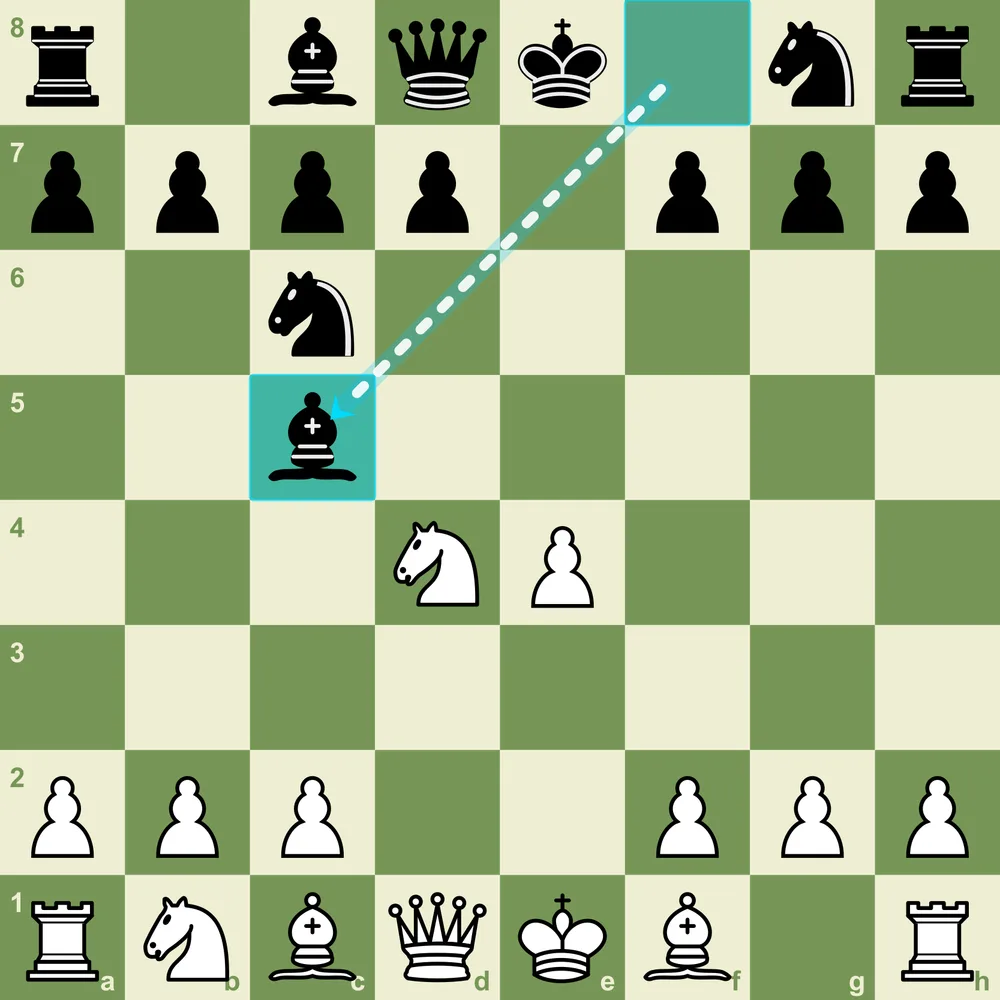
The Classical Variation begins with 4...Bc5, developing the bishop to its most active diagonal and attacking the knight on d4. This is one of Black's most respected and combative replies, immediately putting the question to White's centralized knight and eyeing the sensitive f2 square. It leads to sharp, concrete play where accurate move orders matter.
The main line runs 5.Be3 Qf6 6.c3 Nge7, where Black piles up on the d4 knight while White shores up the center and prepares to develop the light-squared bishop and castle. A key point is that White cannot casually capture on c6, because Black's pieces are coordinated to recapture favorably and generate counterplay against f2 and the e-file. Both sides must play precisely, and the resulting middlegames are rich in tactical possibilities.
Famous practitioners: Anand, Sveshnikov, Rublevsky, Svidler
The Schmidt Variation
4...Nf6Intermediate-Advanced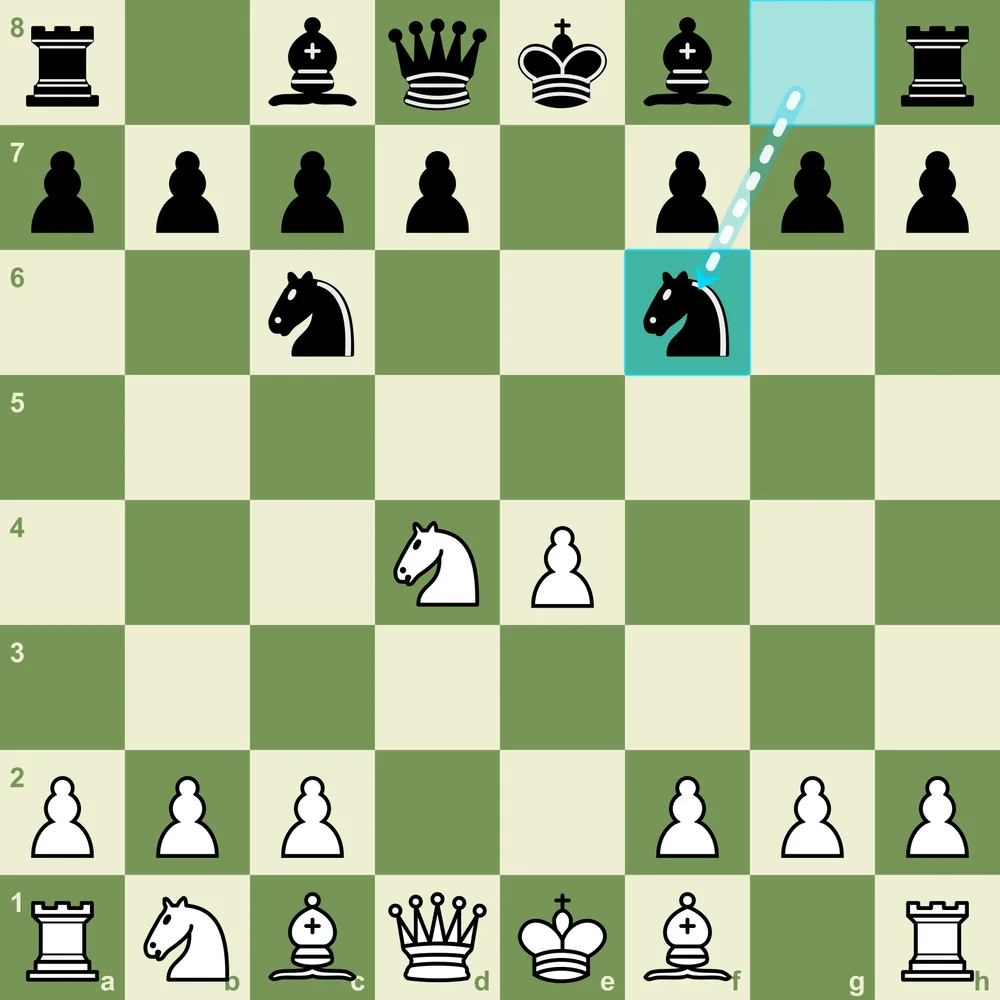
In the Schmidt Variation, Black replies 4...Nf6, developing a piece while immediately attacking White's e4 pawn. Named after Paul Schmidt, this is the most theoretically important line of the modern Scotch and the one Kasparov did so much to popularize. The critical continuation is 5.Nxc6 bxc6 6.e5, the Mieses Variation, where White gains space by kicking the f6 knight and Black obtains the bishop pair.
After 6.e5, Black's correct response is the energetic 6...Qe7, attacking the e5 pawn and preparing to reroute the knight to d5. Play typically continues 7.Qe2 Nd5 8.c4 Ba6, leading to an unbalanced struggle where White's space and central pawn are weighed against Black's bishop pair and pressure on the light squares. These are some of the most heavily analyzed positions in the entire opening and demand precise preparation from both sides.
Famous practitioners: Kasparov, Anand, Nepomniachtchi, Giri
The Scotch Gambit
4.Bc4Intermediate-Advanced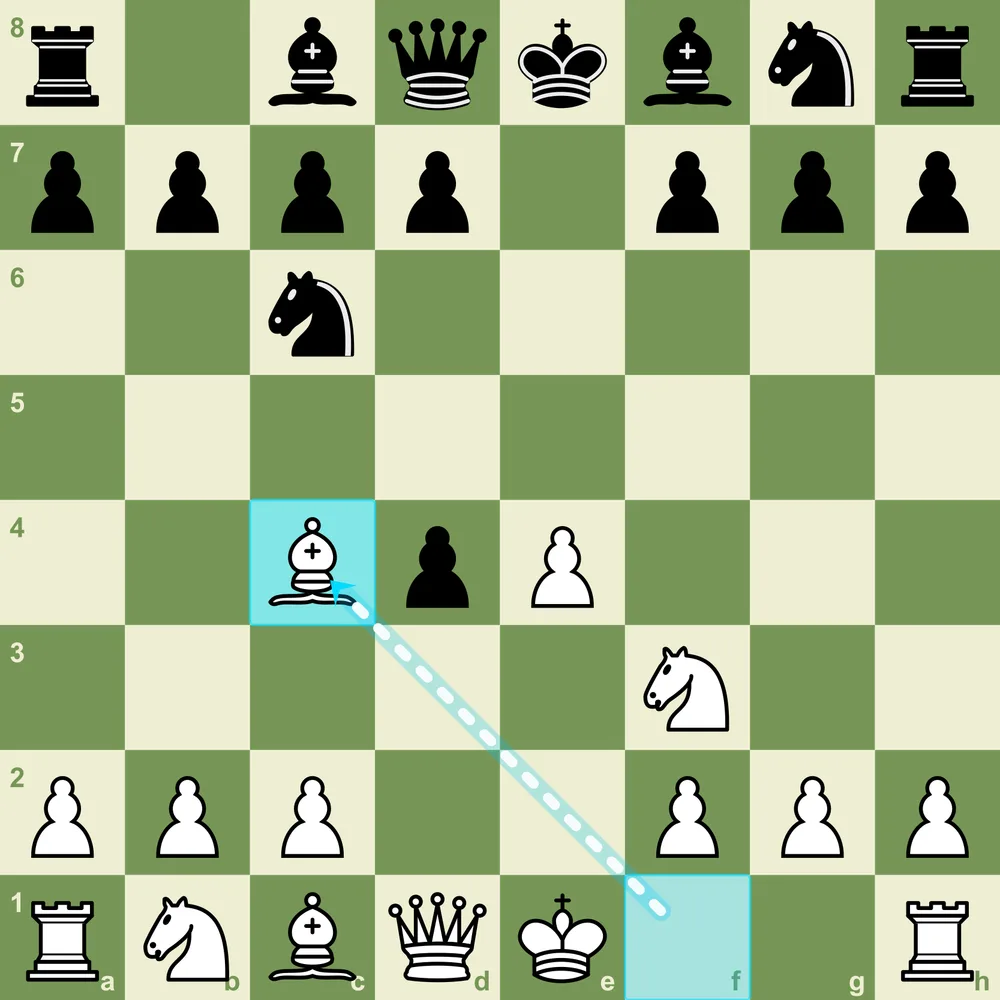
In the Scotch Gambit, White declines to recapture and instead plays 4.Bc4, developing the bishop to its most aggressive diagonal aimed straight at the f7 square. Rather than winning the d4 pawn back immediately, White prioritizes rapid development and the initiative, hoping to launch a quick attack against Black's uncastled king. It is a favorite of attacking players and a dangerous surprise weapon.
A key point is that White is not really down a pawn for long: after moves like 4...Bc5 5.c3 or 4...Nf6 5.e5, White regains the material or generates powerful pressure while staying ahead in development. The main danger for White is treating the gambit as a simple pawn grab; the correct mindset is to keep developing, castle, and open lines toward the black king. Handled correctly, the Scotch Gambit produces exactly the kind of sharp, tactical positions that reward calculation and initiative.
Famous practitioners: Morphy, Blackburne, Estrin, Nakamura
Pros and Cons of the Scotch Game
Advantages
- •Open, active positions - resolving the center with 3.d4 frees every piece and gives White the fast, natural development that fuels the initiative
- •Sidesteps Ruy Lopez theory - the Scotch avoids the enormous body of Spanish theory, letting you fight for an advantage without endless memorization
- •Clear plans - because the pawn structure is defined early, both the strategic and tactical goals are easy to understand and execute
- •Battle-tested at the top - Kasparov's revival proved the Scotch has real bite, and it remains a trusted weapon for elite grandmasters and club players alike
Disadvantages
- •Releases the tension early - by resolving the center on move three, White surrenders the slow, grinding pressure that makes the Ruy Lopez so unpleasant for Black
- •Black has sound equalizers - both 4...Bc5 and 4...Nf6 are well-mapped routes to comfortable, near-equal positions if White plays inaccurately
- •Can become symmetrical - the open structure sometimes leads to simplified, drawish endgames if White does not push for the initiative
- •Sharp main lines require precision - the Mieses Variation with 6.e5 and the gambit lines are concrete, and a single careless move can hand Black the initiative
Common Mistakes to Avoid in the Scotch Game
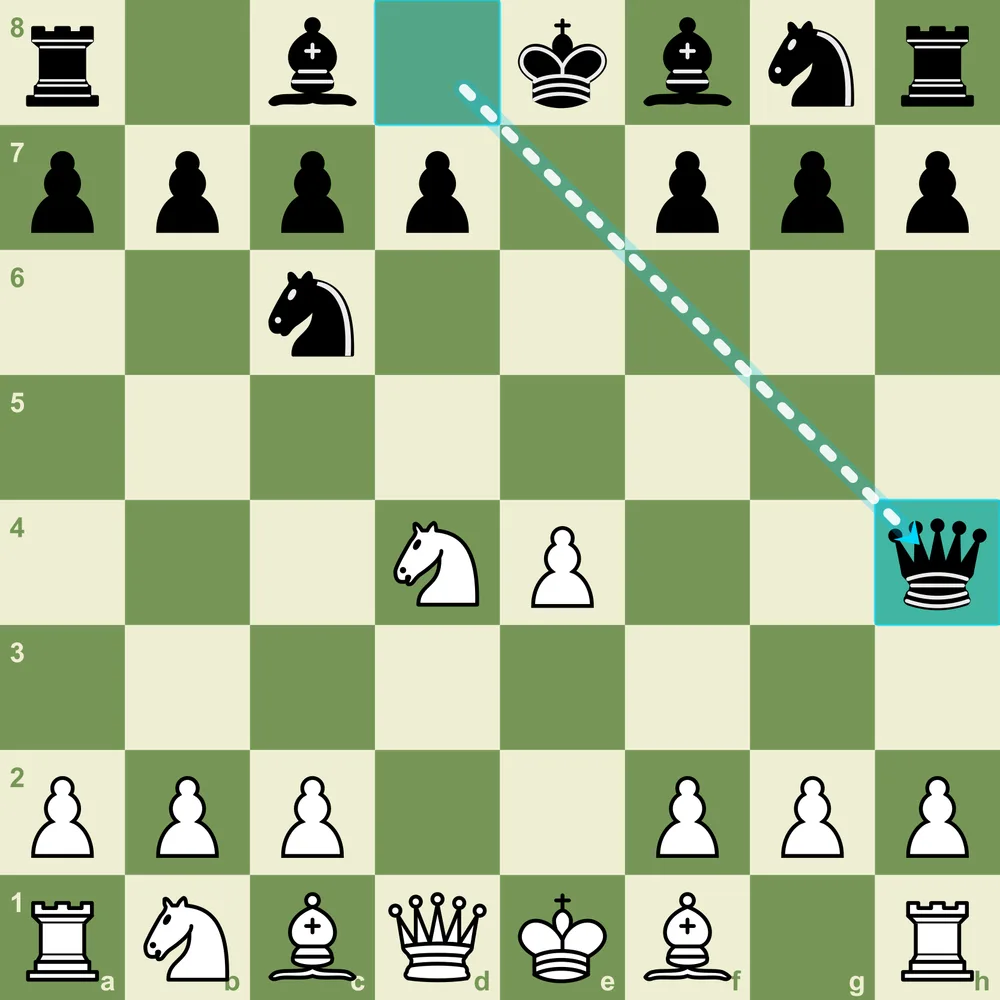
Panicking against the premature 4...Qh4
In the diagram above, Black has grabbed at the initiative with 4...Qh4, attacking the undefended e4 pawn. Many White players panic, either dropping the pawn with a passive move or lashing out with 5.Nf5, which loses time. The correct reply is the calm 5.Nc3, which develops a piece and defends e4 in one stroke. After that, the exposed queen on h4 becomes a liability: White gains tempo with moves like Be3, Qd2, and castling, ending up with a clear lead. Do not fear an early queen sortie - meet it with development.
Trading on c6 without a reason
The exchange Nxc6 doubles Black's pawns, which looks tempting, but it also hands Black the bishop pair and a half-open b-file for counterplay. Playing Nxc6 automatically, without a concrete follow-up such as e4-e5 gaining space, often helps Black more than White. Only capture on c6 when it fits a clear plan; otherwise keep the knight centralized and continue developing.
Treating the Scotch Gambit as a pawn grab
In the Scotch Gambit (4.Bc4), the whole point is the lead in development and the pressure on f7 - not the d4 pawn. Players who spend several moves clawing the pawn back instead of castling and opening lines hand Black time to consolidate and neutralize the attack. Keep developing, get the king safe, and let the initiative do the work; the material usually returns on its own.
Retreating passively after 4...Nf6 5.Nxc6 bxc6 6.e5
This is the critical moment of the Schmidt Variation - and it is a mistake for Black, not White. When White plays 6.e5 attacking the f6 knight, Black must respond with the active 6...Qe7, hitting the e5 pawn and preparing ...Nd5. Retreating the knight passively with something like 6...Ng8 or allowing it to be chased around lets White seize a lasting space advantage for free. Know this precise sequence before entering the main line.
How to Practice the Scotch Game
The Scotch rewards concrete, hands-on study. Follow these steps to make it a reliable part of your 1.e4 repertoire.
Master the main line recapture first
Start with 4.Nxd4 and learn how to handle Black's two main replies, 4...Bc5 and 4...Nf6. Understand the standard developing scheme - c3, Nc3, Be3 or Bc4, and castling - and when the Nxc6 exchange is a good idea. This foundation covers the vast majority of your Scotch games.
Memorize the Mieses Variation move order
The line 4...Nf6 5.Nxc6 bxc6 6.e5 Qe7 7.Qe2 Nd5 8.c4 Ba6 is the theoretical heart of the modern Scotch. Play through it carefully until the sequence feels natural, and understand the imbalance - White's space and central pawn versus Black's bishop pair. Getting this move order right is what separates strong Scotch players from casual ones.
Use ChessHelper to analyze your Scotch games
After each game, review the opening phase with ChessHelper's AI analysis. Did you trade on c6 at the right moment? Was there a stronger developing move or a missed tactic against f7? ChessHelper's AI-powered engine will highlight the critical turning points in your games and help you build a deeper understanding of the open positions the Scotch produces.
Study Kasparov's Scotch games
No player has done more for the Scotch than Garry Kasparov. Replay his games from the 1990 and 1995 World Championship matches to see how he generated attacking chances and handled the resulting middlegames. Pay attention to how he combined central space with piece activity to keep the initiative rolling.
Sharpen your tactics with the Scotch Gambit
Even if you play the solid 4.Nxd4 in serious games, practicing the Scotch Gambit (4.Bc4) in blitz and rapid is a fantastic way to develop your attacking instincts. It trains you to value development and initiative over material and to spot the recurring tactics against f7 - skills that pay off across your entire opening repertoire.
Master the Scotch Game with ChessHelper
Get real-time AI analysis as you practice the Scotch in your online games. Understand every open position, learn from your mistakes, and build an aggressive, reliable repertoire.
Start Practicing for FreeJoin 10,000+ chess players sharpening their openings with ChessHelper
Related Openings
If you enjoy the Scotch Game, these openings share similar themes and will complement your repertoire.
Italian Game
Another classical way to meet 1...e5. White develops the bishop to c4 and aims at f7, leading to rich, attacking middlegames.
1.e4 e5 2.Nf3 Nc6 3.Bc4
Ruy Lopez
The Scotch's great rival against 1...e5. White pressures the c6 knight with 3.Bb5, playing for slow, long-term positional pressure.
1.e4 e5 2.Nf3 Nc6 3.Bb5
Sicilian Defense
The most popular answer to 1.e4 for Black. If your opponents avoid 1...e5, you will need a plan against the sharp, dynamic Sicilian.
1.e4 c5
Scotch Game: Frequently Asked Questions
Yes, the Scotch Game is an excellent choice for beginners and improving players. By opening the center early with 3.d4, it teaches sound classical principles: rapid piece development, central control, and open lines for your pieces. Unlike the Ruy Lopez, which forces White to navigate an enormous body of theory, the Scotch relies on natural, understandable plans - recapture on d4, develop your pieces to active squares, and castle quickly. This makes it far easier to play well without heavy memorization while still fighting for the initiative.
Both the Scotch Game and the Ruy Lopez begin with 1.e4 e5 2.Nf3 Nc6 and aim to exploit White's first-move advantage, but they take opposite strategic paths. The Ruy Lopez (3.Bb5) keeps the center tension and builds slow, long-term pressure - the famous "Spanish torture." The Scotch (3.d4) resolves the center immediately, trading structural tension for open lines, faster development, and clearer plans. Players who prefer concrete, tactical positions and want to avoid the Ruy Lopez's vast theory often adopt the Scotch as a practical alternative.
Garry Kasparov brought the Scotch Game back to the elite level in the early 1990s, most notably in his World Championship matches against Anatoly Karpov and Viswanathan Anand. At the time the Scotch was considered harmless, so it served as a powerful surprise weapon that sidestepped his opponents' deep Ruy Lopez preparation. Kasparov demonstrated that lines like 4.Nxd4 Nf6 5.Nxc6 bxc6 6.e5 gave White real attacking chances and fresh, unexplored middlegames. His successes single-handedly restored the opening's reputation, and it has remained a respected part of top-level repertoires ever since.