
What is the Scandinavian Defense?
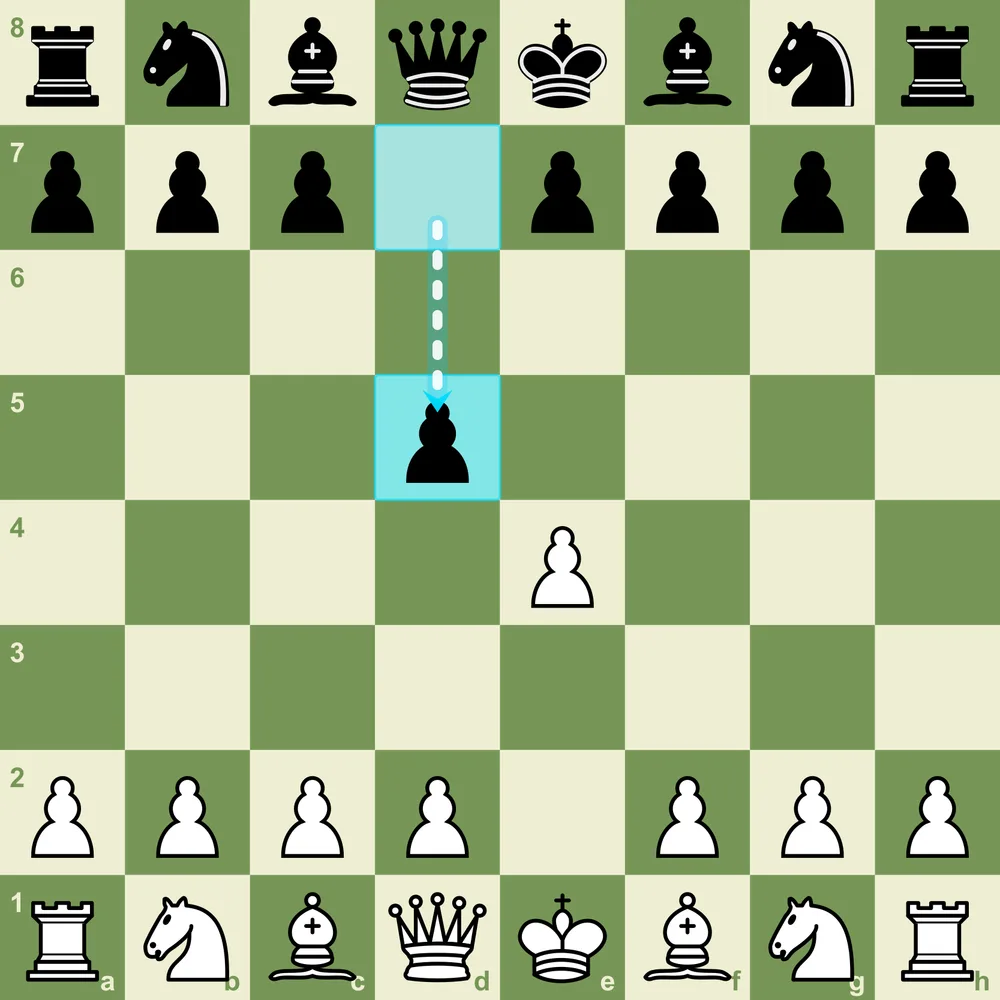
The Scandinavian Defense begins with 1.e4 d5, immediately challenging White's central pawn. Unlike most defenses to 1.e4, which prepare ...d5 with a supporting move first, the Scandinavian plays it right away. After 2.exd5, Black usually recaptures with the queen (2...Qxd5) or delays with 2...Nf6, and in both cases reaches a clear, structurally sound position.
It is one of the oldest recorded openings in chess - games with 1...d5 appear as far back as the 15th and 16th centuries, which is why it is sometimes called the Center Counter Defense. For a long time it was considered slightly dubious because Black brings the queen out early, but modern analysis and practice have thoroughly rehabilitated it. The 3...Qd6 Modern Variation in particular has made the Scandinavian a fully respectable choice at every level.
The great practical appeal of the Scandinavian is that Black essentially gets the same type of position regardless of what White does. You do not need one system against the Ruy Lopez, another against the Italian, and yet another against the King's Gambit - by meeting 1.e4 with 1...d5, you dictate the structure yourself. This makes it a superb time-saving weapon for club players who would rather understand a few plans deeply than memorize many lines.
Strong grandmasters including Magnus Carlsen (as a surprise weapon), Ian Nepomniachtchi in his youth, and specialists like Sergei Tiviakov have used the Scandinavian to good effect. It is solid, direct, and easy to learn - an excellent lifelong defense against 1.e4.
How to Play the Scandinavian Defense
The Scandinavian starts with 1.e4 d5 2.exd5. Black now chooses between the two main paths: 2...Qxd5, recapturing the pawn immediately, or 2...Nf6, delaying the recapture to gain quick piece activity. After 2...Qxd5 3.Nc3, the queen must move, and where it goes defines the variation: a5, d6, or d8.
Whichever queen square you choose, the plans are similar and easy to remember: develop the knight to f6, play ...c6 to give the queen a safe retreat and control d5, develop the light-squared bishop actively to f5 or g4 (outside the pawn chain), play ...e6, and castle. This harmonious setup gives Black a compact, resilient position with no structural weaknesses.
Strategically, Black accepts that White has a small lead in development in exchange for a healthy structure and clear piece placement. The middlegame plans revolve around solid piece play, control of the light squares, and gradually equalizing before looking for winning chances. It is a defense that rewards understanding a handful of setups rather than memorizing long forcing lines.
Main Scandinavian Defense Variations
The Scandinavian divides mainly by where Black's queen goes after 3.Nc3, plus the dynamic 2...Nf6 approach. Here are the four lines to know.
The Main Line
3...Qa5Beginner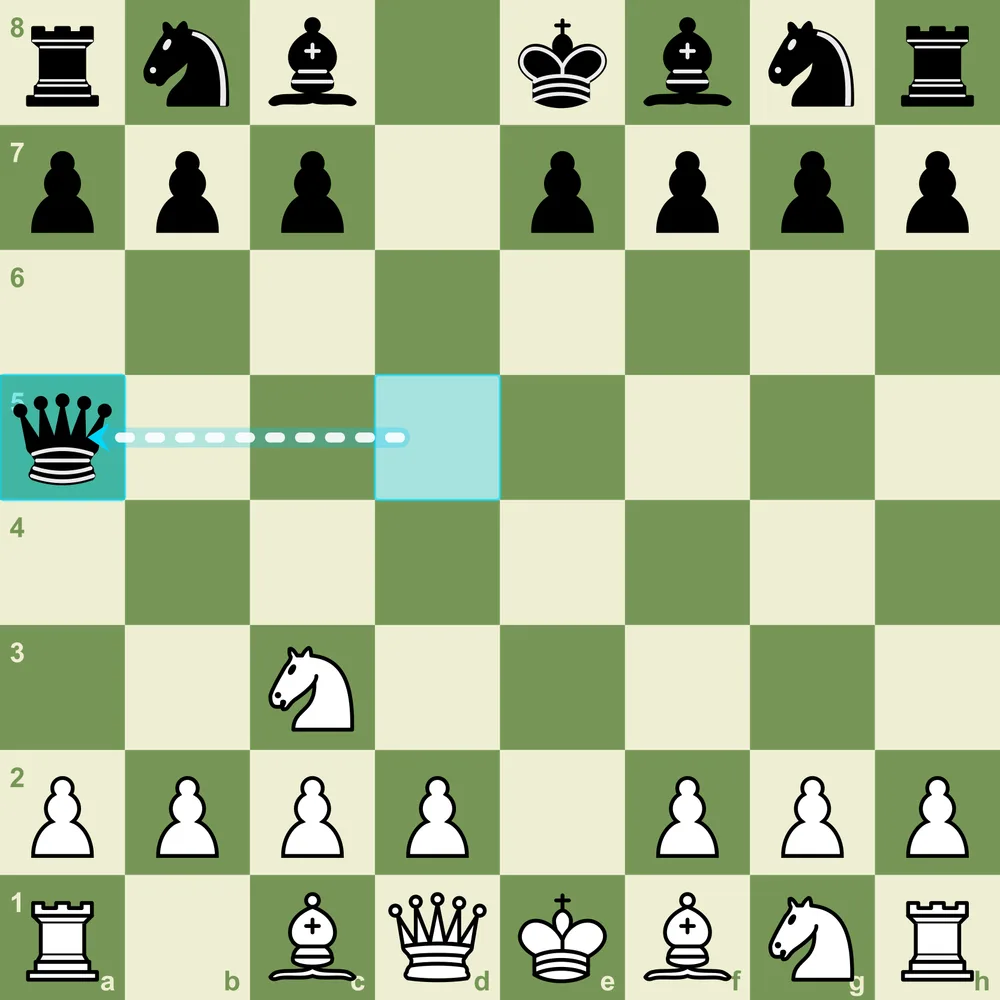
After 1.e4 d5 2.exd5 Qxd5 3.Nc3 Qa5, the queen steps to a5, where it is safe from immediate harassment and supports future queenside play. This is the traditional main line and the easiest to learn. Black continues naturally with ...Nf6, ...c6, ...Bf5 (or ...Bg4), ...e6, ...Be7, and castling kingside.
The ...c6 move is essential: it gives the a5-queen an escape square on c7, controls the important d5 square, and prepares a solid pawn shelter. Black's position is compact and hard to break down, and the light-squared bishop reaches an active post before ...e6 shuts it in. This is the ideal starting point for anyone new to the Scandinavian.
Famous practitioners: Tiviakov, Anand (occasionally), Larsen
The Modern Variation
3...Qd6Intermediate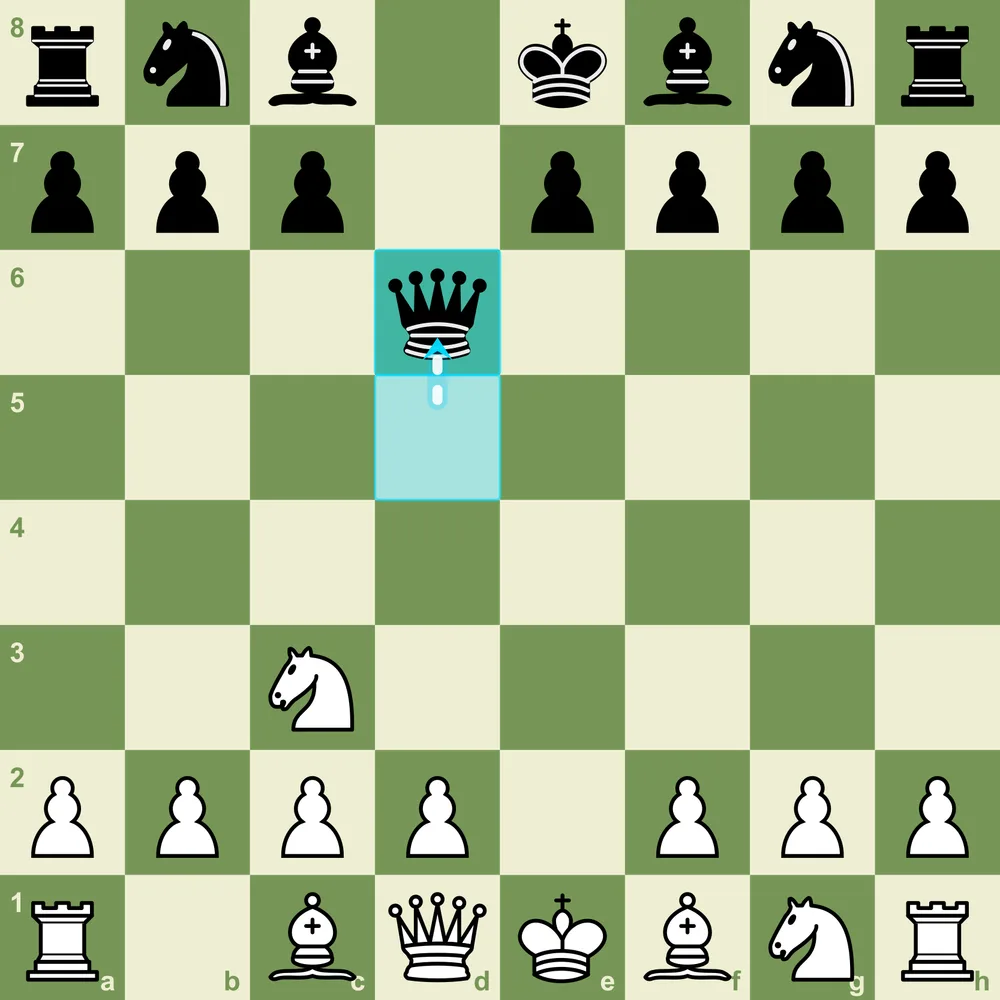
The Modern Variation with 3...Qd6 has become the most popular choice among strong players. From d6 the queen is well placed and surprisingly difficult to attack with tempo, and it keeps options open for both ...c6 setups and quick kingside development. It is the line responsible for the Scandinavian's rise in modern grandmaster practice.
A typical continuation is 4.d4 Nf6 5.Nf3 a6 (the ...a6 useful move prevents Nb5 ideas and prepares queenside expansion), followed by ...Bg4 or ...Bf5, ...e6, ...Be7 or ...g6, and castling. Black gets a solid, flexible position with clear plans and no long forced theory to memorize.
Famous practitioners: Tiviakov, Carlsen (blitz), Nepomniachtchi
The 2...Nf6 Lines
2...Nf6Intermediate-Advanced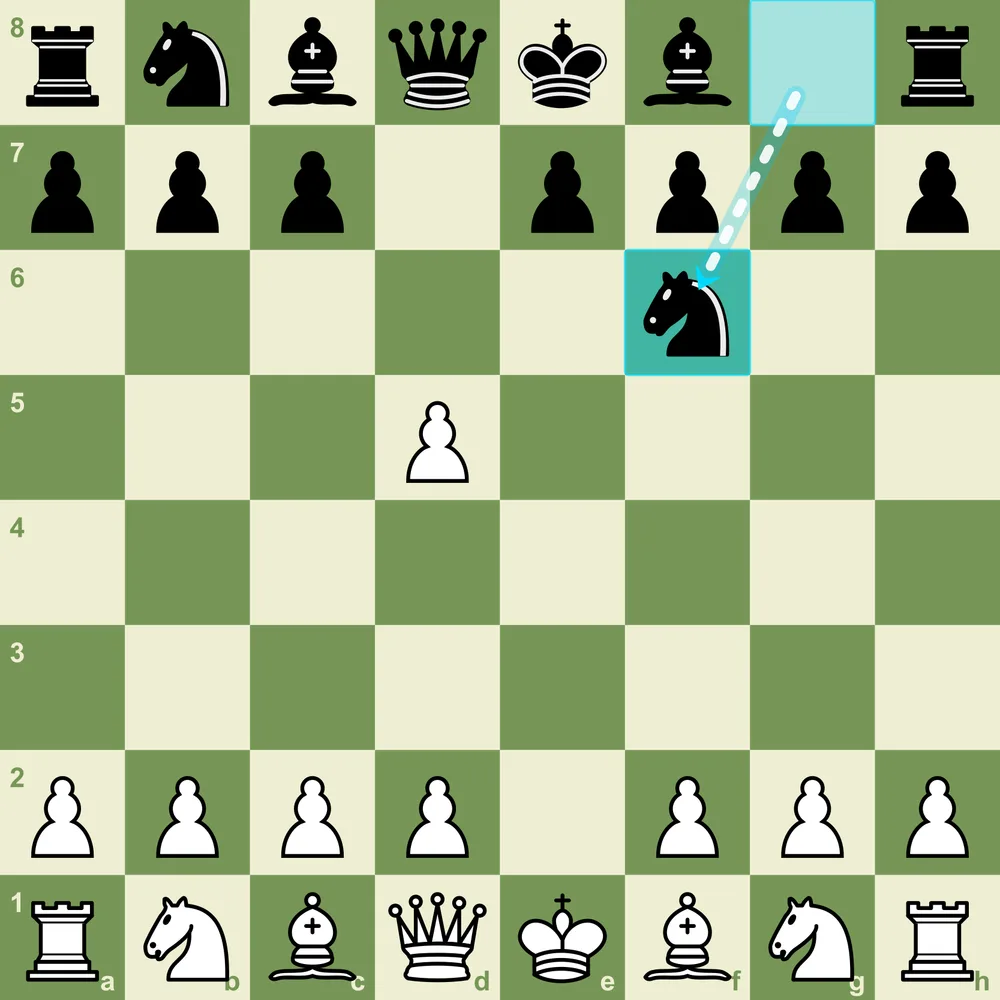
Instead of taking on d5 immediately, Black can play 2...Nf6, developing a piece and preparing to regain the pawn under better circumstances. After the greedy 3.c4, Black can strike with ...e6 or ...c6 gambit ideas (the Icelandic and Portuguese Gambits), generating rapid development and open lines for a pawn.
More commonly White plays 3.d4, when 3...Nxd5 reaches a comfortable game, or 3...Bg4 (the Portuguese) pins ideas and fights for activity. These lines are sharper and more forcing than the queen recaptures, so they suit players who enjoy dynamic, initiative-based chess. Know a little more theory here, but the reward is a very active Black position.
Famous practitioners: Portuguese & Icelandic Gambit specialists, correspondence players
The Classical Retreat
3...Qd8Beginner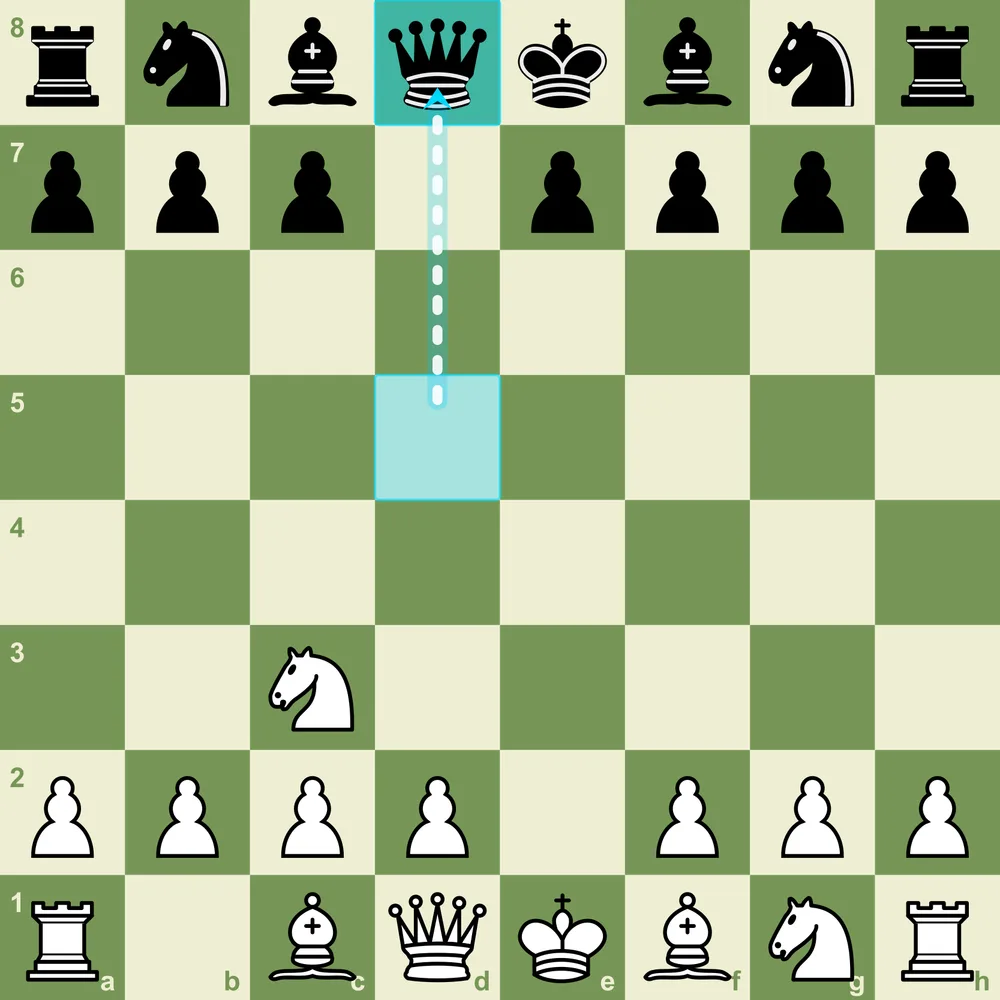
The most solid queen retreat is 3...Qd8, simply returning the queen to its starting square. Black concedes a little more time but gets an extremely sound, weakness-free position. The plan is the same reliable setup: ...Nf6, ...c6, ...Bf5 or ...Bg4, ...e6, and kingside castling.
This line has a reputation for being passive, but it is genuinely difficult to crack and works well for players who value safety above all. If you dislike having your queen chased around, 3...Qd8 gives you the calmest possible Scandinavian, and White's extra tempo rarely amounts to a concrete advantage against accurate play.
Famous practitioners: Solid positional players, club specialists
Pros and Cons of the Scandinavian Defense
Advantages
- •One setup against everything - you dictate the structure on move one, so you avoid learning separate systems against each White opening
- •Very low theory - the plans are simple and repeatable, making it one of the most practical defenses for busy players
- •Sound pawn structure - Black gets a healthy, weakness-free position with an actively placed light-squared bishop
- •Great surprise value - many 1.e4 players spend little time preparing for it, so you often reach a comfortable game quickly
Disadvantages
- •Cedes a tempo - recapturing with the queen lets White develop with gain of time, so Black starts a little behind in development
- •Can be slightly passive - especially in the 3...Qd8 lines, Black may have to defend patiently before generating counterplay
- •Less winning ambition - the Scandinavian aims first to equalize, so it offers fewer built-in winning tries than sharp defenses like the Sicilian
- •Queen safety demands care - the early queen sortie is fine only if you know the safe squares; careless moves can hand White a lasting initiative
Common Mistakes to Avoid in the Scandinavian
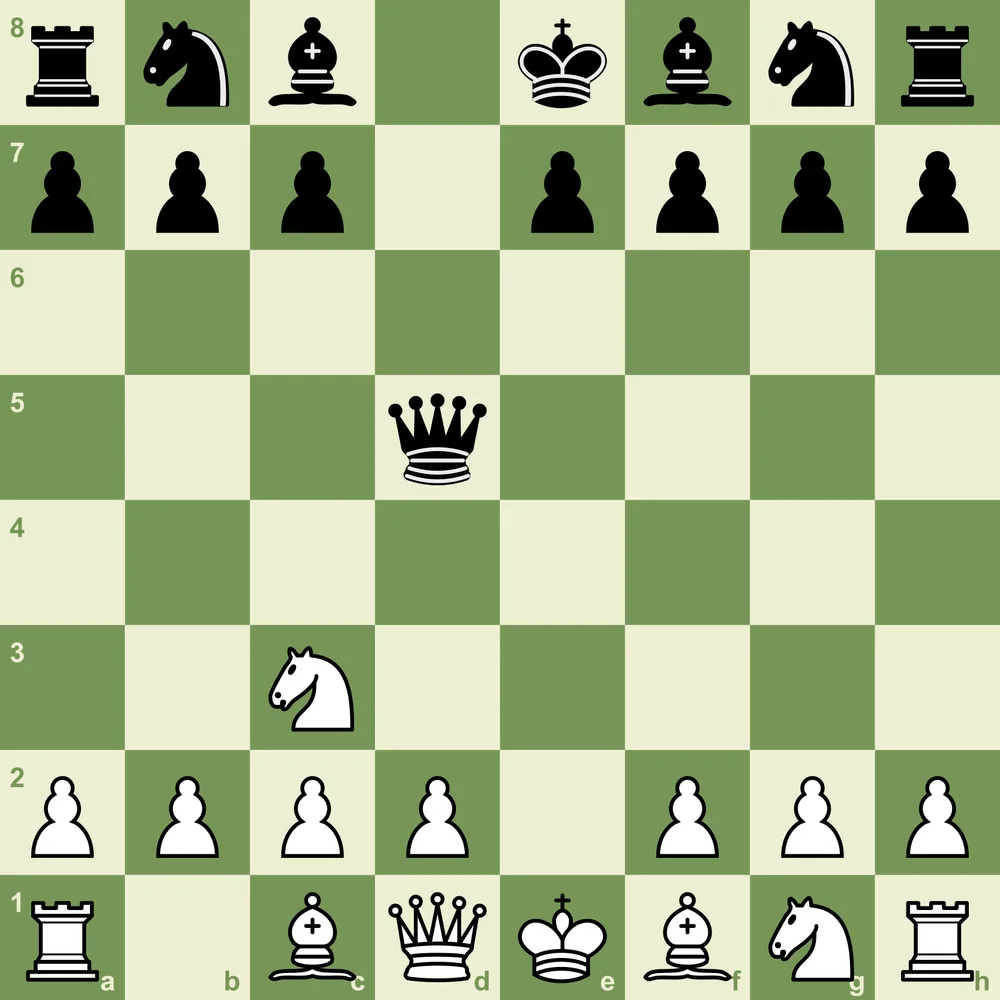
Playing an exposed ...Qe5+
After 3.Nc3, the check 3...Qe5+ looks tempting but places the queen in the center where White develops with tempo (4.Be2 followed by Nf3 hitting the queen again). Stick to the tested squares - a5, d6, or d8 - and let the queen support your solid setup rather than wandering into the open.
Forgetting ...c6
The move ...c6 is the glue of the Scandinavian: it gives the queen a safe retreat, controls d5, and shores up the structure. Players who skip it often find their queen chased and their center fragile. In almost every line, ...c6 should be high on your list of moves.
Locking in the light-squared bishop
Just like in the Caro-Kann, develop the light-squared bishop to f5 or g4 before playing ...e6. Playing ...e6 first traps the bishop behind its own pawns and gives you a passive position. Get the bishop out first, then close the structure with ...e6.
Trying to hold the pawn in the 2...Nf6 lines
In the 2...Nf6 variations, Black's compensation is activity, not material. Grimly hanging on to the d5 pawn with awkward moves surrenders the initiative that justifies the whole approach. Develop quickly, regain the pawn naturally when the moment is right, and keep your pieces active.
How to Practice the Scandinavian Defense
The Scandinavian is quick to learn and easy to practice. Follow these steps to make it a dependable part of your repertoire.
Start with the 3...Qa5 main line
Learn the classic setup first: 2...Qxd5 3.Nc3 Qa5, then ...Nf6, ...c6, ...Bf5, ...e6, ...Be7, and castle. This single plan will carry you through the majority of your games and teaches the core ideas of the whole opening.
Memorize the safe queen squares
The one thing you must know cold is where the queen belongs after 3.Nc3: a5, d6, or d8. Drill this until it is automatic, and you will never be caught off guard by White's attempts to gain time against your queen.
Use ChessHelper to analyze your Scandinavian games
After each game, review the opening with ChessHelper's AI analysis. Did you develop the bishop before ...e6? Was ...c6 played at the right moment? ChessHelper points out the critical decisions so you internalize the correct setups faster.
Explore the Modern 3...Qd6 as you improve
Once the main line feels natural, add the Modern Variation with 3...Qd6 to your repertoire. It is the current top choice and gives you a flexible, resilient queen placement that top players trust in serious games.
Play plenty of games to build pattern recognition
Because the Scandinavian reaches similar structures again and again, the fastest way to master it is simply to play it often. Each game reinforces the piece placements and middlegame plans until they become second nature.
Master the Scandinavian Defense with ChessHelper
Get real-time AI analysis as you practice the Scandinavian in your online games. Learn the safe setups, fix your mistakes, and build a rock-solid answer to 1.e4.
Start Practicing for FreeJoin 10,000+ chess players building solid opening repertoires with ChessHelper
Related Openings
If you enjoy the Scandinavian, these solid answers to 1.e4 share similar ideas and will broaden your repertoire.
Caro-Kann Defense
A close cousin of the Scandinavian. Black plays 1...c6 to support ...d5, keeping the light-squared bishop free and reaching a similarly solid structure.
1.e4 c6
French Defense
Another ...d5 answer to 1.e4. The French is more closed and strategic, with rich pawn-chain middlegames and clear plans for both sides.
1.e4 e6 2.d4 d5
Sicilian Defense
The most ambitious answer to 1.e4. If you want more winning chances than the Scandinavian offers, the Sicilian fights for the initiative from move one.
1.e4 c5
Scandinavian Defense: Frequently Asked Questions
Yes, the Scandinavian is one of the most beginner-friendly answers to 1.e4. After 1.e4 d5 2.exd5 Qxd5 3.Nc3 Qa5, Black reaches a clear, easy-to-understand setup with almost no forced theory: develop the pieces to natural squares (...Nf6, ...c6, ...Bf5 or ...Bg4, ...e6), castle, and play a solid middlegame. Because Black dictates the structure on move one, you avoid having to learn separate systems against every White try, which makes it a very practical first defense.
Normally yes, but the Scandinavian is the well-known exception. After 3.Nc3 the queen retreats to a5, d6, or d8, and while White does gain a tempo attacking it, Black gets a rock-solid pawn structure and easy development in return. The key is to know the safe squares: on a5 the queen supports queenside play, on d6 it stays flexible and modern, and on d8 it simply steps back to safety. Just avoid greedy or exposed queen moves like an early ...Qe5+.
Both are sound. 2...Qxd5 is the classical main line: you regain the pawn immediately and aim for a solid, structured game. 2...Nf6 is more dynamic - Black delays recapturing the d5 pawn, often regaining it later with pieces and creating quick, active play (the Modern or Portuguese approach). If you like clear, calm positions, choose 2...Qxd5; if you enjoy gambit-style initiative and piece activity, try 2...Nf6.