
What is the King's Gambit?
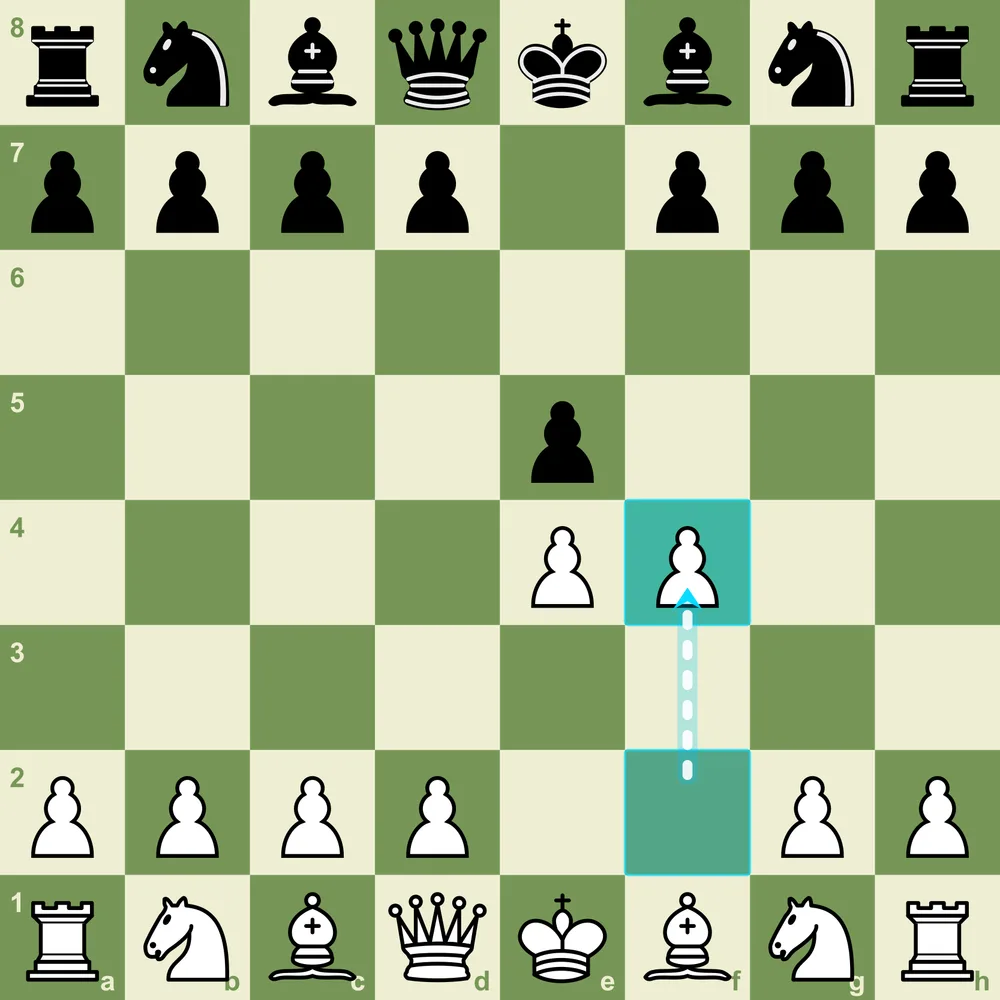
The King's Gambit begins with the moves 1.e4 e5 2.f4 and is the most famous of all the romantic-era gambits. White's idea is bold and direct: offer the f-pawn to lure Black's e5 pawn away from the center, then follow up with rapid development, a big pawn front with d4, and a devastating attack down the newly opened f-file. In return for the material, White gains time, space, and open lines pointed straight at Black's king.
Dating back to the 16th century and analyzed by masters such as Ruy Lopez de Segura and Giulio Cesare Polerio, the King's Gambit was the dominant opening of the 19th century. Legendary attackers including Paul Morphy, Adolf Anderssen, and Wilhelm Steinitz used it to produce some of the most celebrated brilliancies in chess history - the "Immortal Game" of 1851 sprang from exactly this opening. For generations, mastering the King's Gambit was considered a rite of passage for any ambitious attacking player.
The trade-off is clear and unforgiving. By advancing the f-pawn, White voluntarily weakens the king's position and the a7-g1 diagonal, so if the attack fizzles out, Black's extra pawn and superior structure can become decisive. This is what gives the King's Gambit its double-edged, high-risk reputation: White is not playing for a small edge but for a knockout, and every game becomes a battle between attack and defense from the very first moves.
In the modern era the King's Gambit is rare at the very top, where deep engine preparation has sharpened Black's defenses, but it remains a fearsome and fully playable surprise weapon at club, online, and blitz level. Players such as Boris Spassky famously used it to beat Bobby Fischer, and it continues to reward those who study its rich tactical patterns. Few openings teach the principles of initiative, development, and attack as vividly as the King's Gambit.
How to Play the King's Gambit
The King's Gambit begins with 1.e4 e5 2.f4. The point of 2.f4 is to attack the e5 pawn and offer a trade that, if accepted, removes Black's central pawn and opens the f-file for White's rook after castling. White is not simply throwing away a pawn - the gambit is a concrete investment in development speed, central control with a future d4, and direct attacking chances against f7 and the black king.
Black's replies fall into three broad families. The main line is to accept with 2...exf4 (the King's Gambit Accepted), grabbing the pawn and forcing White to demonstrate compensation. Black can decline with the solid 2...Bc5 (the Classical Declined), developing actively and targeting the weakened f2 square while refusing to open the center. The most combative alternative is the counter-strike 2...d5 (the Falkbeer Counter-Gambit), where Black returns the gambit spirit and fights for the initiative rather than clinging to material.
Whatever Black chooses, White's strategic recipe stays consistent: develop the king's knight to f3 (which also prevents the annoying ...Qh4+ check), build the center with d4, fianchetto or develop the bishop actively, castle kingside quickly, and then use the open f-file and the initiative to hunt the black king. The King's Gambit is an opening of energy and precision - every tempo counts, and passive play by either side is punished severely.
Main King's Gambit Variations
The King's Gambit branches immediately depending on how Black meets 2.f4. Here are the four systems every King's Gambit player must understand.
King's Gambit Accepted
2...exf4Advanced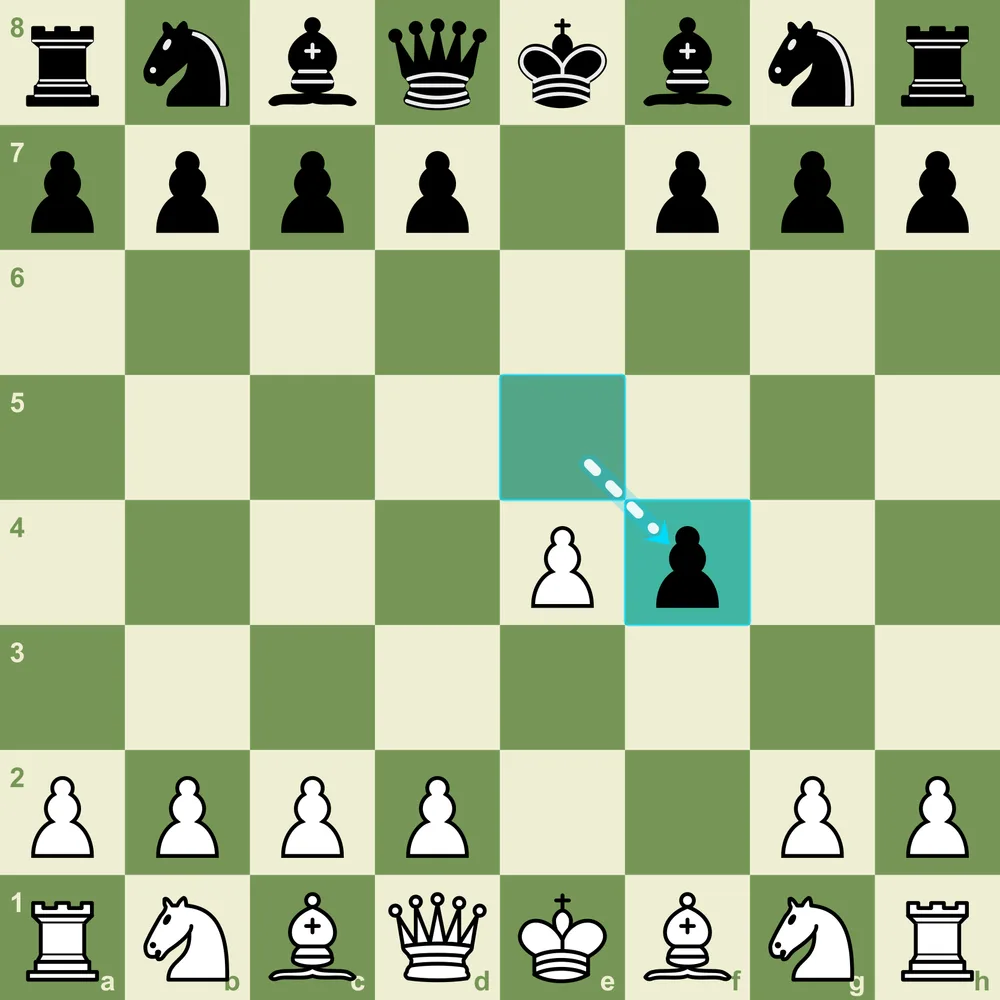
The King's Gambit Accepted is the main line and the most principled reply. After 2...exf4, Black takes the offered pawn and challenges White to justify the sacrifice. White has now removed Black's central pawn and can build a broad center with d4, but the pawn on f4 is a real asset for Black - if White cannot recover it or generate a strong attack, the extra material tells in the endgame.
White's standard follow-up is 3.Nf3, developing and stopping ...Qh4+, after which the game splits into rich sub-variations. The most famous is the Kieseritzky Gambit (3...g5 4.h4 g4 5.Ne5), where White accepts great complications for the attack. Other important tries include the Bishop's Gambit (3.Bc4) and the Muzio Gambit, where White even sacrifices a piece for a raging initiative. These lines are among the sharpest in all of chess and reward deep tactical preparation.
Famous practitioners: Anderssen, Morphy, Spassky, Bronstein
King's Gambit Declined
2...Bc5Intermediate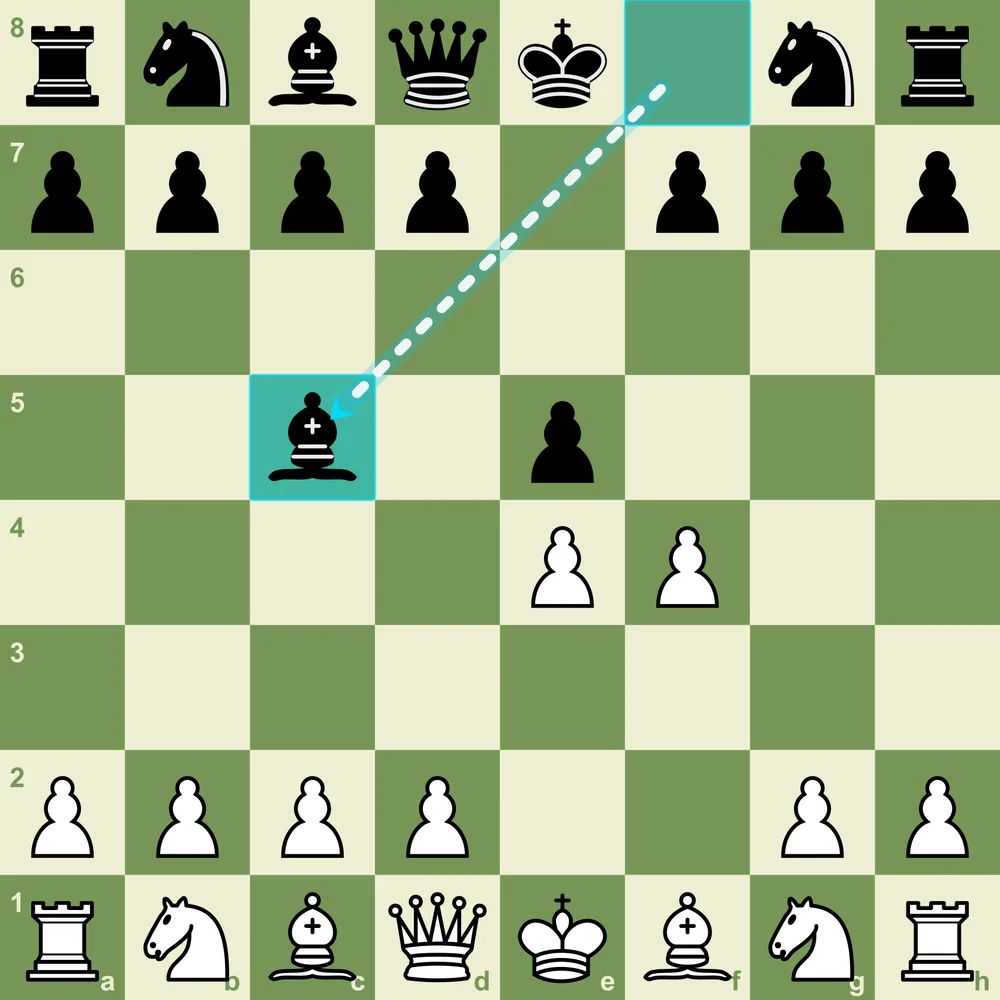
In the Classical Declined, Black sidesteps the sharpest theory with 2...Bc5, developing the bishop to its most natural and aggressive square. The bishop takes aim at the f2 pawn and the a7-g1 diagonal, exploiting exactly the weakness that 2.f4 created. Crucially, this move prevents White from castling comfortably and takes the sting out of the gambit by keeping the center closed rather than opening it on White's terms.
A key point is that White should avoid the greedy 3.fxe5??, which walks into 3...Qh4+ 4.g3 Qxe4+, winning material. Instead White typically continues 3.Nf3 and develops soundly, accepting that the position is now a more strategic struggle than a wild gambit. The Declined is an excellent practical choice for Black: it is far less theoretical than the Accepted, keeps the position solid, and still leaves White with a slightly loosened kingside to worry about.
Famous practitioners: Steinitz, Keres, Carlsen, Nakamura
The Falkbeer Counter-Gambit
2...d5Advanced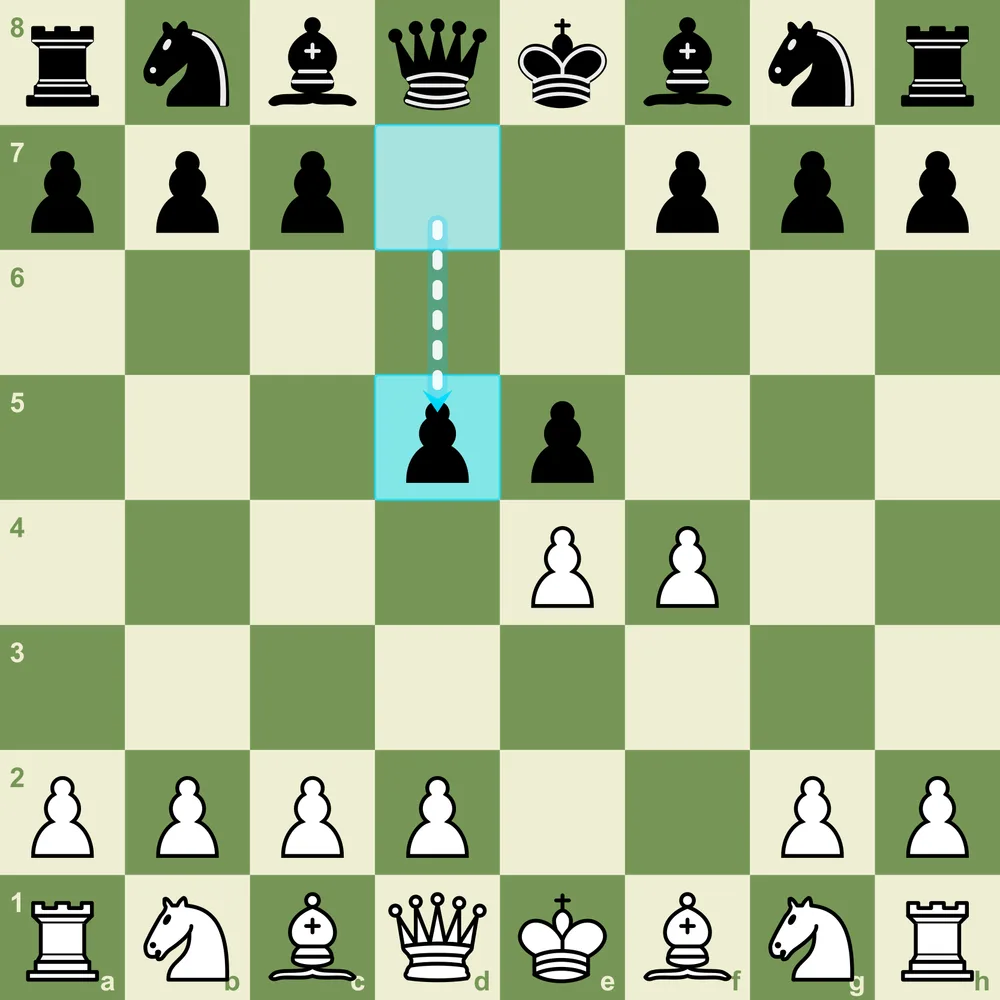
Named after the Austrian master Ernst Falkbeer, the Counter-Gambit answers White's aggression with aggression: 2...d5. Rather than defending the extra pawn after accepting, Black immediately hits the e4 pawn and blows the center open. After 3.exd5 e4, Black gains a strong, cramping pawn on e4 that restricts White's development and, in particular, blunts the natural Nf3 square. Black returns the gambit pawn to seize the initiative.
The modern main line often continues 3.exd5 e4 4.d3, when White challenges the advanced e4 pawn and the resulting positions become extremely concrete. Black plays for rapid development and pressure against White's slightly awkward setup, while White aims to consolidate the extra structure and untangle. The Falkbeer flips the usual King's Gambit dynamic on its head - here it is Black who is often the attacker - and it is a favorite of players who refuse to be put on the defensive.
Famous practitioners: Falkbeer, Nimzowitsch, Spielmann, Rubinstein
The King's Knight Gambit
3.Nf3Advanced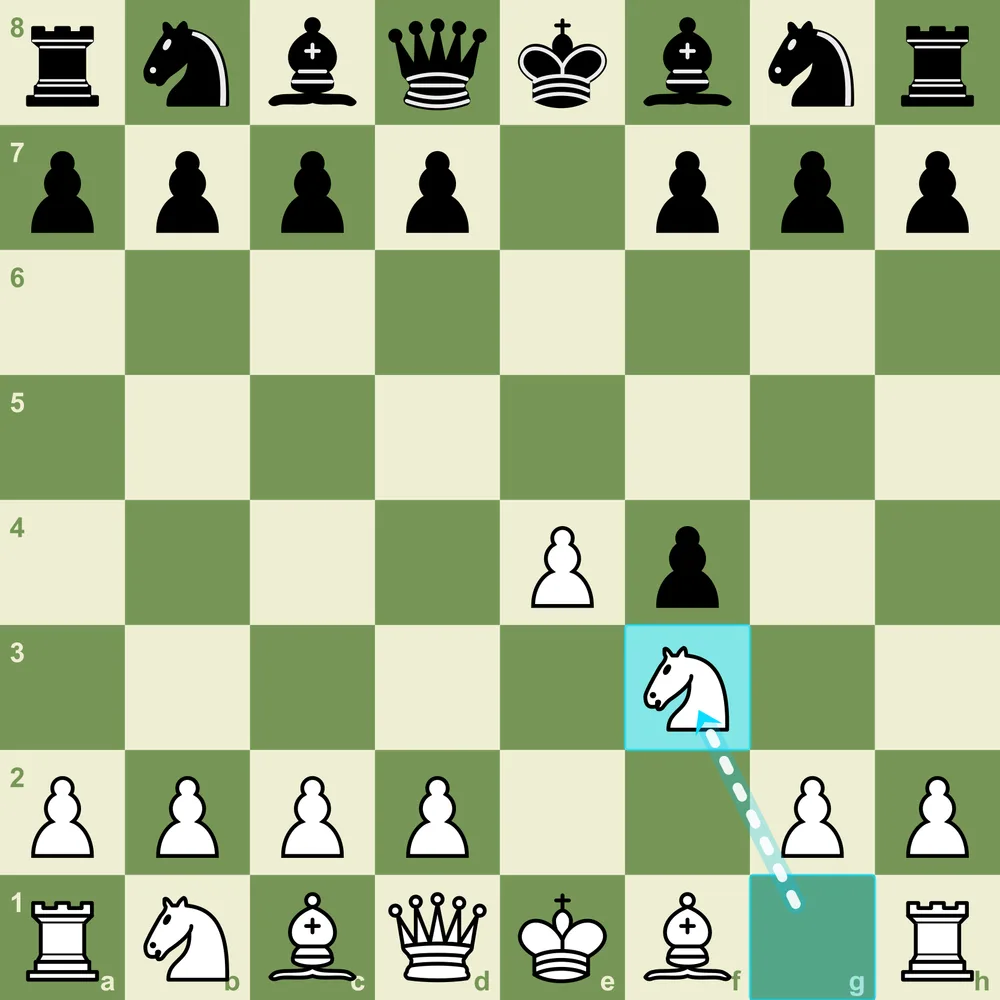
After 2...exf4, the overwhelmingly most popular continuation is 3.Nf3, known as the King's Knight Gambit. This natural developing move does three jobs at once: it brings a piece toward the center, it prepares kingside castling and the use of the f-file, and above all it prevents the disruptive check 3...Qh4+, which would otherwise force the ugly 3.g3 or 3.Ke2 in other move orders.
From here the great classical battlegrounds appear. Black's most testing reply is 3...g5, grabbing space and bracing to hold the f4 pawn with the pawn chain, leading to the razor-sharp Kieseritzky and Allgaier gambits. Quieter, fully sound options for Black include 3...d5 (the Modern Defense, returning the pawn for easy development) and 3...Nf6, hitting e4. The King's Knight Gambit is the true heart of the opening and the position from which most King's Gambit theory flows.
Famous practitioners: Kieseritzky, Chigorin, Spassky, Fischer
Pros and Cons of the King's Gambit
Advantages
- •Powerful initiative - the pawn sacrifice buys development speed, open lines, and an immediate attack that puts Black under pressure from move two
- •Devastating surprise value - many opponents rarely face it and can go wrong quickly, making it a superb practical weapon in rapid, blitz, and club play
- •Open f-file attack - after castling, White's rook bears down the f-file toward f7, the weakest square in Black's camp
- •Trains your tactics - few openings sharpen calculation, sacrifice, and attacking technique as effectively as the King's Gambit
Disadvantages
- •Weakens White's king - advancing the f-pawn opens the a7-g1 diagonal and exposes the king, so a failed attack often leaves White simply worse
- •Material deficit if it stalls - if White does not generate concrete threats, Black's extra pawn and healthier structure can decide the endgame
- •Heavy theory in the sharp lines - the Kieseritzky, Muzio, and Bishop's Gambit require precise memorization where one slip can be fatal
- •Objectively risky at the top - with best engine-checked defense the gambit is only equal at most, which is why it is rare in elite classical play
Common Mistakes to Avoid in the King's Gambit
Capturing on e5 too early and allowing ...Qh4+
In the Declined lines after 2...Bc5, the natural-looking 3.fxe5?? is a serious blunder because of 3...Qh4+ 4.g3 Qxe4+, forking the king and the loose e5 pawn and leaving White's position in ruins. Because 2.f4 opens the e8-h5 diagonal toward White's king, always account for the ...Qh4+ resource before grabbing pawns. Playing 3.Nf3 first, controlling h4, is the safe and standard approach.
Grimly hanging on to the f4 pawn as Black
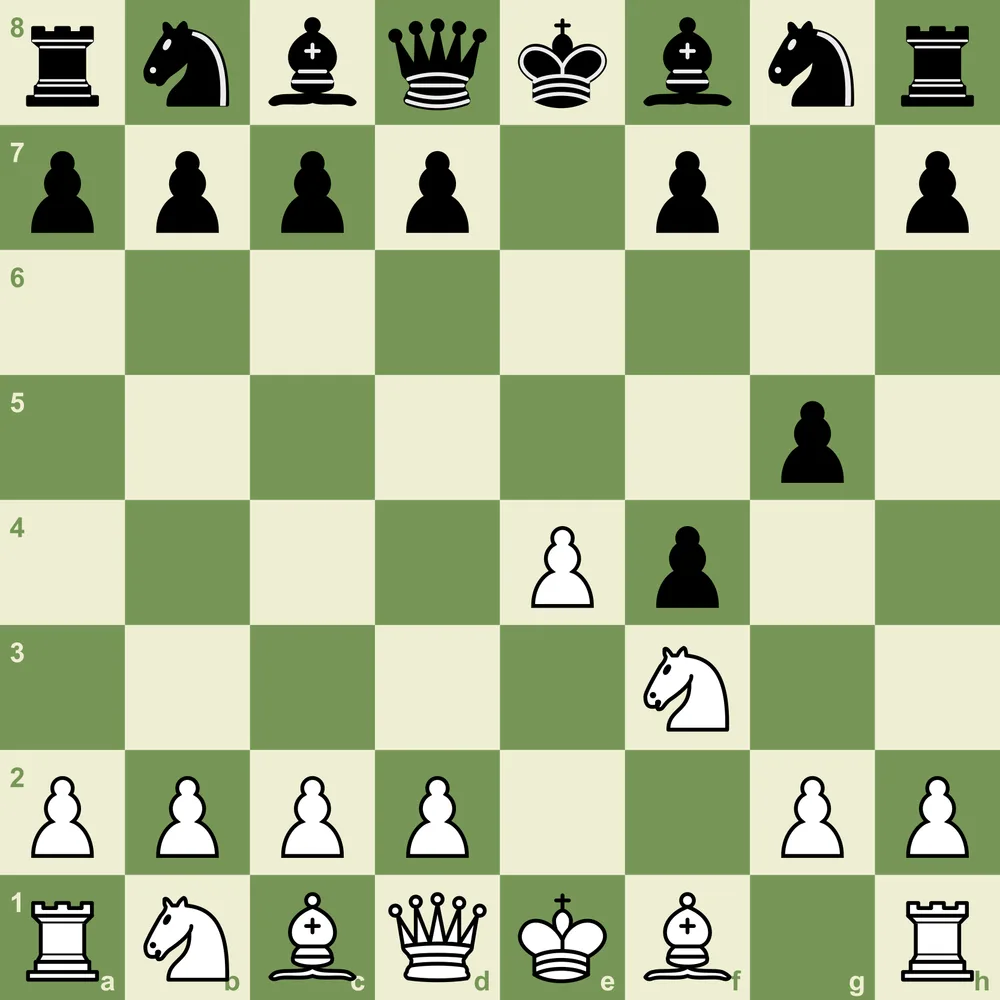
After 3.Nf3 g5, shown above, Black tries to hold the extra pawn with the pawn chain, but overextending the kingside is double-edged. If Black spends too many moves defending f4 with ...g5 and ...h6 while neglecting development, White breaks through with h4, Nc3, d4, and Bxf4 or a piece sacrifice on g5, and the loosened black kingside becomes a target. The pawn is often worth returning for safe, quick development.
Playing the gambit passively as White
The King's Gambit is an investment that only pays off through energetic, forcing play. White who develops slowly, delays castling, or fails to strike with d4 and open the center simply ends up a pawn down with a weakened king. If you choose this opening, commit to the attack: mobilize every piece toward the black king and keep the initiative at all costs, because passivity turns the gambit into a positional liability.
Underestimating the Falkbeer Counter-Gambit
Many King's Gambit players prepare only against 2...exf4 and are caught off guard by 2...d5. Reflexively grabbing with 3.fxe5?? here again invites ...Qh4+, and clumsy handling of the resulting positions can leave White facing a strong e4 pawn and a lasting initiative for Black. Study the correct 3.exd5 e4 4.d3 structures in advance so the counter-gambit does not turn your intended attack into a defensive struggle.
How to Practice the King's Gambit
The King's Gambit rewards bold, tactical preparation. Follow these steps to turn it into a genuine attacking weapon in your repertoire.
Start with the King's Knight Gambit (3.Nf3)
Anchor your repertoire on 2...exf4 3.Nf3, the soundest and most flexible setup. Learn why 3.Nf3 stops ...Qh4+ and prepares castling, and get comfortable with the main black replies 3...g5, 3...d5, and 3...Nf6. Mastering this backbone means you will always have a reliable plan against the most common line before you ever wade into the wildest gambits.
Prepare for the Declined and the Falkbeer
You will not always get the Accepted, so study the Classical Declined (2...Bc5) and the Falkbeer Counter-Gambit (2...d5) in equal measure. Learn the critical rule that 3.fxe5 is a mistake against both because of ...Qh4+, and memorize the correct responses - sound development against 2...Bc5 and the 3.exd5 e4 4.d3 structure against the Falkbeer. This closes the gaps opponents most often exploit.
Use ChessHelper to analyze your King's Gambit games
After each game, review the opening and early middlegame with ChessHelper's AI analysis. Did your attack have a concrete follow-up, or did you drift into a lost pawn ending? Was there a stronger sacrifice you missed? ChessHelper's AI-powered engine pinpoints the critical attacking and defensive moments in your games, helping you learn exactly when to press and when to consolidate.
Study the classic attacking masterpieces
No opening has a richer library of brilliancies. Replay Anderssen's Immortal Game, the great Muzio and Kieseritzky attacks, and Boris Spassky's famous King's Gambit wins - including his celebrated victory over Bobby Fischer. Absorbing these games trains your eye for the recurring sacrificial patterns on f7, g5, and the open f-file that define successful King's Gambit play.
Sharpen it in blitz, then trust it in longer games
Blitz and rapid games are the perfect laboratory for the King's Gambit: you can test many attacking lines quickly and build pattern recognition for the typical sacrifices. Once the ideas feel natural, bring the opening into slower time controls where you have time to calculate the forcing lines accurately. This two-speed approach builds both intuition and precision - the twin skills the gambit demands.
Master the King's Gambit with ChessHelper
Get real-time AI analysis as you launch the King's Gambit in your online games. Find the sharpest attacks, learn from every sacrifice, and build a fearless attacking repertoire.
Start Practicing for FreeJoin 10,000+ chess players building sharper opening repertoires with ChessHelper
Related Openings
If you enjoy the King's Gambit, these 1.e4 e5 openings share similar attacking themes and will complement your repertoire.
Italian Game
A classical 1.e4 e5 opening that develops the bishop to c4 and eyes the f7 square. It offers attacking chances in the Fried Liver and Evans Gambit while remaining sound.
1.e4 e5 2.Nf3 Nc6 3.Bc4
Ruy Lopez
The most respected 1.e4 e5 opening, pressuring the knight that defends e5. It blends deep strategy with lasting pressure and is a mainstay at every level.
1.e4 e5 2.Nf3 Nc6 3.Bb5
Scandinavian Defense
Prefer to be the one striking early? The Scandinavian answers 1.e4 with an immediate central challenge, leading to sharp, forcing play with the black pieces.
1.e4 d5
King's Gambit: Frequently Asked Questions
The King's Gambit is a fantastic teaching opening, but it is not a low-risk one. By offering the f-pawn on move two, White immediately opens lines and creates the kind of sharp, tactical positions where quick development, king safety, and calculation decide the game. Beginners who play it will sharpen their attacking instincts and learn to punish loose defense, but they must accept that a single inaccuracy can rebound quickly because White has weakened the king's position. It is best learned by players who want to embrace tactics rather than avoid them.
At elite level the King's Gambit is considered playable but slightly dubious with best defense, which is why it is rare in top grandmaster practice today. Modern engines have found accurate defensive resources for Black, particularly in the Falkbeer Counter-Gambit and certain lines of the Accepted. That said, the opening is far from refuted: it retains enormous practical value, scores well at club and blitz level, and has been used as a surprise weapon even by world-class players. Its reputation as unsound is overstated for anyone below master strength.
Both approaches are fully respectable. Accepting with 2...exf4 is the most testing and principled reply - Black grabs the pawn and dares White to prove the compensation, leading to the sharpest theory. Declining with 2...Bc5 is a solid, practical choice: Black develops actively, eyes the sensitive f2 square, and refuses to open the position on White's terms. The Falkbeer Counter-Gambit (2...d5) is the most aggressive answer, immediately counter-striking in the center rather than defending. The right choice depends on your style and how much sharp theory you want to study.