
What is the Vienna Game?
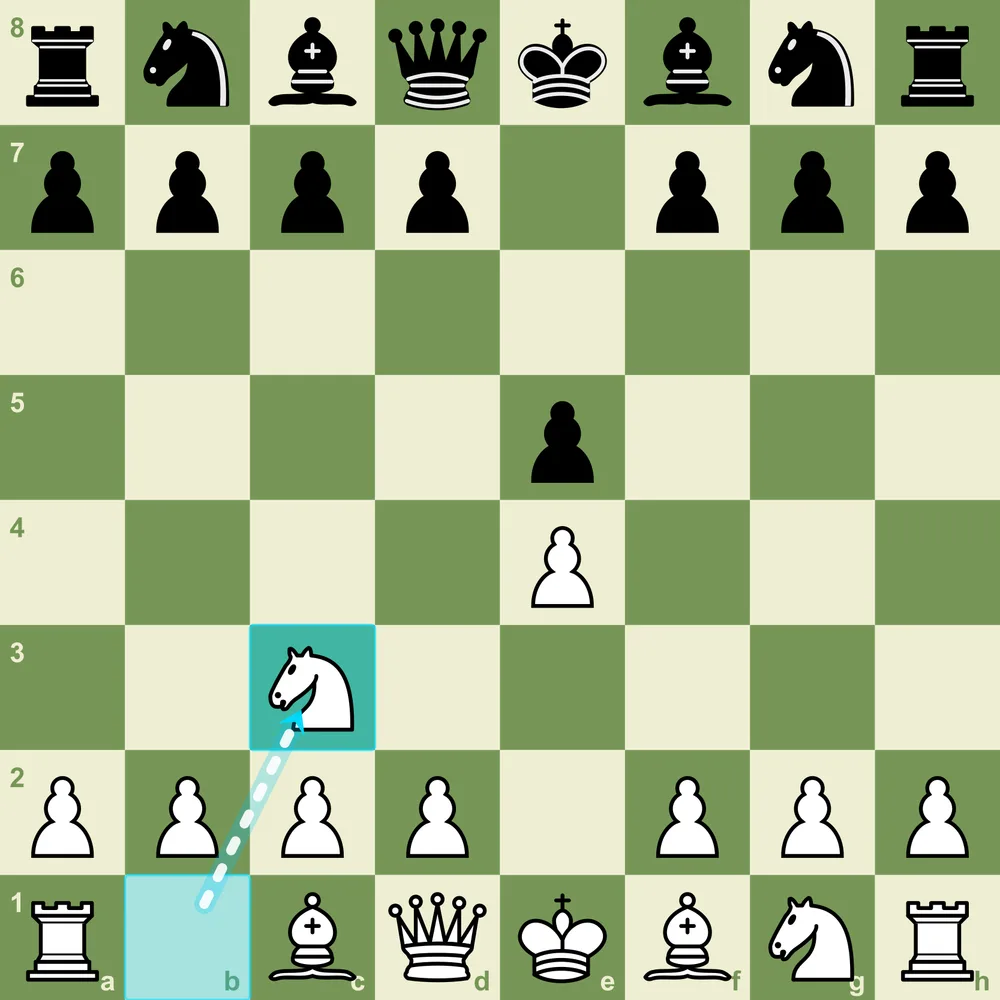
The Vienna Game begins with the moves 1.e4 e5 2.Nc3 and is one of the oldest and most flexible open games in chess. The point of 2.Nc3 is subtle but important: White develops a piece toward the center and reinforces control of the d5 and e4 squares, all while deliberately keeping the f-pawn free. Unlike 2.Nf3, which blocks the f-pawn and steers the game into the Italian, Ruy Lopez, or Scotch, the Vienna preserves the possibility of the thematic f2-f4 thrust - the same attacking dream that powers the King's Gambit, but with a developing move played first.
The opening takes its name from the group of 19th-century Viennese masters who championed it, most notably Carl Hamppe. It was later refined and popularized by the first World Champion, Wilhelm Steinitz, and the great attacking players Rudolf Spielmann and Jacques Mieses, who used the gambit lines to devastating effect. Because it sidesteps the enormous bodies of theory attached to the Ruy Lopez and the Italian, the Vienna has always appealed to players looking for a sound but less-charted battleground.
Compared with the King's Gambit (1.e4 e5 2.f4), the Vienna is considered the more restrained and positionally justified way to pursue the same idea. By inserting 2.Nc3 before f4, White avoids the immediate loosening of the kingside and keeps the knight actively placed on a natural square. The Vienna also shares a great deal of ground with the Bishop's Opening (1.e4 e5 2.Bc4): after a later Nc3 or Bc4, the two openings frequently transpose into one another, giving White a rich web of move orders to steer the game toward familiar structures.
In modern practice the Vienna is prized as a practical surprise weapon. The quiet fianchetto systems with g3 and Bg2 produce strategically rich middlegames, while the Vienna Gambit generates ferocious attacking chances that unprepared opponents rarely survive. Grandmasters such as Nigel Short have wheeled it out to sidestep an opponent's preparation, and it remains a favorite of ambitious club players who want to fight for the initiative from move two.
How to Play the Vienna Game
The Vienna begins with 1.e4 e5 2.Nc3. This developing move quietly declares White's intentions: control the center, prepare rapid development, and keep the f-pawn available for a later strike. The knight on c3 already presses against d5, so if Black is careless about the center, White can seize space and open lines with tempo.
After the most common reply, 2...Nf6, White chooses between three main plans. The aggressive route is the Vienna Gambit, 3.f4, blasting open the center and the f-file. The classical route is 3.Bc4, aiming the bishop at the sensitive f7 square and inviting sharp tactics. The positional route is 3.g3 followed by Bg2, a patient buildup that pressures d5 and the long diagonal. Against the alternative 2...Nc6, White can meet it with the same ideas - 3.Bc4 and 3.g3 being the most popular.
The strategic philosophy of the Vienna is flexibility. White decides, based on the opponent and the mood of the game, whether to launch a direct kingside attack or to grind out a slow positional advantage. What ties every line together is the fight for the center and the ever-present threat of f2-f4. Learn to recognize when the position calls for the gambit and when it calls for restraint, and the Vienna becomes a complete, lifelong repertoire against 1...e5.
Main Vienna Game Variations
The Vienna branches into several distinct systems that range from calm and positional to razor-sharp. Here are the variations every Vienna player must know.
The 2...Nf6 Main Reply
2...Nf6Intermediate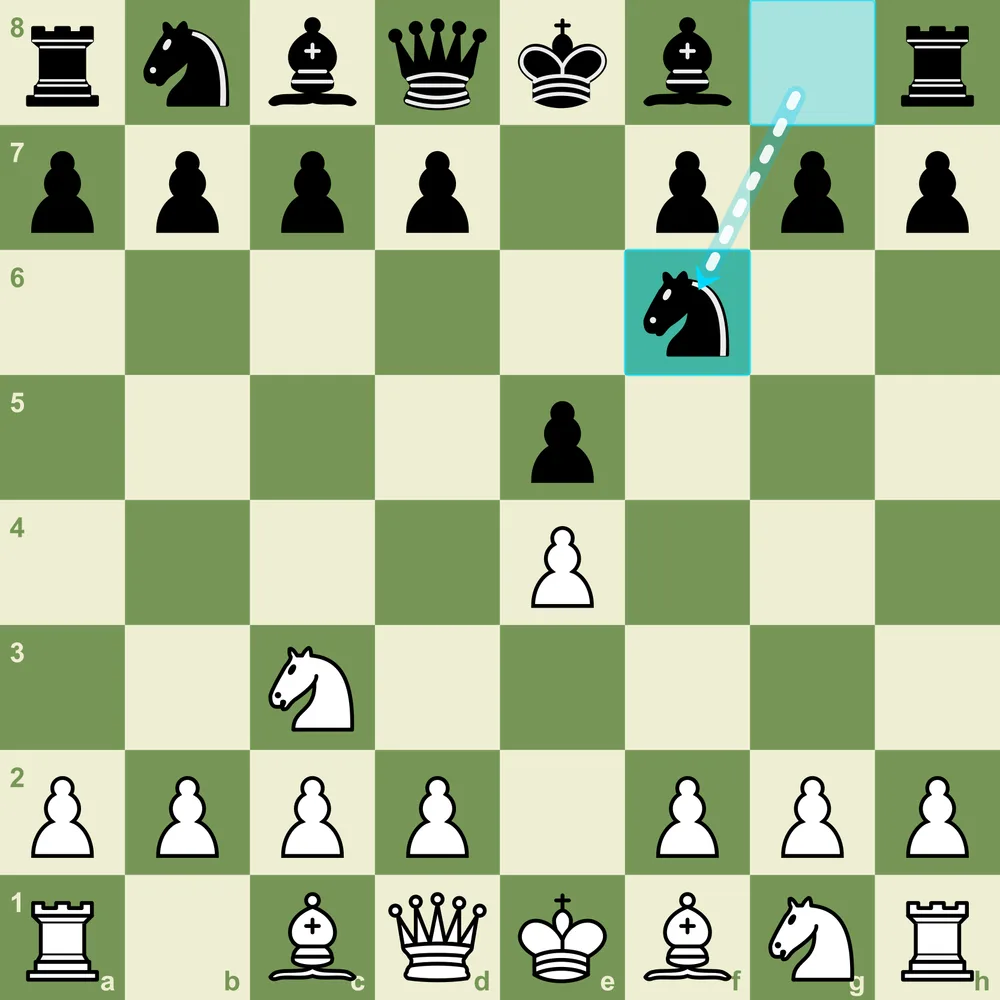
By far the most popular and best-regarded answer to the Vienna is 2...Nf6. Black mirrors White's development, puts a piece on its most natural square, and - crucially - attacks the e4 pawn, forcing White to make a concrete decision about the center right away. This is the position from which all of the Vienna's most important variations spring.
White's three principal tries are 3.f4 (the Vienna Gambit), 3.Bc4 (the aggressive Bishop's line), and 3.g3 (the positional fianchetto). The move 3.g3, sometimes called the Paulsen Variation, defends e4 indirectly and prepares Bg2, after which White presses on the long diagonal and often follows up with a later f4. Whatever White chooses, Black must be ready to fight for the center immediately, since a passive response allows White to build an ideal pawn duo with d4 and f4.
Famous practitioners: Steinitz, Spielmann, Short, Nakamura
The Vienna Gambit
3.f4Intermediate-Advanced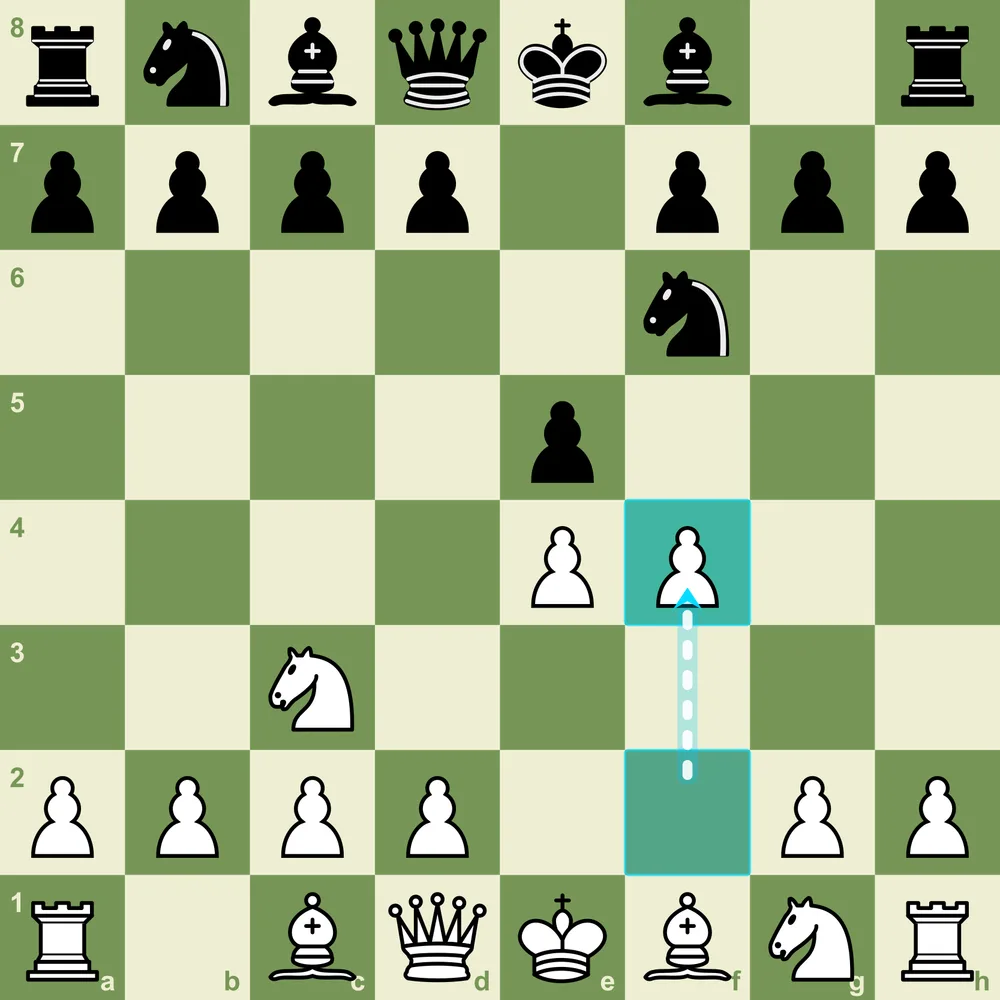
The Vienna Gambit arises after 1.e4 e5 2.Nc3 Nf6 3.f4 and is the most combative line in White's arsenal. The idea is pure King's Gambit energy - offer the f-pawn to rip open the center and the f-file - but with the knight already developed to c3, the gambit rests on a much healthier foundation. If Black accepts inaccurately, White's lead in development and central pawns can quickly become overwhelming.
The critical response is 3...d5, striking back in the center rather than grabbing the pawn. After 4.fxe5 Nxe4, the game becomes sharp and roughly balanced, with White continuing 5.Nf3, 5.Qf3, or 5.d3 to challenge the active knight on e4. The point to remember is that the tempting 3...exf4 is a positional error: after 4.e5 the knight on f6 is chased away, White gains time and a commanding center, and Black's extra pawn on f4 offers little compensation. Mastering this one distinction is the key to the entire gambit.
Famous practitioners: Spielmann, Mieses, Hamppe, Rapport
The Max Lange / 2...Nc6
2...Nc6 3.Bc4Beginner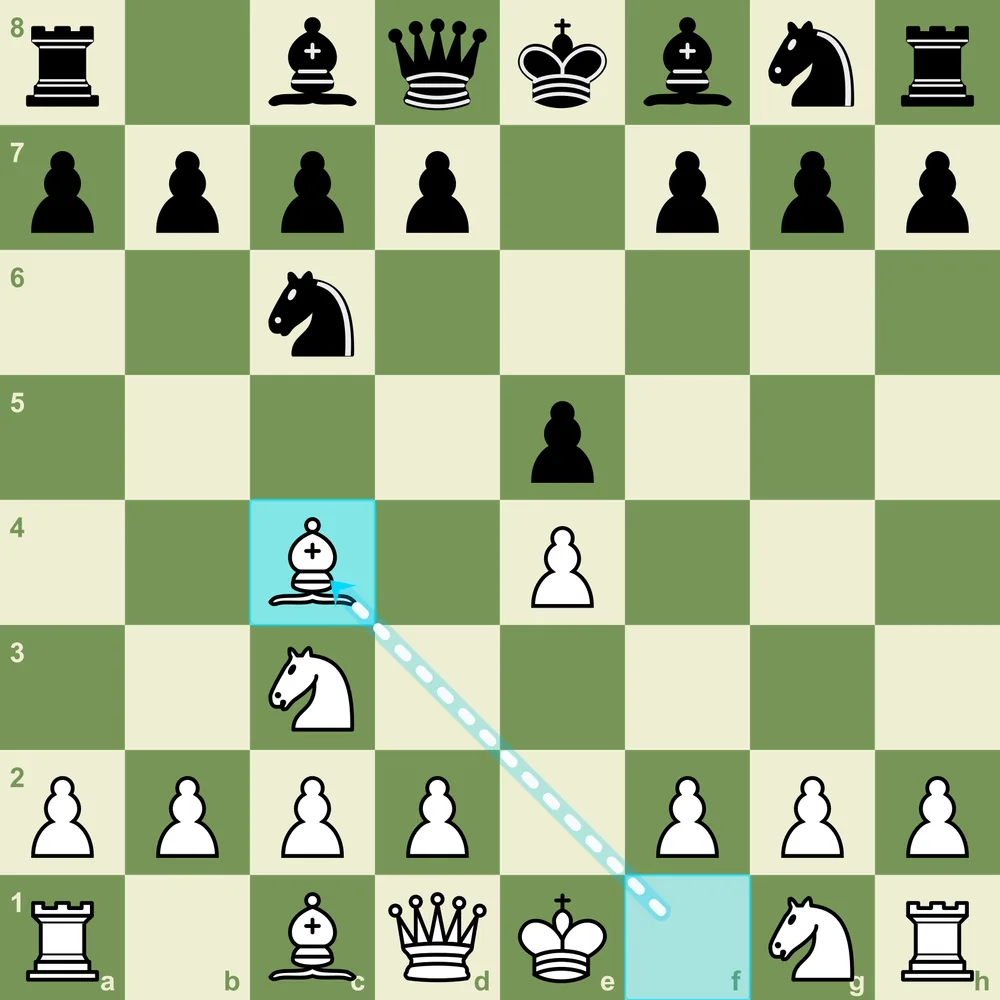
When Black develops with 2...Nc6, defending e5 in the most natural way, White's straightforward and reliable reply is 3.Bc4, the setup associated with Max Lange. The bishop takes aim at the vulnerable f7 square, and White prepares a harmonious buildup with d3, and often Qf3 or f4 to come. This line is beginner-friendly precisely because the plans are so clear: develop naturally, castle, and choose between a central break or a kingside expansion.
These positions frequently transpose into the Italian Game or the Bishop's Opening, so the knowledge carries over across your entire 1.e4 e5 repertoire. Black usually replies with 3...Bc5 or 3...Nf6 and follows up with ...d6 and ...O-O. One recurring tactical motif to respect is the ...Nd4 jump, which can hit a queen on f3 or exploit a loose bishop, so White should keep an eye on that square before committing the queen.
Famous practitioners: Max Lange, Steinitz, Paulsen, Adams
The Bishop's Line
3.Bc4Intermediate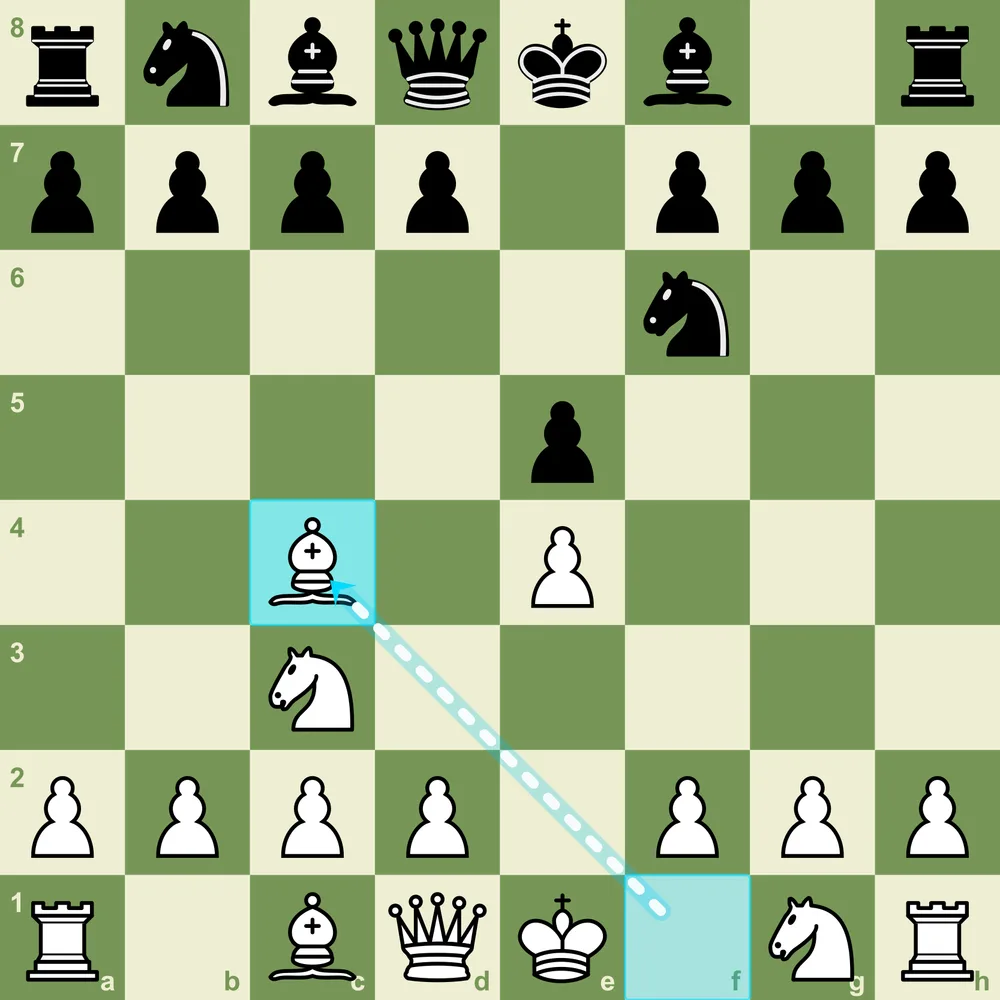
Against 2...Nf6, White can also play the developing 3.Bc4, placing the bishop on the classical attacking diagonal. This move issues a provocative challenge, because the e4 pawn is now only defended by the knight on c3. The most fearless reply is 3...Nxe4!?, snatching the pawn and entering the notorious Frankenstein-Dracula Variation - one of the sharpest, most theory-laden battles in all of the open games.
After 3...Nxe4 4.Qh5!, White regains the material by force: Black must play 4...Nd6 to defend, and following 5.Bb3 Nc6 6.Nb5 the position erupts into wild complications where both kings can come under fire. Players who prefer a quieter life simply avoid the pawn grab with 3...Nc6 or 3...Bc5, transposing into calmer Bishop's Opening and Italian structures. Either way, White enjoys a pleasant, principled game - but only if you know the forcing lines cold before allowing ...Nxe4.
Famous practitioners: Alekhine, Larsen, Short, Rapport
Pros and Cons of the Vienna Game
Advantages
- •Remarkable flexibility - White can choose a razor-sharp gambit or a calm positional squeeze from the very same starting position, tailoring the game to the opponent
- •Excellent surprise weapon - far less common than the Ruy Lopez or Italian, so opponents are frequently out of their prepared lines within a few moves
- •Sound attacking chances - the f2-f4 break delivers King's Gambit-style aggression while keeping White's position structurally healthy
- •Rich in transpositions - lines overlap with the Bishop's Opening and Italian, so what you learn reinforces the rest of your 1.e4 e5 repertoire
Disadvantages
- •Precise play required in the gambit - if Black knows the correct 3...d5 response, White must handle sharp, forcing positions accurately or risk standing worse
- •Limited edge against good preparation - the quiet g3 lines are solid but rarely promise White more than a small pull against accurate defense
- •Heavy theory in the Bishop's line - the Frankenstein-Dracula complications after 3.Bc4 Nxe4 demand real memorization if you invite them
- •Early queen sorties can backfire - motifs like ...Nd4 mean careless aggression with Qf3 or Qh5 can leave White's pieces overextended
Common Mistakes to Avoid in the Vienna Game
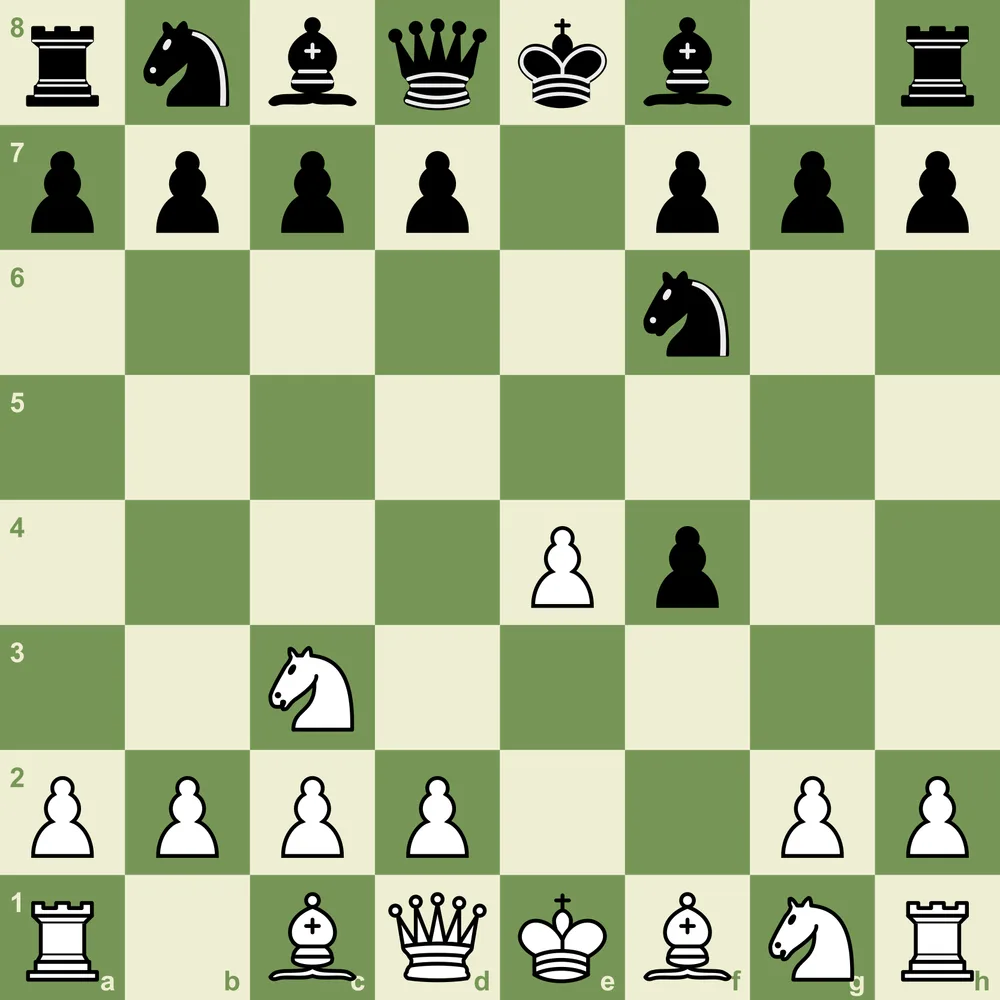
Accepting the gambit with 3...exf4 instead of 3...d5
This is the mistake shown in the diagram above, and it is the single most common error against the Vienna Gambit. After 3...exf4, White plays the powerful 4.e5, chasing the f6-knight and seizing a huge center with a big lead in development. The extra pawn on f4 is meaningless when Black's pieces are being pushed around. The correct move is the central counter-strike 3...d5, which challenges White immediately and keeps the balance.
Playing f4 without following up energetically
As White, the whole justification for the Vienna Gambit is rapid development and pressure. If you play 3.f4 and then drift with slow, non-committal moves, Black consolidates with ...d5, completes development, and can even turn the half-open f-file against your own king. Once you commit to the gambit, keep developing with tempo, get castled, and look for concrete ways to exploit the open lines rather than trying to cling to material.
Grabbing on e4 without knowing the theory
After 3.Bc4, the capture 3...Nxe4 is objectively playable, but only for a player who has studied the Frankenstein-Dracula lines. The reply 4.Qh5! forces a precise sequence, and one wrong step can leave Black's king hopelessly exposed. If you have not memorized the theory, decline the pawn with 3...Nc6 or 3...Bc5. Equally, White should not play 3.Bc4 expecting an easy game without also knowing the forcing lines that follow.
Treating 2.Nc3 as a purely quiet developing move
The Vienna is not a passive system, and playing it on autopilot wastes its potential. White should always keep the f2-f4 break and the pressure on d5 in mind; drifting into aimless development throws away the initiative. From Black's side, the mirror mistake is to develop routinely and allow White a free f4 with an ideal pawn center. Both sides must play with a plan - the Vienna punishes the player who forgets it is a fighting opening.
How to Practice the Vienna Game
The Vienna rewards players who understand both its attacking and positional souls. Follow these steps to make it a reliable part of your opening repertoire.
Master the Vienna Gambit main line first
Begin with 3.f4 and burn the critical response 3...d5 into your memory - both as the move Black should make and as the reason 3...exf4 fails to 4.e5. Understanding this single branching point unlocks the most important attacking line in the entire opening and immediately makes you dangerous against unprepared opponents.
Learn the 3.Bc4 lines and the Nxe4 tactics
Study the Bishop's line so you are never surprised by 3...Nxe4. Work through the Frankenstein-Dracula sequence beginning with 4.Qh5 until the forcing moves feel natural, and decide in advance whether you want to invite those complications or steer toward quieter Italian and Bishop's Opening structures. Knowing your plan before the game removes the fear from these positions.
Use ChessHelper to analyze your Vienna games
After each game, review the opening with ChessHelper's AI analysis. Did your attack fizzle because you delayed castling? Did you miss the right moment for the f4 break, or overextend your queen? ChessHelper's AI-powered engine pinpoints the critical moments and shows you the strongest continuations, helping you turn every Vienna game into a lesson.
Study the games of Spielmann and Steinitz
Few players demonstrated the Vienna's attacking power better than Rudolf Spielmann and Wilhelm Steinitz. Replay their games to see how they combined rapid development with the f4 break to generate crushing initiatives, and study how they judged when to sacrifice and when to convert to a positional advantage. Modern practitioners like Nigel Short offer excellent examples of the opening in contemporary play.
Practice both the sharp and the quiet setups
The Vienna is a two-faced weapon, so train both sides of it. Play some rapid games with the gambit to sharpen your feel for the initiative, then play slower games with the g3 and Bg2 fianchetto to learn the positional squeeze. Experiencing both extremes teaches you when each approach is appropriate and makes your handling of the opening far more complete.
Master the Vienna Game with ChessHelper
Get real-time AI analysis as you practice the Vienna in your online games. Understand every position, learn from your mistakes, and build an unstoppable attacking repertoire.
Start Practicing for FreeJoin 10,000+ chess players building sharper opening repertoires with ChessHelper
Related Openings
If you enjoy the Vienna Game, these openings share similar strategic themes and will complement your repertoire.
Italian Game
A classical 1.e4 e5 opening where the bishop targets f7, just like the Vienna's Bc4 lines. Many Vienna positions transpose directly into it.
1.e4 e5 2.Nf3 Nc6 3.Bc4
Ruy Lopez
The most respected of all 1.e4 e5 openings. If you want a deeper, more strategic White weapon to pair with the Vienna, the Ruy Lopez is the gold standard.
1.e4 e5 2.Nf3 Nc6 3.Bb5
Scotch Game
Love the Vienna's direct fight for the center? The Scotch opens the position early with 3.d4, giving White active piece play and a clear plan.
1.e4 e5 2.Nf3 Nc6 3.d4
Vienna Game: Frequently Asked Questions
Yes, the Vienna Game is an excellent choice for improving players. Its starting move, 2.Nc3, follows sound opening principles by developing a piece toward the center and fighting for the key d5 and e4 squares. It also teaches two valuable skills at once: how to build a slow positional squeeze with the g3 fianchetto setups, and how to launch a direct attack with the f2-f4 break. The one caveat is that the sharpest gambit lines require some memorization, so beginners should learn the critical 3.f4 d5 response before venturing into the wildest variations.
The Vienna Gambit (1.e4 e5 2.Nc3 Nf6 3.f4) is fully sound and remains a dangerous practical weapon at every level below elite grandmaster play. Because White has already developed the knight to c3, the gambit is considered safer and more positionally justified than the King's Gambit, where the f-pawn is thrust forward before any pieces come out. The critical point is that Black must respond with the central counter-strike 3...d5, not by grabbing the pawn with 3...exf4. If Black does capture, 4.e5 chases the f6-knight and hands White a powerful center and a lasting initiative.
All three are aggressive 1.e4 e5 systems, but they differ in move order. The King's Gambit (2.f4) offers a pawn immediately and slightly loosens White's kingside before developing. The Vienna Game (2.Nc3) develops a knight first and only then prepares f4, keeping the same attacking dream while avoiding the early weaknesses. The Bishop's Opening (2.Bc4) targets f7 at once; it frequently transposes into the Vienna after a later Nc3, so the two openings share a great deal of theory. Many Vienna players deliberately use these overlapping move orders to reach the structures they know best.