
What is the Alekhine Defense?
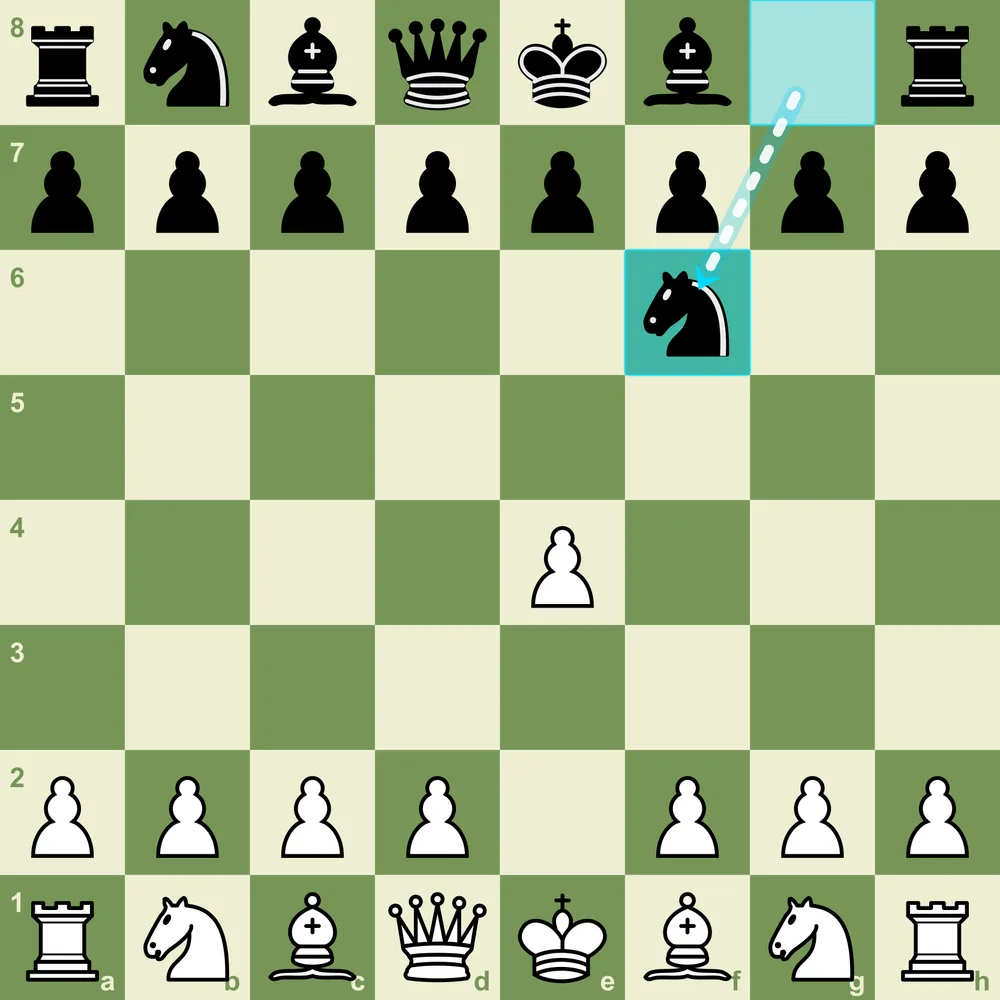
The Alekhine Defense begins with the moves 1.e4 Nf6 and is an immediate, provocative attack on White's e4 pawn before Black has advanced a single pawn of its own. Rather than contesting the center with a pawn as in the Caro-Kann or Sicilian, Black develops a piece and dares White to build a broad center. The main line runs 2.e5 Nd5, chasing the knight to the edge of White's expanding pawn front. This is the essence of hypermodern chess: Black cedes the center temporarily, planning to undermine and attack it later with pieces and well-timed pawn breaks.
The opening is named after Alexander Alekhine, the fourth World Champion, who introduced it in a tournament game at Budapest in 1921. Alekhine, one of the most imaginative attacking players in history, understood that a large pawn center is not automatically an asset - it can also be a target. His new defense startled contemporaries who had been raised on classical principles demanding that Black meet a central pawn with a central pawn. Though initially viewed with suspicion, the Alekhine gradually earned respect as a fully sound, if unconventional, answer to 1.e4.
The strategic idea rests on provocation. By tempting White to play e5, d4, c4, and sometimes f4, Black lures those pawns forward where they can be attacked with ...d6, ...c5, and ...f6. If White overextends, the advanced pawns become weaknesses and Black's pieces spring to life against them; if White develops modestly, Black completes development and reaches a sound, if slightly cramped, middlegame. The bargain is clear: Black accepts less space in return for a concrete plan against a defined target.
Modern grandmasters still use the Alekhine as both a surprise weapon and a genuine fighting defense. Lev Alburt built much of his career on it, and elite players including Vasily Ivanchuk, Magnus Carlsen, and Baadur Jobava have all employed it to sidestep heavily analyzed main lines and drag opponents into unfamiliar territory. It remains one of the most principled ways for Black to unbalance the game from the very first move.
How to Play the Alekhine Defense
The Alekhine begins with 1.e4 Nf6. The purpose of this move is to attack e4 at once and force White to make a decision. The most testing reply is 2.e5, gaining space and pushing the knight on again with 2...Nd5. White usually follows with 3.d4, and after 3...d6 the battle lines are drawn: Black immediately strikes at the head of the pawn chain while White decides how much of the center to commit.
White's main choices define the character of the game. 4.c4 Nb6 5.f4 is the Four Pawns Attack, the most ambitious try, in which White builds a massive center and plays for a direct attack. 4.Nf3 is the Modern Main Line, a restrained approach that keeps the structure flexible. 4.c4 Nb6 5.exd6 is the Exchange Variation, releasing the central tension early. And the sharp 3.c4 Nb6 4.c5 - the Chase Variation - drives the knight around the board at the cost of overextending. Each of these choices leads to a fundamentally different type of position.
The strategic philosophy stays consistent no matter what White chooses: challenge the advanced pawns with ...d6 and ...dxe5, develop the light-squared bishop actively to f5 or g4 before playing ...e6, and prepare the freeing break ...c5. Black is rarely trying to win by direct assault. Instead, the goal is to provoke White into overextending, then dismantle the center piece by piece and emerge with the healthier structure.
Main Alekhine Defense Variations
The Alekhine branches into four major systems, each demanding a distinct strategic approach. Here are the variations every Alekhine player must know.
The Four Pawns Attack
4.c4 Nb6 5.f4Intermediate-Advanced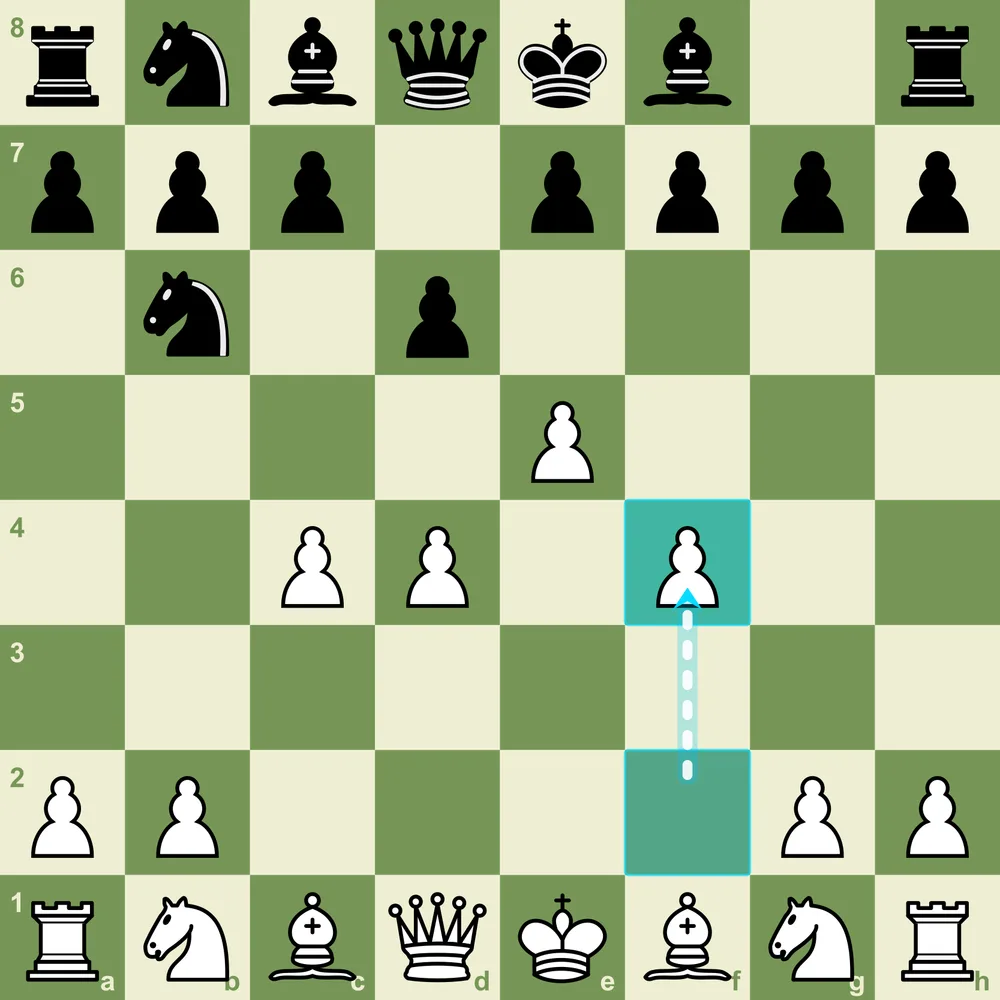
The Four Pawns Attack is the most aggressive answer to the Alekhine. After 1.e4 Nf6 2.e5 Nd5 3.d4 d6 4.c4 Nb6 5.f4, White erects an enormous pawn phalanx on c4, d4, e5, and f4, seizing the maximum amount of space and threatening to steamroll Black off the board. This is precisely the position the Alekhine player invites: a center this large is imposing, but it is also a sprawling structure that has to be defended on every move.
Black strikes back at once. A main line runs 5...dxe5 6.fxe5 Nc6, hitting d4, followed by ...Bf5 or ...Bg4, ...e6, and the thematic ...c5 break. If White tries to hold everything, the center can buckle under the combined pressure of Black's pieces; if White pushes prematurely, the pawns leave weak squares in their wake. The line is theory-heavy and double-edged, rewarding whoever knows the concrete moves - which, historically, has often been Black.
Famous practitioners: Fischer, Alburt, Bagirov, Korchnoi
The Modern Main Line
4.Nf3Intermediate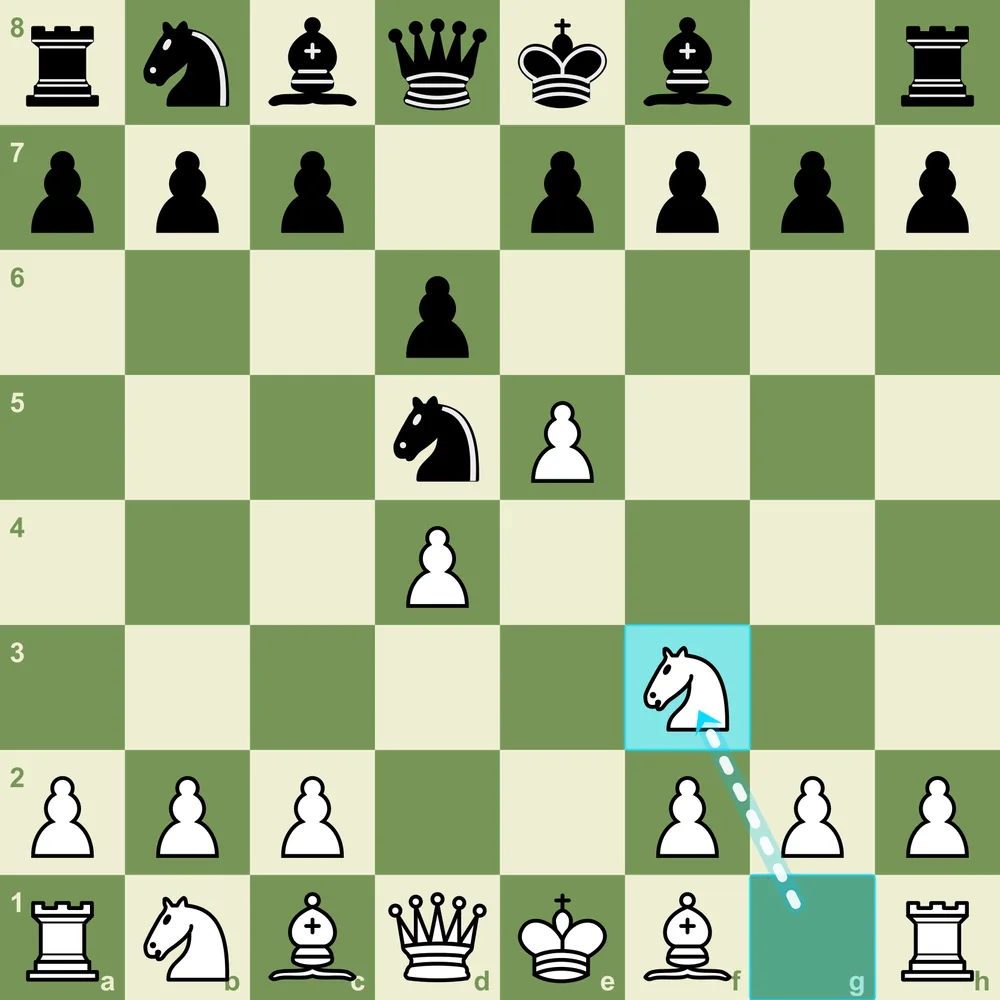
The Modern Main Line, often simply called the Modern Variation, is widely regarded as White's most reliable and testing continuation. After 1.e4 Nf6 2.e5 Nd5 3.d4 d6 4.Nf3, White declines to grab more space and instead develops naturally, keeping the e5 pawn firmly defended. By refusing to overextend, White denies Black the inviting targets that the Four Pawns Attack hands over, playing for a small but durable spatial edge.
Black's critical response is 4...Bg4, pinning the f3-knight against the queen and increasing the pressure on d4, followed by ...e6, ...Be7, ...O-O, and ...Nc6. A solid alternative is 4...dxe5 5.Nxe5 g6, developing the bishop to g7 and castling behind a fianchetto. In both cases Black reaches a resilient position, though one where active counterplay must be earned patiently rather than seized by force.
Famous practitioners: Carlsen, Ivanchuk, Jobava, Nakamura
The Exchange Variation
4.c4 Nb6 5.exd6Beginner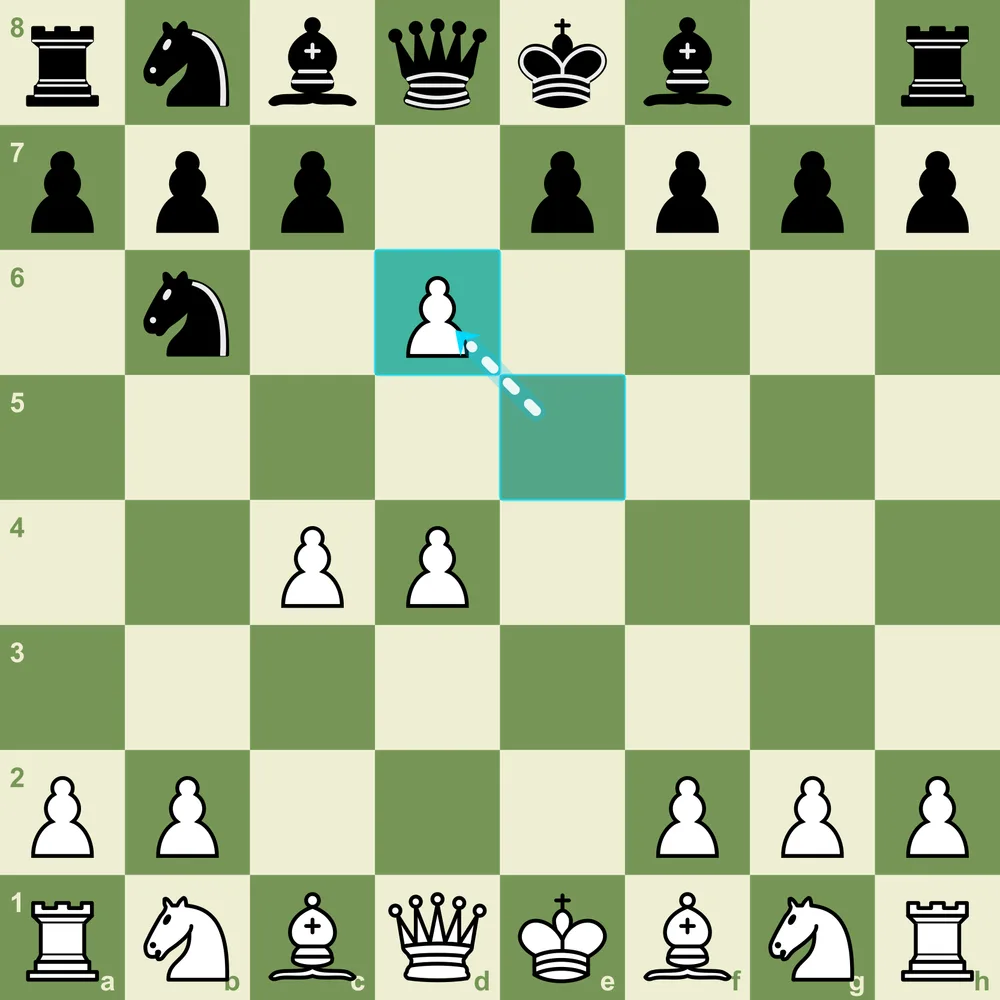
The Exchange Variation arises after 1.e4 Nf6 2.e5 Nd5 3.d4 d6 4.c4 Nb6 5.exd6, when White resolves the central tension rather than maintaining the big pawn front. Black can recapture in two distinct ways, each defining a different game. 5...exd6 yields a solid, roughly symmetrical structure with a half-open e-file and effortless development, while 5...cxd6 opens the c-file and stakes a broader central claim - a more ambitious try popularized by Bent Larsen.
Although the Exchange Variation has a quiet reputation, it is far from a forced draw. White keeps a small space advantage thanks to the c4 pawn, but Black's pieces develop smoothly and the ensuing middlegames are rich in maneuvering. Black should complete development with ...Nc6, ...g6 or ...Be7, and ...O-O, then use the file opened by the recapture to generate play. As in many calm lines, the real danger for Black is complacency: precise, purposeful moves are required to prove full equality.
Famous practitioners: Larsen, Kengis, Baburin, Sax
The Chase Variation
3.c4 Nb6 4.c5Intermediate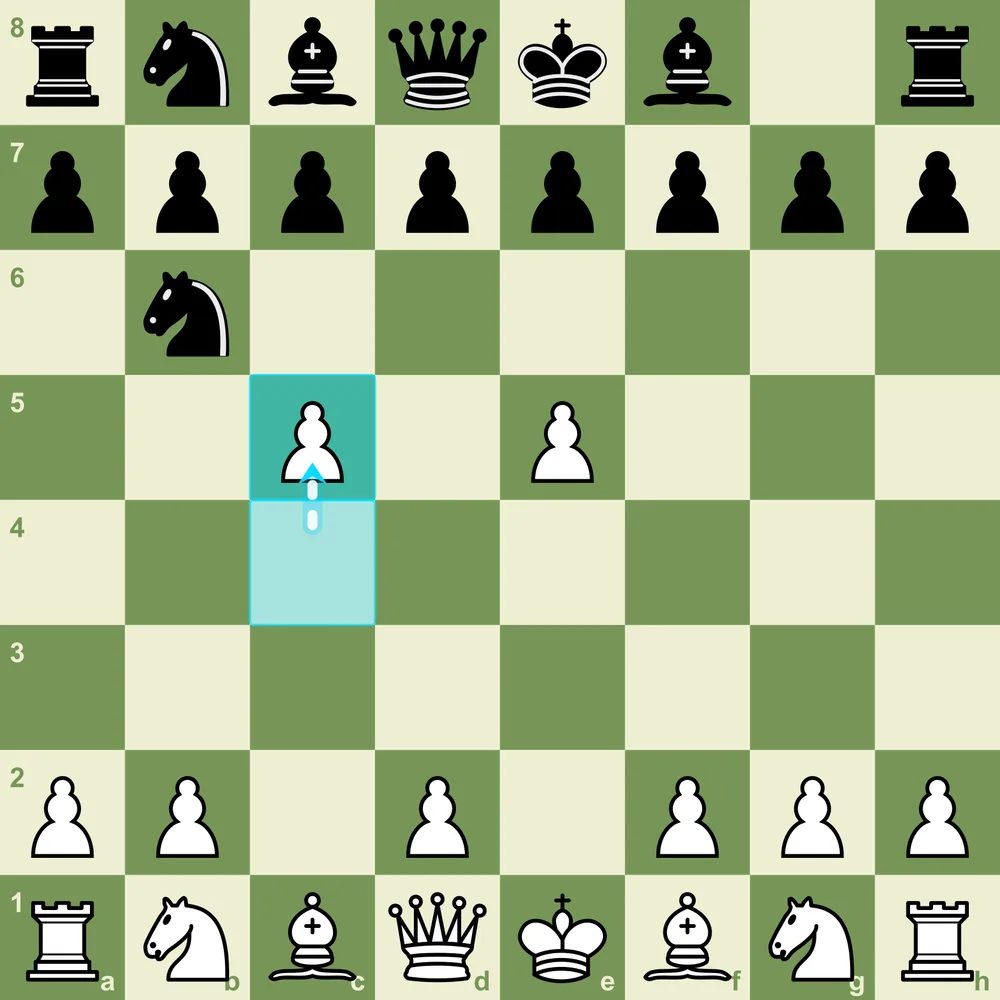
The Chase Variation, also known as the Two Pawns Attack, meets the Alekhine's provocation with provocation of its own. After 1.e4 Nf6 2.e5 Nd5 3.c4 Nb6 4.c5, White kicks the knight yet again and plants a menacing pawn wedge on c5 and e5. The knight retreats with 4...Nd5, and White enjoys an imposing advanced-pawn presence - but has committed early and, tellingly, has moved only pawns.
This is a genuine test of nerve for both sides. White's space can become overwhelming if Black plays passively, yet the c5 and e5 pawns are themselves overextended and can be pried apart with ...b6, ...d6, and ...e6. The variation shows the Alekhine's central bargain in its sharpest form: whoever understands the resulting pawn structure better comes out ahead, and the extra tempi White spends chasing the knight often rebound once the wedge is challenged.
Famous practitioners: Alburt, Bagirov, Vaganian, Sutovsky
Pros and Cons of the Alekhine Defense
Advantages
- •Provokes overextension - by luring White's pawns forward, Black creates concrete targets and steers the game toward positions where a broad center becomes a liability
- •Sidesteps main-line theory - 1...Nf6 avoids the vast bodies of Sicilian, Ruy Lopez, and Italian theory, making it an excellent surprise weapon
- •Unbalanced fighting positions - the asymmetrical pawn structures give Black real winning chances rather than sterile equality
- •Sharpens dynamic understanding - playing against a big center trains your feel for piece activity, pawn breaks, and the trade-off between space and targets
Disadvantages
- •Cedes central space - Black voluntarily hands White a spatial advantage, and if the center is not challenged in time Black can be slowly squeezed
- •Repeated knight moves - Black spends several early tempi shuffling one knight (Nf6-d5-b6), delaying development and demanding accurate follow-up
- •Punishes passive play - unlike the forgiving Caro-Kann, a few slow moves can leave Black cramped and strategically lost with little counterplay
- •Requires concrete knowledge - the Four Pawns Attack and Chase lines contain forcing sequences where a single inaccuracy can prove fatal
Common Mistakes to Avoid in the Alekhine
Leaving the center unchallenged
The single biggest error in the Alekhine is treating it as a passive defense. If Black develops quietly and never plays ...d6, ...dxe5, or ...c5, White simply keeps the big pawn center intact and slowly suffocates Black. The entire justification for the opening is to attack those advanced pawns, so always have a concrete plan to strike at e5 and d4 - usually beginning with ...d6.
Wandering with the knight and losing time
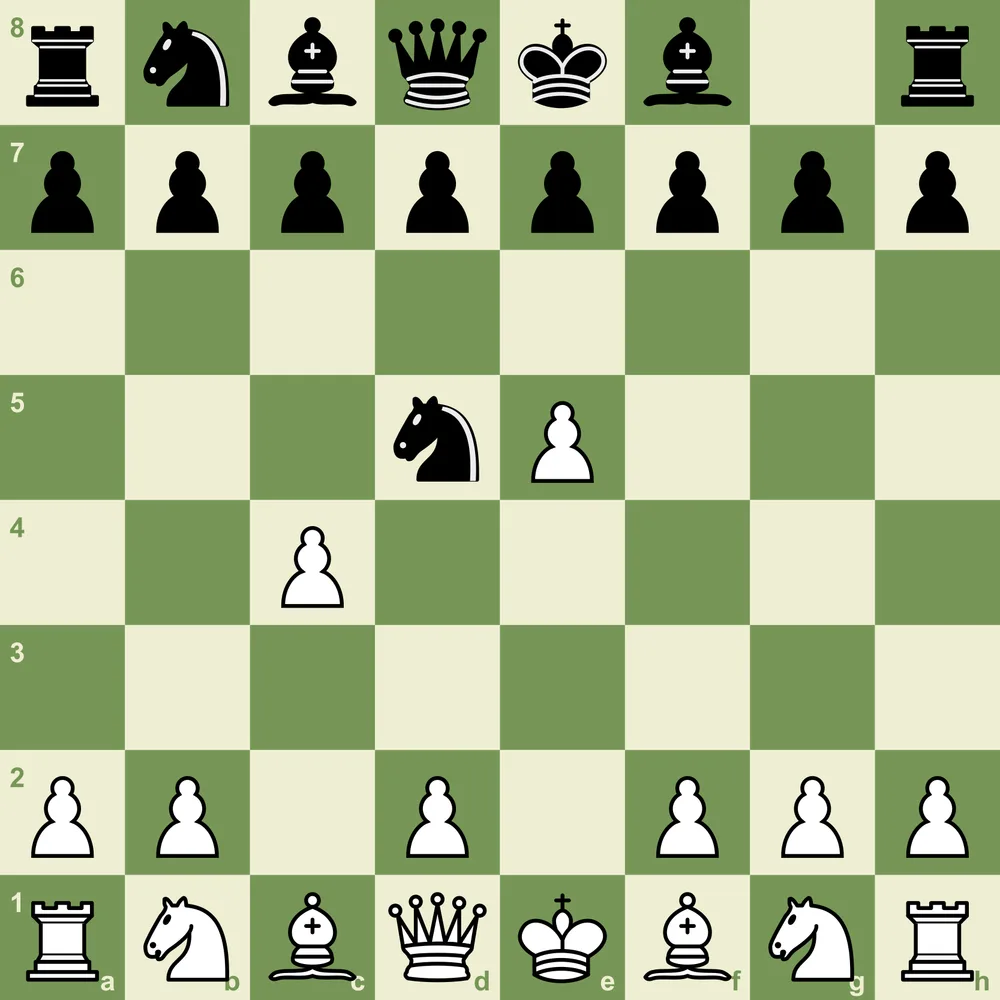
After being chased to d5 and then b6, the knight must find a stable home; hopping it around aimlessly burns tempi that Black cannot spare. In the position above, 3...Nb6 is the standard, sound retreat. Speculative jumps like 3...Nf4?! or dropping the knight onto squares where a quick c4-c5 or a tactic wins it are common ways to hand White a large advantage for free.
Grabbing the e4 pawn after 2.Bc4
Against the sideline 2.Bc4, the greedy 2...Nxe4?? is a notorious blunder: White replies 3.Bxf7+! Kxf7 4.Qh5+, and after the king steps aside, 5.Qxe4 regains the knight with a crushing position and Black's king stranded in the center. Whenever White appears to offer the e-pawn, check that it is not a trap before you snatch it.
Entombing the light-squared bishop
Just as in the French Defense, playing ...e6 too early can lock in Black's light-squared bishop. In most Alekhine lines that bishop belongs on f5 or g4, developed actively before the ...e6 pawn move closes its diagonal. Getting the move order wrong leaves Black with a permanently passive piece and undermines the dynamic play the opening is supposed to deliver.
How to Practice the Alekhine Defense
The Alekhine rewards concrete, methodical study. Follow these steps to make it a reliable part of your opening repertoire.
Start with the Modern Main Line
Because 4.Nf3 is White's most common and most testing continuation, learn it first. Understand why ...dxe5 and ...Bg4 are useful, how to complete development safely, and where each piece belongs. Mastering the Modern lines gives you a solid foundation for the whole opening before you tackle the sharper attacks.
Drill the Four Pawns Attack breaks
The Four Pawns Attack looks terrifying until you know the antidotes. Practice the key pawn breaks - ...dxe5 and especially ...c5 - and memorize the main move orders, since this is the most forcing line you will face. Knowing exactly how to hit White's center turns your opponent's most ambitious choice into one of your best scoring weapons.
Learn to handle the chase
Set up positions from the Chase and Two Pawns lines and practice retreating the knight correctly, then undermining the c5 and e5 pawns with ...b6, ...d6, and ...e6. Getting comfortable with these cramped-looking positions removes the main psychological barrier to playing the Alekhine with confidence.
Analyze your games with ChessHelper
After each game, review the opening phase with ChessHelper's AI analysis. Did you challenge the center in time? Was your knight on its best square? Did you miss a ...c5 break? ChessHelper's AI-powered engine highlights the critical moments in your Alekhine games and helps you understand the recurring pawn structures you reach in practice.
Study Alekhine and Alburt's model games
Learn from the specialists. Alexander Alekhine's own games capture the provocative spirit of the opening, while Lev Alburt's and Vladimir Bagirov's games are model demonstrations of how to dismantle an overextended center. Replaying annotated master games is the fastest way to absorb the plans that an engine alone will not teach you.
Master the Alekhine with ChessHelper
Get real-time AI analysis as you play the Alekhine in your online games. Learn exactly when to challenge White's center, where your knight belongs, and how to turn a big pawn center into a target.
Start Practicing for FreeJoin 10,000+ chess players building sharper opening repertoires with ChessHelper
Related Openings
If you enjoy the Alekhine, these openings share similar strategic themes and will complement your repertoire.
Pirc Defense
Another hypermodern defense: Black lets White build a big center, then strikes back with pieces and the ...e5 or ...c5 breaks.
1.e4 d6 2.d4 Nf6 3.Nc3 g6
Scandinavian Defense
Like the Alekhine, it challenges 1.e4 immediately and unconventionally, here with 1...d5, leading to clear plans and little heavy theory.
1.e4 d5
Caro-Kann Defense
Prefer a calmer answer to 1.e4? The Caro-Kann offers a rock-solid pawn structure and easy development for Black.
1.e4 c6
Alekhine Defense: Frequently Asked Questions
The Alekhine Defense is best suited to intermediate players and above. Its hypermodern philosophy - inviting White to build a large pawn center and then attacking it - requires a good sense of when to strike back with ...d6, ...c5, and ...f6. Beginners often struggle because a single passive move can leave Black cramped behind White's advanced pawns. That said, it is a superb learning tool: playing the Alekhine teaches you how to fight against a broad pawn center, a skill that transfers to many other openings.
The knight tour (Nf6-d5, often on to b6) is the whole point of the opening, not a waste of time. By attacking White's e4 pawn on move one, Black provokes 2.e5, which gains space but also commits White to advancing and defending those pawns. Each time White chases the knight with c4 or c5, another pawn leaves its home square and becomes a potential target. Black accepts a temporary lag in development in exchange for concrete weaknesses to attack in White's overextended center.
Most theory considers the Modern Main Line with 4.Nf3 to be White's most testing try. Instead of grabbing maximum space with the Four Pawns Attack, White develops soundly, keeps the e5 pawn defended, and avoids creating the targets that Black craves. Against it Black usually plays ...dxe5, ...Bg4 to pin the knight, ...e6, and ...Be7, aiming for a solid but slightly passive position. The Four Pawns Attack looks scarier at first glance, but if Black knows the theory, White's sprawling center can become a liability.