
What is the Benoni Defense?
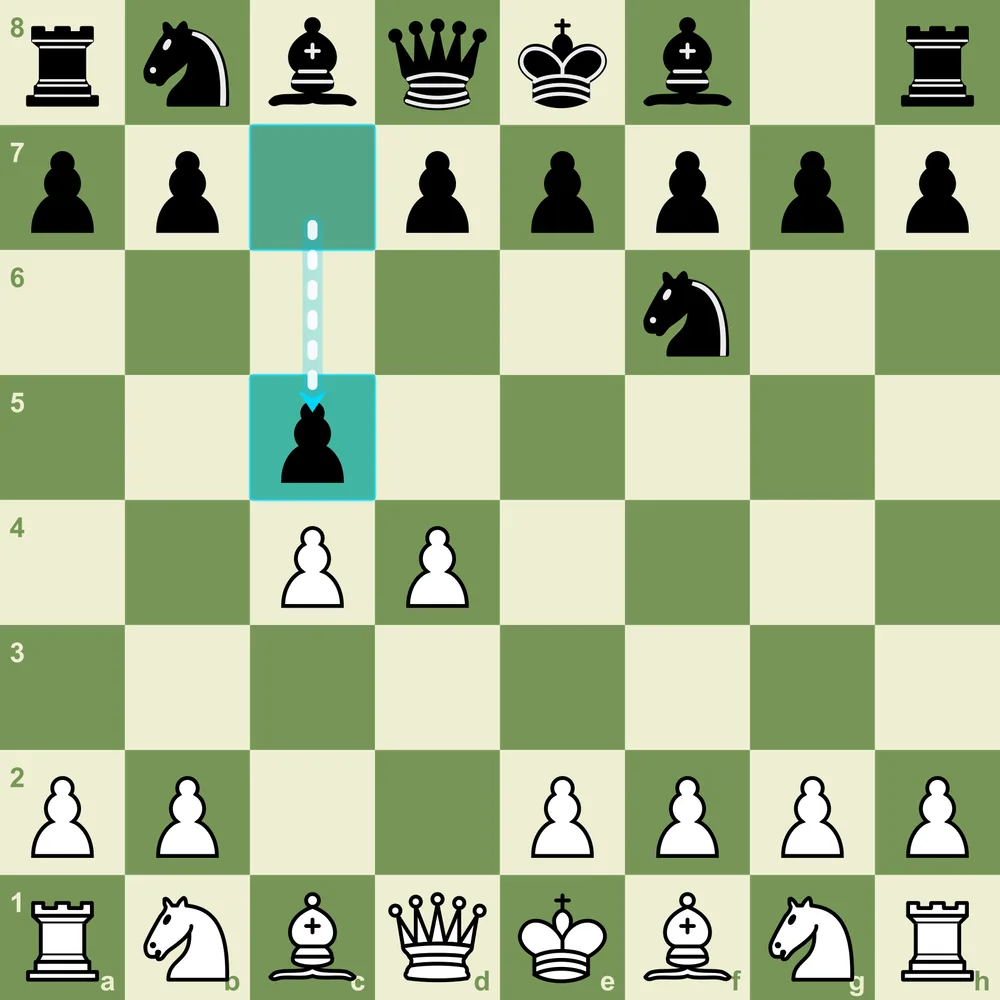
The Benoni Defense arises after 1.d4 Nf6 2.c4 c5 and is one of the most uncompromising ways for Black to meet 1.d4. Rather than mirroring White's central setup, Black immediately confronts the d4 pawn with the flank thrust ...c5, inviting White to advance with 3.d5 and lock the center. The result is a deeply asymmetrical struggle: White gains space in the center, while Black obtains a queenside pawn majority and a springboard for dynamic, piece-driven counterplay.
The name "Benoni" comes from the Hebrew phrase ben-oni, meaning "son of my sorrow." It was borrowed by Aaron Reinganum for an 1825 study of defenses to 1.d4, and the label stuck. For much of chess history the Benoni was viewed as slightly dubious, an opening for players willing to accept a cramped position in the hope of confusing the opponent. That reputation changed dramatically in the mid-twentieth century, when a generation of attacking players demonstrated just how much venom the resulting positions contain.
No player did more for the Benoni's reputation than Mikhail Tal, the eighth World Champion, whose sacrificial masterpieces showed that Black's active pieces and pawn breaks could overwhelm even the most solid White setups. Later, Garry Kasparov adopted the Modern Benoni as a fighting weapon in his rise to the top, and it has been wielded by attacking grandmasters such as Veselin Topalov and Vugar Gashimov. The common thread is a willingness to play for a win from move two by keeping the position unbalanced.
The strategic bargain at the heart of the Benoni is simple to state and hard to master: Black trades central space for the two great long-term assets of the position - a queenside pawn majority and superb piece activity. The dark-squared bishop lands on the powerful g7 diagonal, the half-open e-file gives the rooks a target, and the thematic breaks ...b5 and ...f5 keep White under constant pressure. Handled accurately, the Benoni is a genuine winning try; handled carelessly, it can leave Black passively squeezed. That razor's edge is precisely what makes it so appealing to ambitious players.
How to Play the Benoni Defense
The Benoni begins with 1.d4 Nf6 2.c4 c5. With the second-move pawn thrust, Black challenges White's d4 pawn and refuses to build a symmetrical center. White's principled reply is 3.d5, pushing the pawn forward, seizing space, and defining the character of the game. Black now chooses how to unbalance the position further.
The main and most thematic continuation is 3...e6, entering the Modern Benoni. After 4.Nc3 exd5 5.cxd5, the classic Benoni pawn structure appears: White has a central duo on d5 and (soon) e4, while Black owns a queenside majority with pawns on c5 and d6. Black then follows a clear developing plan - ...d6, ...g6, ...Bg7, ...O-O - and prepares the counterattacking breaks ...b5 and ...f5. Black's two most important alternatives are 3...e5 (the solid, closed Czech Benoni) and 3...b5 (the Benko Gambit, sacrificing a pawn for queenside initiative).
The strategic philosophy is the mirror image of a quiet, solid opening. Black deliberately accepts less space, betting that dynamic piece play, the queenside pawn majority, the half-open e-file, and the powerful g7 bishop will more than compensate. Success in the Benoni is not about holding a fortress; it is about generating and sustaining counterplay. The player who breaks with ...b5 or ...f5 at the right moment, and who prevents White from crashing through with a timed e4-e5, is the one who reaps the rewards of this fighting defense.
Main Benoni Defense Variations
The Benoni is really a family of related systems, each with its own flavor of imbalance. Here are the four every Benoni player needs to understand.
The Modern Benoni
3...e6Advanced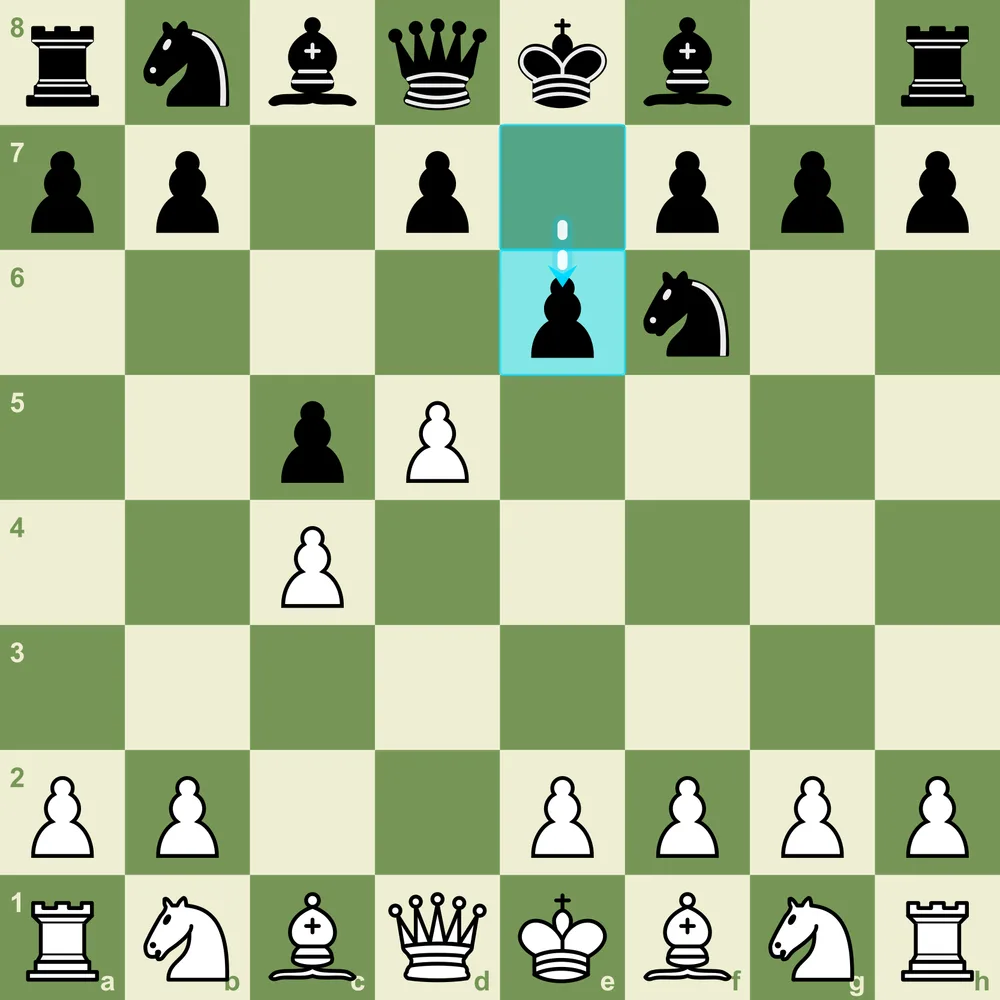
The Modern Benoni is the main line and the reason the opening enjoys its fearsome reputation. After 3...e6, Black offers to exchange on d5 and open the position on Black's own terms. The typical follow-up 4.Nc3 exd5 5.cxd5 establishes the defining structure: White's advanced d5 pawn and central majority against Black's queenside pawns on c5 and d6.
From here Black develops with ...d6, ...g6, ...Bg7 and ...O-O, placing the dark-squared bishop on its dream diagonal and eyeing White's center and queenside. The plan is unmistakable: prepare ...b5 to activate the queenside majority, or ...f5 to strike at the e4 pawn, while pieces such as the knight rerouting via a6 to c7 or via d7 to e5 add pressure. It is a razor-sharp battle where both sides play for the full point, and it demands accurate, energetic handling from Black.
Famous practitioners: Tal, Kasparov, Topalov, Gashimov
The Main Line Structure
5.cxd5 d6 6.e4Advanced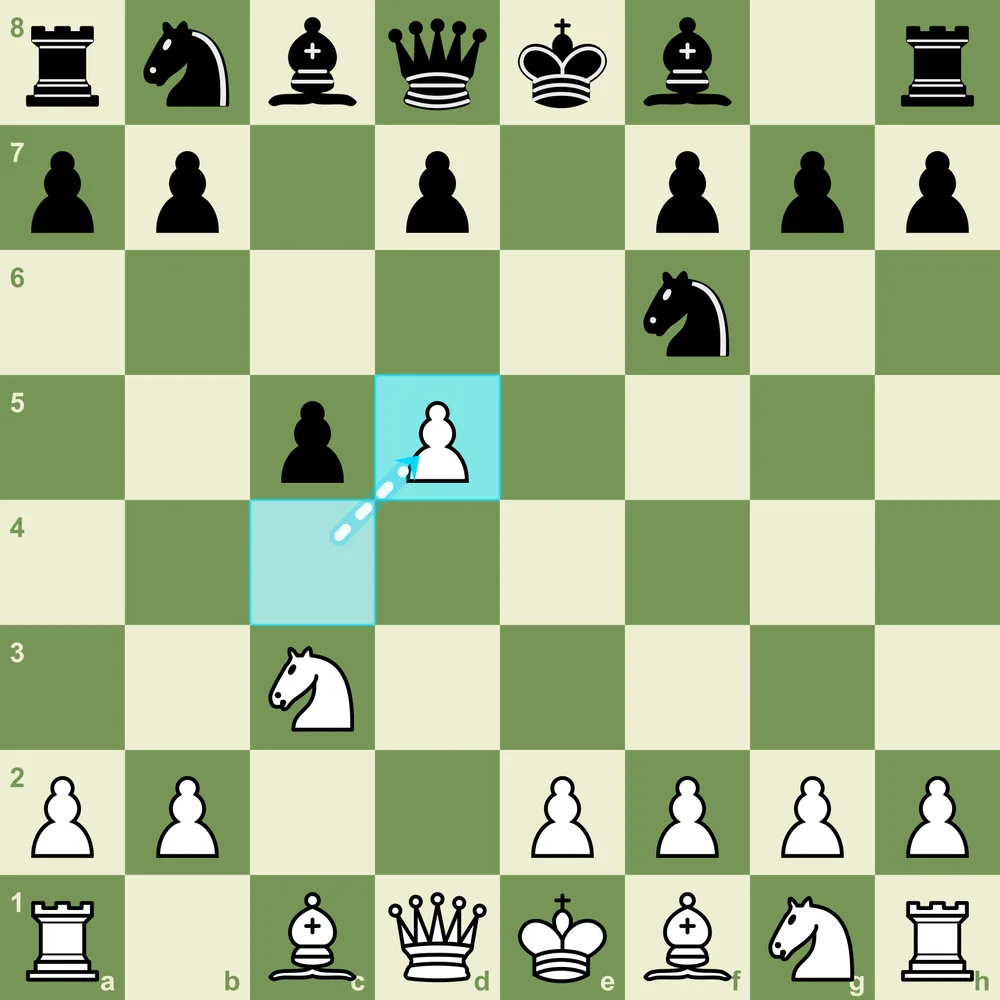
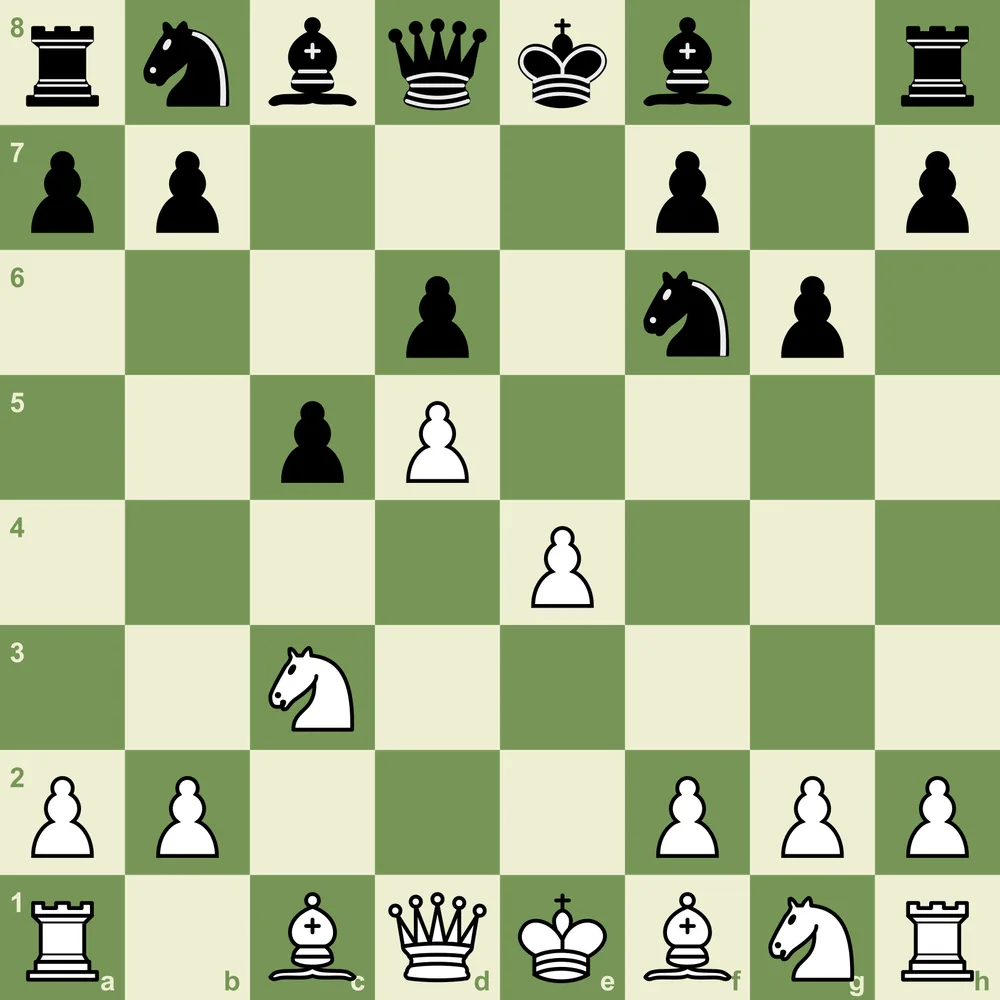
The heart of the Benoni is the pawn structure that emerges after 5.cxd5 d6 6.e4. White erects an imposing pawn center on d5 and e4, gaining space and restricting Black's pieces, while Black settles into the position with the queenside majority and the fianchetto. Understanding this tabiya, rather than memorizing individual moves, is what separates strong Benoni players from the rest.
White has several ambitious setups against it. The Taimanov Variation with 7.f4 and an early Bb5+ tries to punish Black's development before the counterplay gets going, and the Four Pawns Attack throws the whole center forward in search of a knockout. Black meets these plans with precise move orders, timely piece maneuvers, and above all the thematic breaks: ...b5 to open the queenside and ...f5 to challenge e4. Whoever controls the timing of the central e4-e5 advance usually controls the game.
Famous practitioners: Fischer, Kasparov, Nakamura, Gashimov
The Czech Benoni
3...e5Intermediate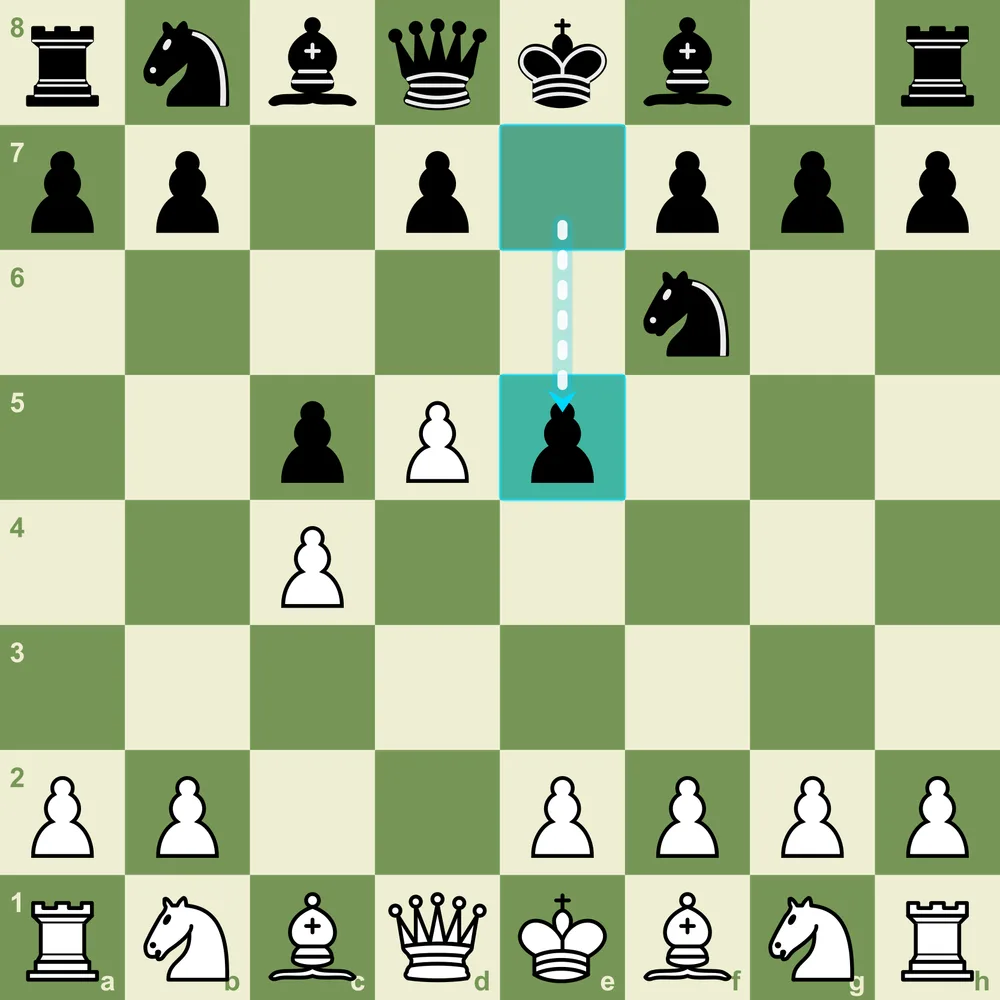
The Czech Benoni arises after 3...e5, immediately closing the center rather than opening it. This is the quieter, more strategic cousin of the Modern Benoni: with the pawns locked on d5 and e4 against d6 and e5, the game becomes a slow-burning maneuvering battle rather than a tactical shootout. It requires far less concrete theory, which makes it a practical choice for players who prefer to understand plans over memorizing lines.
Black's typical setup involves ...d6, ...Be7, ...O-O and patient regrouping, with the knights heading toward strong squares and the whole army eventually supporting the freeing break ...f5. Because the structure is closed, both sides can afford to reposition pieces at length, and the player with the better plan and more patience tends to prevail. The trade-off is that Black's position can become passive if the ...f5 break never materializes, so accurate preparation for that lever remains essential.
Famous practitioners: Hort, Bronstein, Czech school specialists
The Benko Gambit
3...b5Advanced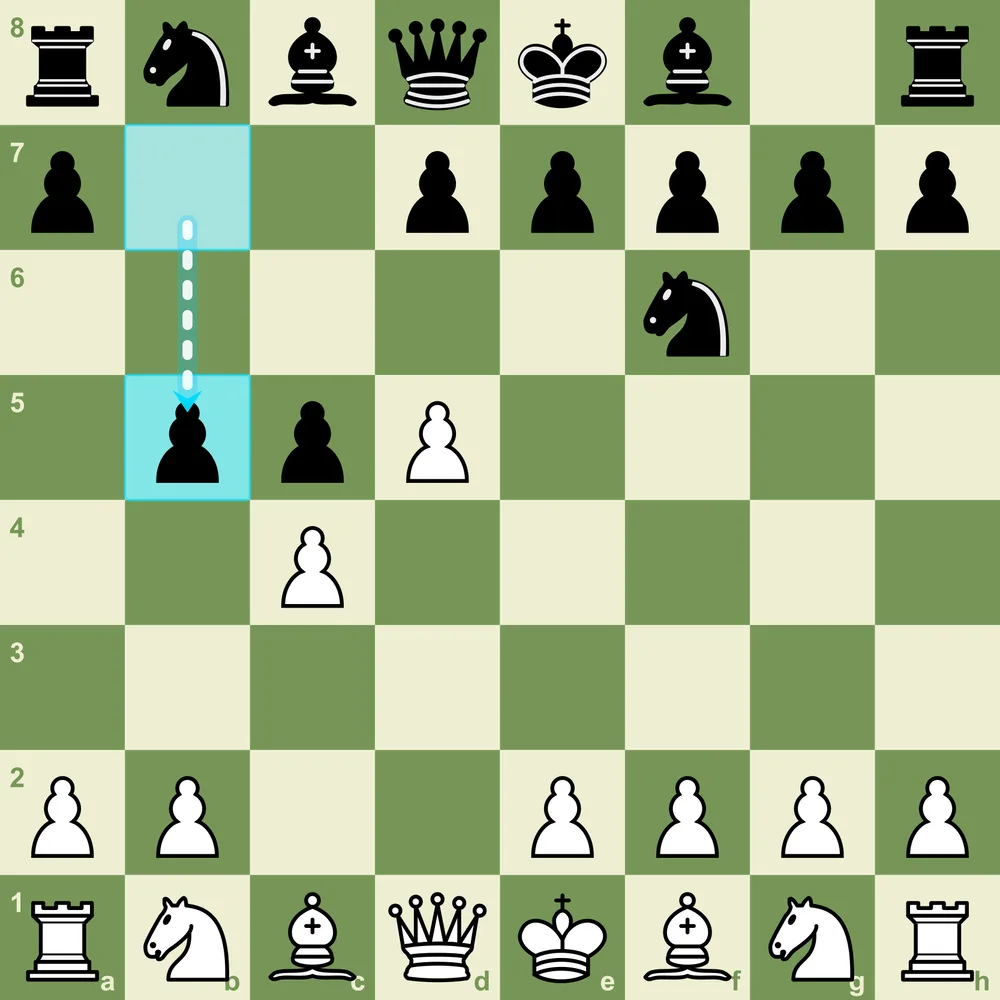
The Benko Gambit, also known as the Volga Gambit, is one of the most respected pawn sacrifices in all of chess. After 3...b5, Black offers the b-pawn - the main line runs 4.cxb5 a6 - in order to blast open the a- and b-files. It is named after the Hungarian-American grandmaster Pal Benko, who pioneered its modern treatment and demonstrated the remarkable compensation Black obtains for so small an investment.
Unlike most gambits, the Benko is prized for its clarity rather than its complications. Black fianchettoes with ...g6 and ...Bg7, doubles rooks on the a- and b-files, and applies relentless positional pressure against White's queenside, often reaching endgames where the extra pawn is a liability rather than an asset. It is an ideal choice for players who enjoy long-term initiative and easy-to-follow plans, and it remains a fully sound weapon at every level.
Famous practitioners: Benko, Topalov, Alburt, Fedorov
Pros and Cons of the Benoni Defense
Advantages
- •Dynamic, unbalanced positions - the asymmetrical structure keeps winning chances alive and avoids the sterile symmetry that leads to quick draws
- •Queenside pawn majority - a genuine long-term asset that can become decisive in the endgame, especially in Benko Gambit lines
- •Active pieces and clear plans - the g7 bishop, the half-open e-file, and the thematic ...b5 and ...f5 breaks give Black concrete, purposeful counterplay
- •A dangerous surprise weapon - it forces sharp, double-edged play that positional White players often find uncomfortable to face
Disadvantages
- •Concedes central space - White's d5 and e4 pawns can become an overwhelming steamroller if Black's counterplay is too slow
- •Sharp, demanding theory - critical tries such as the Taimanov Variation and the Four Pawns Attack require precise, well-memorized responses
- •Structural weaknesses to defend - the backward d6 pawn and the weakened squares around it can become long-term targets for White
- •Little margin for error - one careless, passive move can leave Black cramped and strategically lost with no counterplay in sight
Common Mistakes to Avoid in the Benoni
Playing passively and forgetting about counterplay
The Benoni is not a defense you can play on autopilot. Because Black has conceded central space, sitting still allows White to expand unchecked and slowly squeeze the life out of the position. Every plan should be oriented toward activity - completing the fianchetto quickly, castling, and then preparing the ...b5 or ...f5 break. If you find yourself shuffling pieces without a target, you have already drifted into a worse position.
Neglecting the ...b5 and ...f5 breaks
These two pawn breaks are the engine of Black's entire strategy. The ...b5 break activates the queenside majority and opens lines against White's position, while ...f5 challenges the e4 pawn and frees Black's pieces. Preparing them requires accurate piece placement, and delaying them for too long hands White a free hand in the center. Always know which break you are playing for and what your pieces need to be in place before you strike.
Allowing a well-timed e4-e5 break by White
The single most dangerous idea for White in the Benoni is the central advance e4-e5. Played at the right moment, it rips open the position while Black's king is still exposed and the pieces are not coordinated, often winning material or launching a decisive attack. Keep an eye on this break at all times, control the e5 square with your pieces, and do not weaken your setup in a way that invites it.
Mishandling the Taimanov Variation and the check on b5
Against the aggressive Taimanov setup with 7.f4 and an early Bb5+, imprecise move orders can land Black in serious trouble before development is complete. You need to know exactly how to meet the check - whether to block with a piece, interpose the knight, or arrange ...Nbd7 - and how to react to White's central pawn storm. Learning this critical line thoroughly is essential before you take the Modern Benoni into a serious game.
How to Practice the Benoni Defense
The Benoni rewards players who combine sharp preparation with a deep feel for dynamic positions. Follow these steps to make it a reliable part of your repertoire.
Start with the Modern Benoni main line
Begin by mastering the core structure after 3...e6 4.Nc3 exd5 5.cxd5 d6 6.e4 g6. Learn the standard development scheme - ...Bg7, ...O-O, ...Re8, and the knight maneuvers to a6-c7 or d7-e5 - and internalize when the ...b5 and ...f5 breaks are appropriate. Everything else in the Benoni becomes easier once you truly understand this tabiya.
Prepare for the critical anti-Benoni systems
White has several dangerous tries you must be ready for: the Taimanov Variation with 7.f4 and Bb5+, the Four Pawns Attack, and the quieter Fianchetto systems where White plays g3 and Bg2. Study each one until you know the key move orders and the resulting middlegame plans. Because the Benoni is theory-heavy, this preparation is what keeps you out of trouble in the opening.
Use ChessHelper to analyze your Benoni games
After each game, review the opening and middlegame with ChessHelper's AI analysis. Did you break with ...b5 or ...f5 at the right moment? Did you allow White a favorable e4-e5? ChessHelper's AI-powered engine pinpoints the critical turning points and shows you the stronger continuations, helping you build the pattern recognition that Benoni positions demand.
Study the Benoni masterpieces of Tal and Kasparov
No one demonstrated the attacking potential of the Benoni better than Mikhail Tal, and few showed its fighting spirit more clearly than Garry Kasparov. Play through their games to see how the pawn breaks are prepared, how the pieces coordinate for an attack, and how Black turns a spatial deficit into dynamic energy. These games teach the ideas far more vividly than any move list.
Play the resulting positions and review them deeply
The Benoni is best learned through experience, since so much depends on judging the timing of pawn breaks and the safety of your king. Play plenty of practice games in these structures, ideally at slower time controls where you can weigh your plans carefully, and then review each one to understand where the counterplay succeeded or fell short. Over time you will develop the instinct that makes the Benoni such a potent weapon.
Master the Benoni with ChessHelper
Get real-time AI analysis as you practice the Benoni in your online games. Learn when to break with ...b5 and ...f5, keep your counterplay flowing, and turn unbalanced positions into wins.
Start Practicing for FreeJoin 10,000+ chess players building sharp opening repertoires with ChessHelper
Related Openings
If you enjoy the Benoni, these openings share similar fighting spirit and Indian Defense themes and will complement your repertoire.
King's Indian Defense
The Benoni's close cousin. Black fianchettoes with ...g6 and ...Bg7, cedes central space, and unleashes a kingside pawn storm for a full-blooded fight.
1.d4 Nf6 2.c4 g6
Grunfeld Defense
Another hypermodern answer to 1.d4. Black lets White build a big center, then strikes at it with pieces and the ...c5 break for dynamic counterplay.
1.d4 Nf6 2.c4 g6 3.Nc3 d5
Dutch Defense
A combative reply to 1.d4 where Black grabs kingside space with ...f5, aiming for the same kind of imbalance and attacking chances the Benoni offers.
1.d4 f5
Benoni Defense: Frequently Asked Questions
The Benoni is generally not recommended as a first opening for beginners. It is one of the sharpest and most unbalanced defenses to 1.d4, and it requires Black to voluntarily concede central space in exchange for dynamic counterplay that must be executed accurately. A single passive move can leave Black cramped and strategically lost, and lines like the Taimanov and Four Pawns Attack demand precise theoretical knowledge. Improving players who already understand pawn breaks, piece activity, and king safety will get far more out of it. Beginners are usually better served by solid systems such as the King's Indian or a classical Queen's Gambit Declined before graduating to the Benoni.
Both arise after 1.d4 Nf6 2.c4 c5 3.d5, but they pursue different kinds of compensation. In the Modern Benoni (3...e6), Black keeps material equality and fights for activity through the classic pawn structure - pawns on c5 and d6 against White's d5 and e4 - relying on the fianchettoed bishop on g7 and the ...b5 and ...f5 breaks. In the Benko Gambit (3...b5), Black actually sacrifices a pawn after 4.cxb5 a6 to blast open the a- and b-files, gaining long-lasting positional pressure against White's queenside for the price of a single pawn. The Modern Benoni is more tactical and double-edged, while the Benko is a slower, strategic gambit prized for its clear plans.
White's pawns on d5 and e4 give a large space advantage, so Black cannot sit passively. The correct approach is to treat the center as a target rather than a threat. Black completes the fianchetto with ...g6 and ...Bg7, castles, and then generates counterplay on the wings: the ...b5 break challenges White's queenside and opens lines for the queenside majority, while the ...f5 break strikes directly at the e4 pawn and opens the position for Black's pieces. Black also uses the half-open e-file and maneuvers such as ...Na6-c7 or ...Nbd7-e5 to pressure key squares. The one thing Black must avoid is letting White play a well-timed e4-e5, which can rip the position open in White's favor.