
What is the Nimzo-Indian Defense?
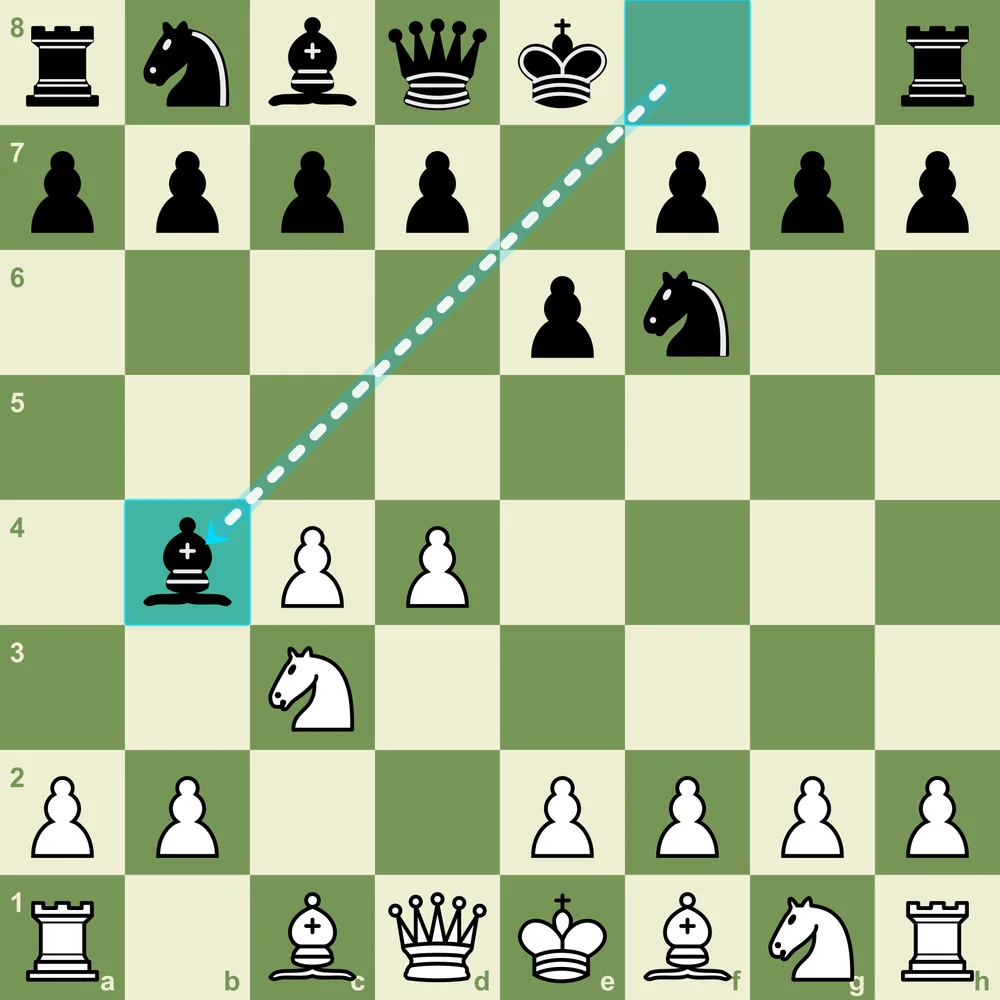
The Nimzo-Indian Defense begins with the moves 1.d4 Nf6 2.c4 e6 3.Nc3 Bb4 and is widely regarded as one of the most respected and theoretically sound defenses to 1.d4. The point of 3...Bb4 is to pin White's knight on c3, immediately contesting control of the central e4 square. Rather than staking a claim in the center with pawns, Black develops a piece with tempo and prepares to fight for the center with pieces - a hallmark of the hypermodern school of chess.
The opening is named after Aron Nimzowitsch, the Latvian-born grandmaster and one of the founding fathers of hypermodern chess. Nimzowitsch championed the revolutionary idea that the center could be controlled and undermined from a distance rather than occupied directly, and the Nimzo-Indian is perhaps the purest expression of that philosophy. His famous concepts of blockade, overprotection, and prophylaxis run through virtually every main line of the defense.
The defining strategic theme of the Nimzo-Indian is Black's willingness to trade the dark-squared bishop for White's knight on c3. In many lines Black plays ...Bxc3, conceding the bishop pair in return for inflicting doubled c-pawns on White and seizing lasting control of the light squares, especially e4. This is a classic dynamic-versus-structural trade-off: White gains the long-term potential of two bishops and a broad pawn center, while Black gains a concrete structural target and superior piece coordination. Knowing when this trade favors Black - and when it simply hands White a strong center - is the key to playing the Nimzo well.
The Nimzo-Indian has been employed by nearly every World Champion since Capablanca, including Botvinnik, Petrosian, Fischer, Karpov, Kasparov, and Kramnik. It remains a staple at the elite level today in the hands of players such as Carlsen, Caruana, and Ding Liren. Because 3.Nc3 is required to allow 3...Bb4, many 1.d4 players sidestep the Nimzo with 3.Nf3, against which Black usually transposes to the closely related Queen's Indian Defense - which is why the two openings are almost always studied together.
How to Play the Nimzo-Indian Defense
The Nimzo-Indian begins with 1.d4 Nf6 2.c4 e6 3.Nc3 Bb4. Black's first two moves are flexible developing moves, but the character of the opening is set by 3...Bb4. By pinning the knight on c3, Black attacks the natural defender of the e4 square and threatens ideas based on doubling White's pawns or dominating the light squares. Crucially, this move is only possible because White has committed the knight to c3 - if White plays 3.Nf3 instead, Black must choose a different setup such as the Queen's Indian.
White has four principal ways to meet the pin. 4.e3 (the Rubinstein System) is the most flexible and popular, preparing quiet, harmonious development. 4.Qc2 (the Classical or Capablanca Variation) defends the knight in advance so that ...Bxc3 can be met by Qxc3, avoiding doubled pawns. 4.Nf3 (the Kasparov Variation) keeps options open and often transposes to related structures. 4.a3 (the Samisch Variation) immediately challenges the bishop and, after 4...Bxc3+ 5.bxc3, accepts doubled pawns for the bishop pair and a big center. Other tries include 4.Bg5 (the Leningrad) and 4.f3.
The strategic philosophy of the Nimzo-Indian is control before occupation. Black is happy to exchange the b4 bishop for the c3 knight when it damages White's structure or wins the fight for e4, and then to blockade and pressure White's weaknesses. In lines where Black keeps the bishop, the plans revolve around ...d5, ...c5, and ...b6 with ...Bb7, striking at the center and completing development. Patience, precise move orders, and a firm grasp of pawn structure are rewarded - which is exactly why the Nimzo is considered an advanced, deeply positional opening.
Main Nimzo-Indian Defense Variations
The Nimzo-Indian branches according to White's fourth move, and each system leads to a distinct type of struggle. Here are the four variations every Nimzo-Indian player must know.
The Rubinstein System
4.e3Intermediate-Advanced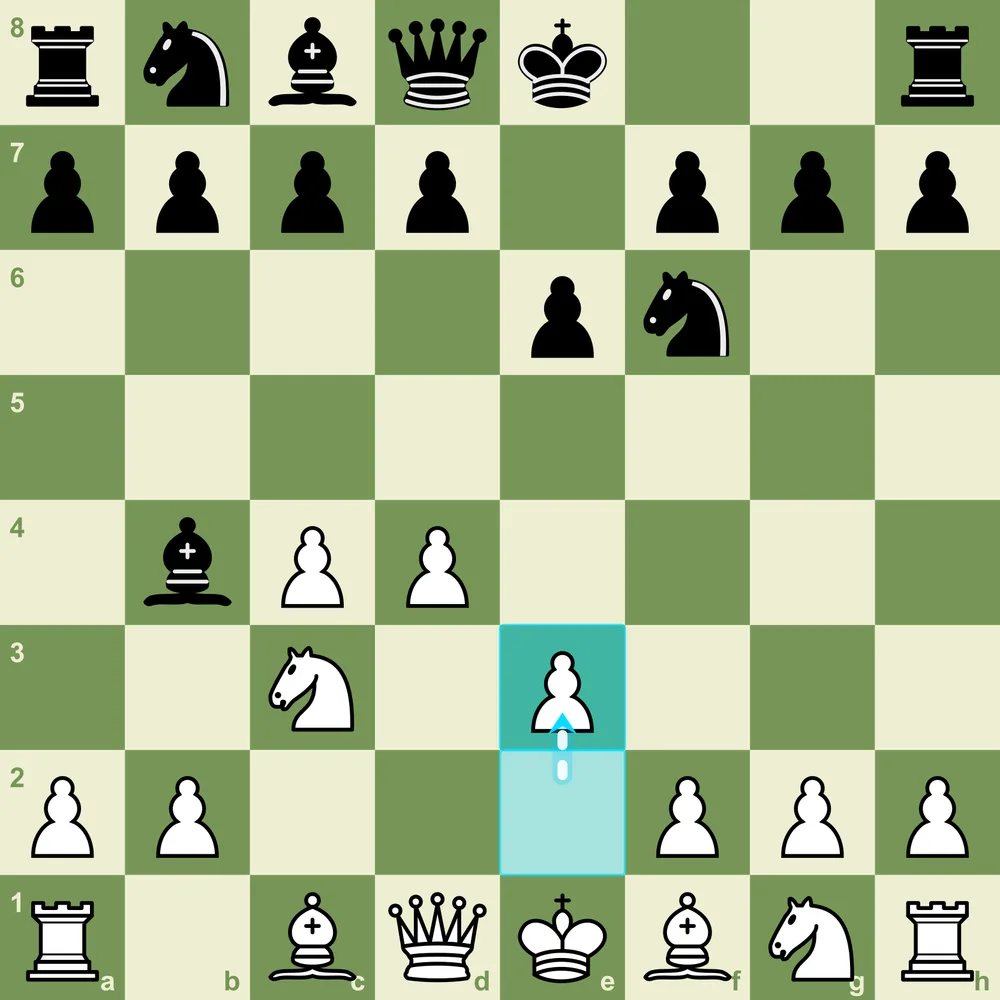
The Rubinstein System is White's most flexible and popular response to the Nimzo-Indian. With 4.e3, White opens a diagonal for the light-squared bishop, prepares Bd3 and Nf3 (or Nge2), and keeps the central structure fluid rather than committing to an early plan. Named after the great Akiba Rubinstein, this modest-looking move sidesteps the immediate structural questions posed by 4.a3 and 4.Qc2 and invites a long strategic battle.
Black has several sound setups. The main lines run 4...O-O 5.Bd3 d5 or 5...c5, striking at the center. Black typically aims for the freeing breaks ...c5 and ...d5, or the flexible ...b6 and ...Bb7 to reinforce control of the e4 square. If White later plays a3, Black must judge whether ...Bxc3 - doubling the c-pawns at the cost of the bishop pair - is worth it. The resulting positions are rich and balanced, which is why the Rubinstein has been a workhorse for players from Rubinstein himself to Karpov, Kasparov, and Carlsen.
Famous practitioners: Rubinstein, Karpov, Kasparov, Carlsen
The Classical Variation
4.Qc2Advanced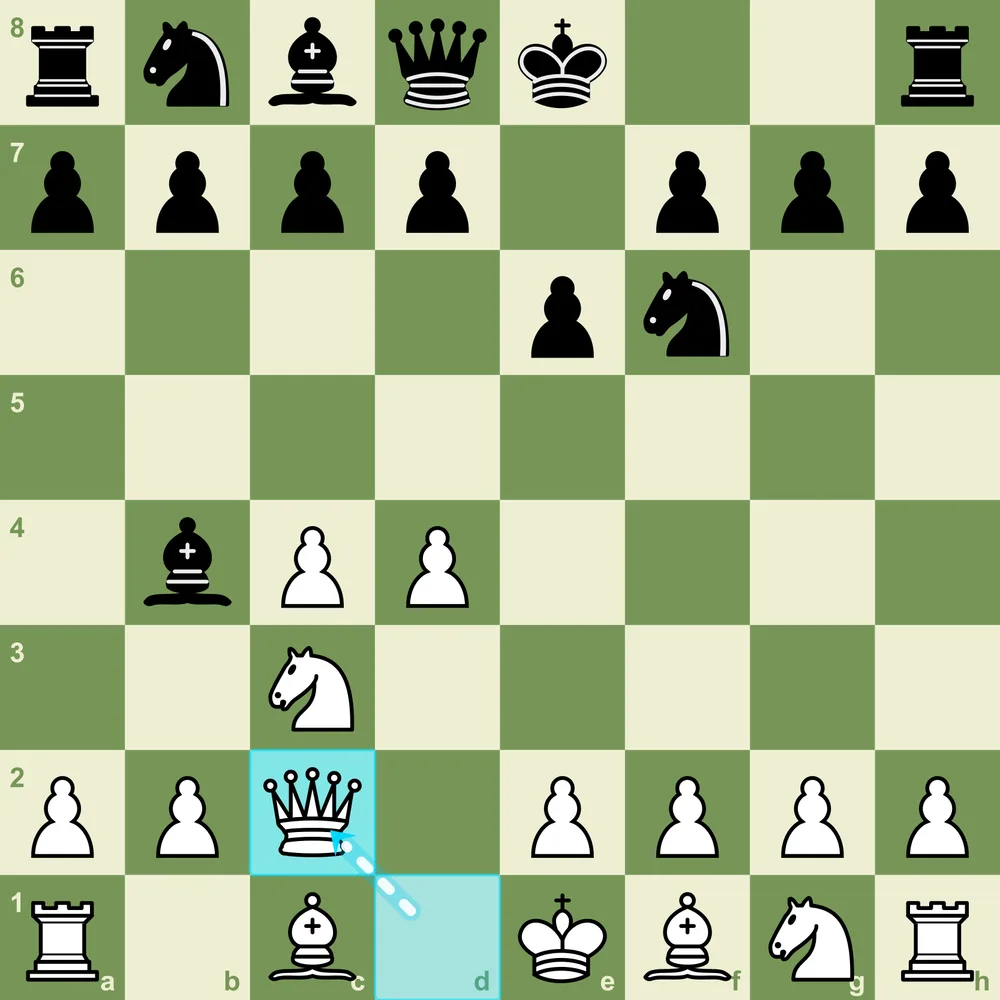
The Classical Variation, also called the Capablanca Variation, is one of White's most principled tries. By playing 4.Qc2, White defends the c3 knight in advance so that if Black plays ...Bxc3, the queen recaptures - avoiding the doubled c-pawns that define so many other Nimzo lines. In return, White accepts a slight loss of time and a queen that can later become a target.
Play often continues 4...O-O 5.a3 Bxc3+ 6.Qxc3, when White has the bishop pair and a clean structure, while Black bases counterplay on the e4 square, rapid development, and pawn breaks with ...d5 or ...c5. Alternatively, Black can keep the tension with 4...d5 or 4...c5 immediately. The Classical has been a battleground at the highest level, championed by Capablanca, Kasparov, Kramnik, and Aronian, and it remains one of the most theoretically demanding ways to meet the Nimzo.
Famous practitioners: Capablanca, Kasparov, Kramnik, Aronian
The Kasparov Variation
4.Nf3Advanced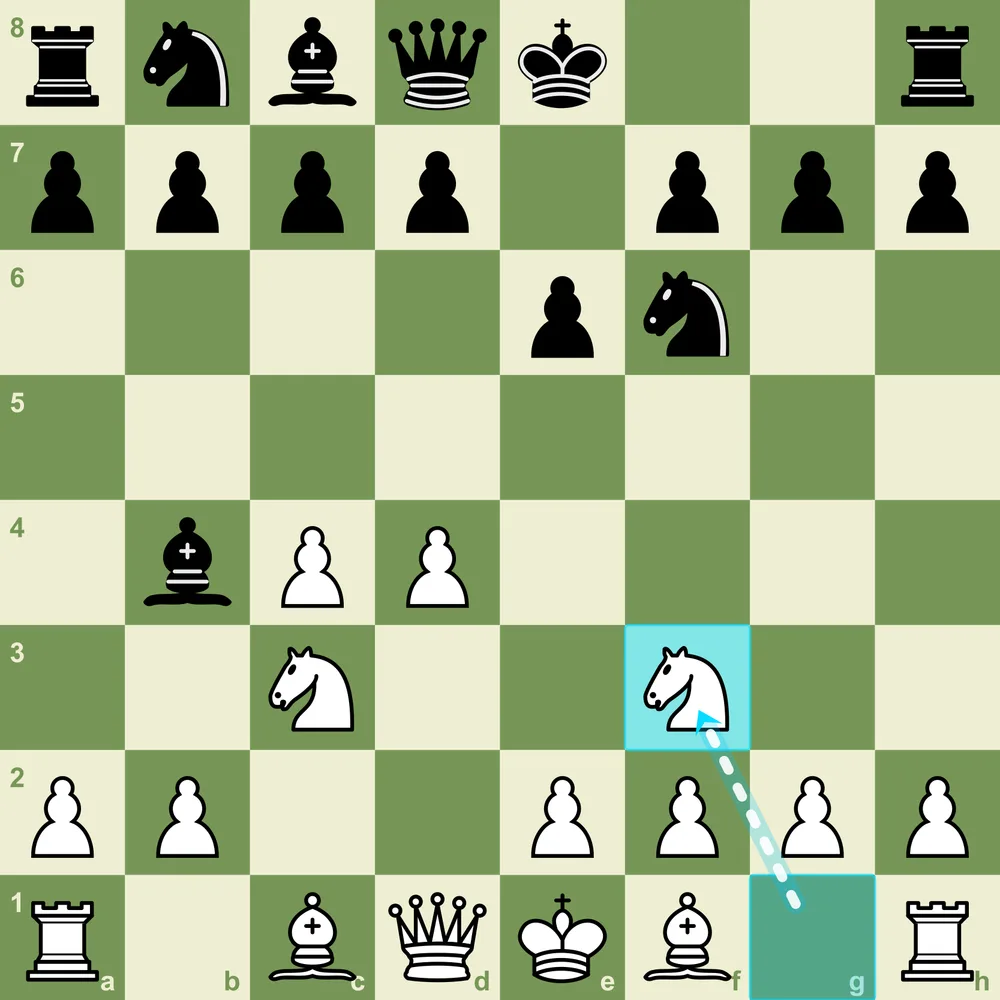
The Kasparov Variation, 4.Nf3, is a flexible developing move that keeps White's options open and often steers the game toward Queen's Indian or Ragozin-style structures. Popularized by Garry Kasparov during his world championship years, it avoids committing the pawn structure early and completes kingside development before resolving the tension on c3.
Black's main responses are 4...c5, immediately challenging the center, and 4...b6, preparing ...Bb7 and a fight for the long light-squared diagonal and the e4 square. After 4...c5 5.g3, White fianchettoes and plays for a small but lasting positional edge. These positions demand accurate move-order knowledge from both sides, and they have been tested extensively by Kasparov, Anand, Kramnik, and Caruana.
Famous practitioners: Kasparov, Anand, Kramnik, Caruana
The Samisch Variation
4.a3Advanced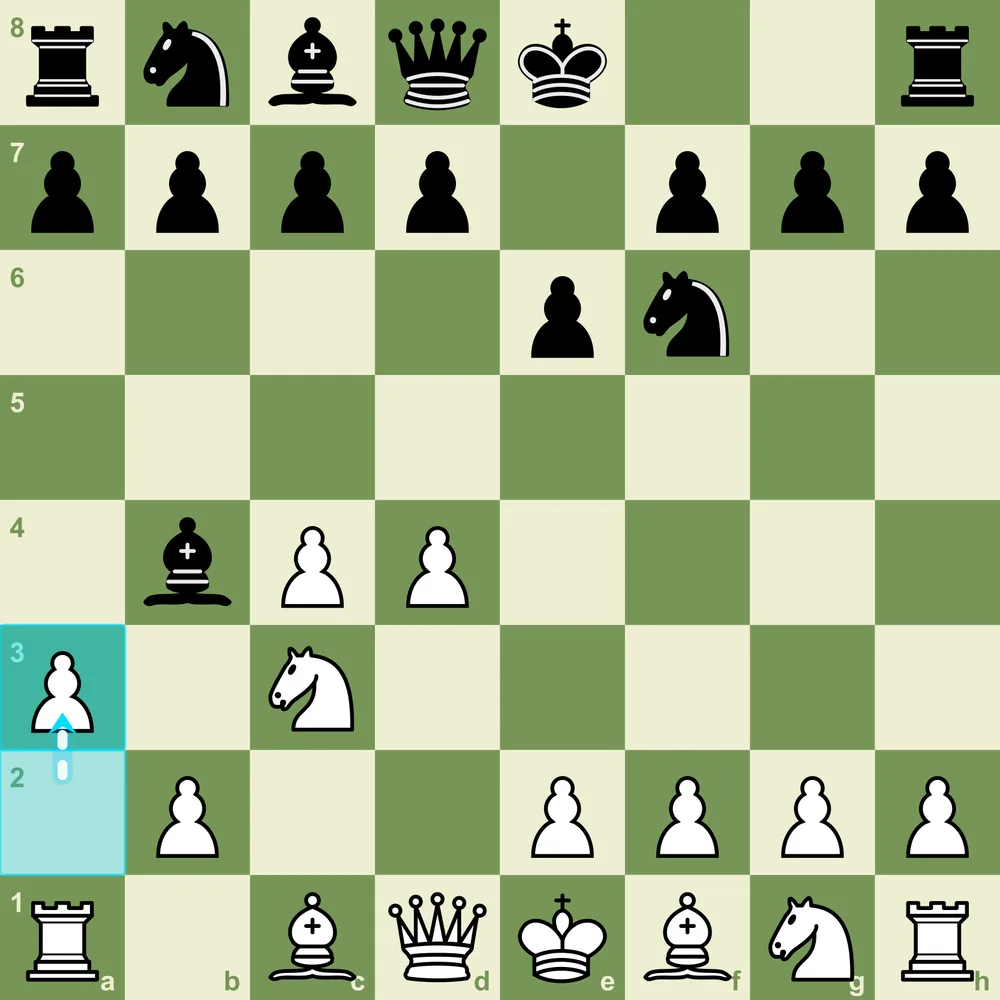
The Samisch Variation is the most direct and ambitious response: with 4.a3, White immediately questions the b4 bishop and forces the issue. After 4...Bxc3+ 5.bxc3, White voluntarily accepts doubled c-pawns in exchange for the bishop pair and a powerful pawn center that can be expanded with f3 and e4.
This is a true test of the Nimzo's central philosophy: White bets that the two bishops and a broad center outweigh the structural damage, while Black plays to blockade the doubled pawns, pressure c4, and exploit the light squares with ...d6, ...Nc6-a5, ...b6, and ...Ba6. Famously employed by Friedrich Samisch and later by Botvinnik and Spassky, the line leads to sharp, double-edged struggles in which a deep understanding of the doubled-pawn structure is essential.
Famous practitioners: Samisch, Botvinnik, Spassky, Bronstein
Pros and Cons of the Nimzo-Indian Defense
Advantages
- •Immediate, purposeful pressure - 3...Bb4 develops a piece with tempo and pins the c3 knight, contesting the vital e4 square from move three
- •Inflicts structural damage - in many lines ...Bxc3 saddles White with doubled c-pawns, giving Black a concrete long-term target to attack
- •World-championship pedigree - one of the soundest defenses to 1.d4, trusted by nearly every World Champion from Capablanca to Carlsen
- •Rich strategic content - blockade, the fight for e4, and minority-attack themes make it a superb teacher of positional chess
Disadvantages
- •Concedes the bishop pair - the thematic ...Bxc3 hands White two bishops, which can become powerful if the position opens up
- •White can avoid it entirely - after 3.Nf3 the pin is unavailable, so Black must prepare a companion system such as the Queen's Indian
- •Theory-heavy and advanced - the Rubinstein, Classical, Kasparov, and Samisch systems each demand distinct, well-studied plans
- •Requires precise handling - mistime the ...Bxc3 trade or lose the fight for e4 and Black's pieces can drift into passivity
Common Mistakes to Avoid in the Nimzo-Indian
Trading on c3 without a concrete reason
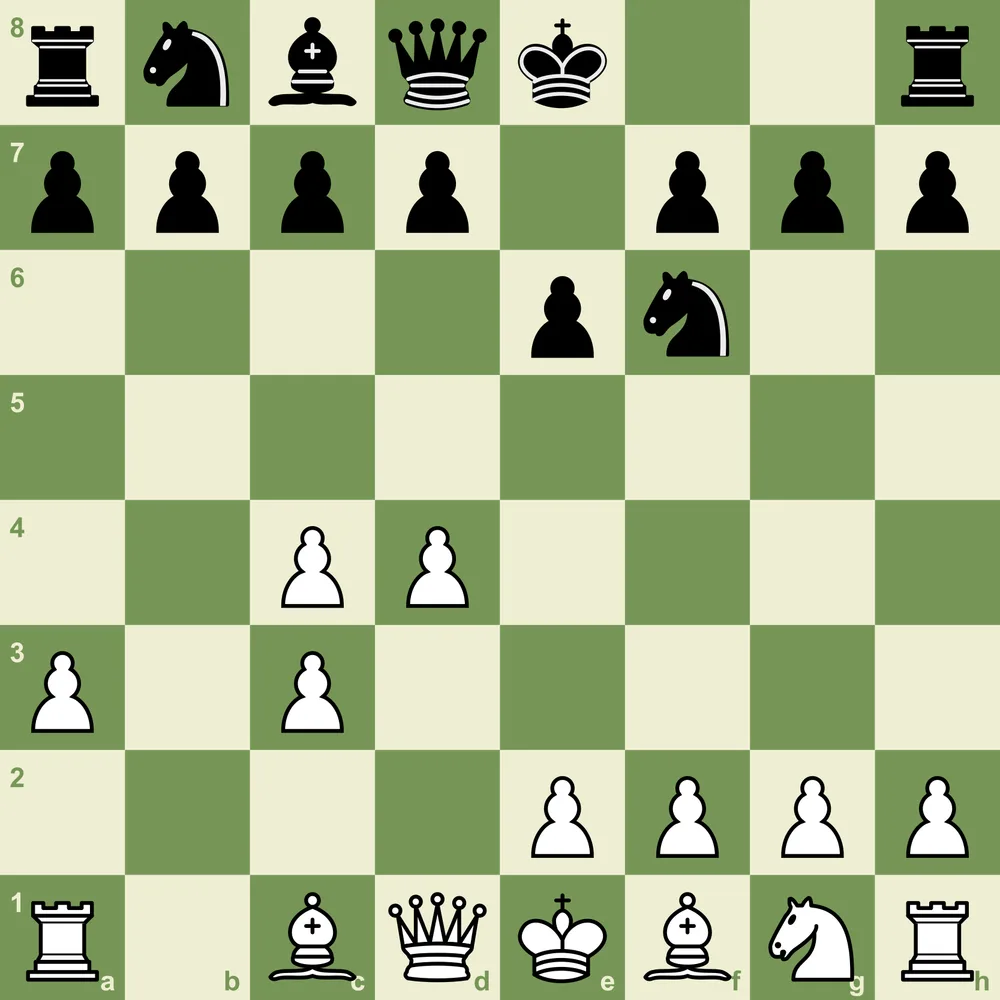
The exchange ...Bxc3 is the soul of the Nimzo-Indian, but it should never be automatic. Giving up the bishop pair only makes sense when it doubles White's pawns or wins the battle for e4. If you capture when White can recapture with the queen (as in the 4.Qc2 lines) or when the doubled pawns are easy to untangle, you simply hand your opponent the two bishops for nothing. Always ask what you get in return before releasing the pin.
Losing the fight for the e4 square
The e4 square is the strategic heart of the Nimzo-Indian. The pin on c3, the moves ...b6 and ...Bb7, ...d5, and sometimes ...Ne4 all serve to control it. Players who drift and allow White a well-timed e4 (often supported by f3) surrender the initiative and let White's center and bishops spring to life. Keep e4 firmly in your sights and always be ready to contest it.
Mishandling the doubled-pawn structure in the Samisch
After 4.a3 Bxc3+ 5.bxc3, White has doubled c-pawns but also the bishop pair and a big center. A common error is to sit passively and let White expand comfortably with f3 and e4. Instead, Black must play actively to blockade and attack the doubled pawns - typical plans include ...d6, ...Nc6-a5, ...b6, and ...Ba6 to pile pressure on the weak c4 pawn before White can consolidate.
Forgetting that White can avoid the Nimzo entirely
The Nimzo-Indian only appears after 3.Nc3. Many 1.d4 players prefer 3.Nf3, when 3...Bb4+ is easily neutralized and the pin loses its sting. If you build your entire repertoire around the Nimzo without preparing a companion system - almost always the Queen's Indian with 3...b6 - you will eventually be caught out. Study both openings together so you are never left without a plan.
How to Practice the Nimzo-Indian Defense
The Nimzo-Indian rewards structured, methodical study. Follow these steps to make it a reliable part of your opening repertoire against 1.d4.
Start with the Rubinstein System
The Rubinstein (4.e3) is White's most common choice, so it is the natural place to begin. Learn the standard setups with ...O-O, ...d5 or ...c5, and ...b6 with ...Bb7. Understanding these flexible plans will prepare you for the majority of your Nimzo-Indian games and teach you the opening's core strategic ideas.
Understand the Classical Variation plans
The Classical Variation (4.Qc2) is one of the most theoretically important lines because White tries to avoid the doubled pawns. Study why Black plays ...O-O, ...d5, and ...c5, and get comfortable with the fight for e4 after 5.a3 Bxc3+ 6.Qxc3. Knowing this line well will make you far more confident against strong, well-prepared opponents.
Use ChessHelper to analyze your Nimzo-Indian games
After each game, review the opening and early middlegame with ChessHelper's AI analysis. Did you trade on c3 at the right moment? Did you win or lose the battle for e4? ChessHelper's AI-powered engine highlights the critical decisions in your games and helps you build a deeper understanding of the pawn structures you reach in practice.
Study the games of Karpov and Kasparov
Few players have shown the power of the Nimzo-Indian more clearly than Anatoly Karpov and Garry Kasparov, from both sides of the board. Replay their games to see how the elite handle the bishop-pair trade, blockade doubled pawns, and generate play on the light squares. Their classic encounters are a masterclass in Nimzo-Indian strategy.
Play slow time controls to internalize the plans
The Nimzo-Indian is a deeply positional opening, and its nuances are best absorbed in longer games where you have time to think about structure rather than just moves. Play some practice games at 15+10 or slower, and keep asking the key questions: should I trade on c3, who controls e4, and where are the long-term weaknesses?
Master the Nimzo-Indian with ChessHelper
Get real-time AI analysis as you practice the Nimzo-Indian in your online games. Understand every pawn structure, learn from your mistakes, and build a rock-solid repertoire against 1.d4.
Start Practicing for FreeJoin 10,000+ chess players building solid opening repertoires with ChessHelper
Related Openings
If you enjoy the Nimzo-Indian, these openings share similar strategic themes and will round out your repertoire against 1.d4 and the flank openings.
King's Indian Defense
Another hypermodern reply to 1.d4. Black cedes White a big pawn center, then strikes back with pieces and a timely ...e5 or ...c5 for dynamic, attacking play.
1.d4 Nf6 2.c4 g6
Queen's Gambit
The classical mainstay of 1.d4. White offers the c-pawn to deflect Black's d5 pawn and build a strong center - essential knowledge for any Nimzo player facing 1.d4.
1.d4 d5 2.c4
English Opening
A flexible flank opening starting with 1.c4. Rich in transpositions, it frequently reaches Nimzo- and Queen's Indian-style structures by another move order.
1.c4
Nimzo-Indian Defense: Frequently Asked Questions
The Nimzo-Indian is a sound but relatively advanced opening. Its ideas are strategic rather than tactical, and getting the most out of it requires a solid understanding of pawn structure - particularly when to trade the b4 bishop for the c3 knight and how to exploit or defend the resulting doubled c-pawns. Beginners can certainly play it and will learn excellent positional principles, but players who prefer clear, forcing lines may find openings like the Italian Game or the Caro-Kann easier to handle at first.
In many Nimzo lines Black plays ...Bxc3, trading the dark-squared bishop for White's knight. Black accepts this concession for two reasons: it often doubles White's c-pawns, creating a permanent structural target, and it hands Black firm control of the light squares, especially the key e4 square. This is a classic dynamic-versus-structural trade-off. Whether it favors Black depends on the position - if White's doubled pawns are hard to attack and the two bishops become active, the trade can backfire, which is why timing the exchange correctly is so important.
Both arise from 1.d4 Nf6 2.c4 e6, and they are almost always learned together. The Nimzo-Indian requires White to play 3.Nc3, which allows 3...Bb4 pinning the knight. If White instead plays 3.Nf3, the pin is no longer available, so Black typically responds with 3...b6 and ...Bb7, entering the Queen's Indian Defense. In short, the Nimzo-Indian is Black's answer when White commits the knight to c3, and the Queen's Indian is the natural companion system when White develops the knight to f3 instead.